
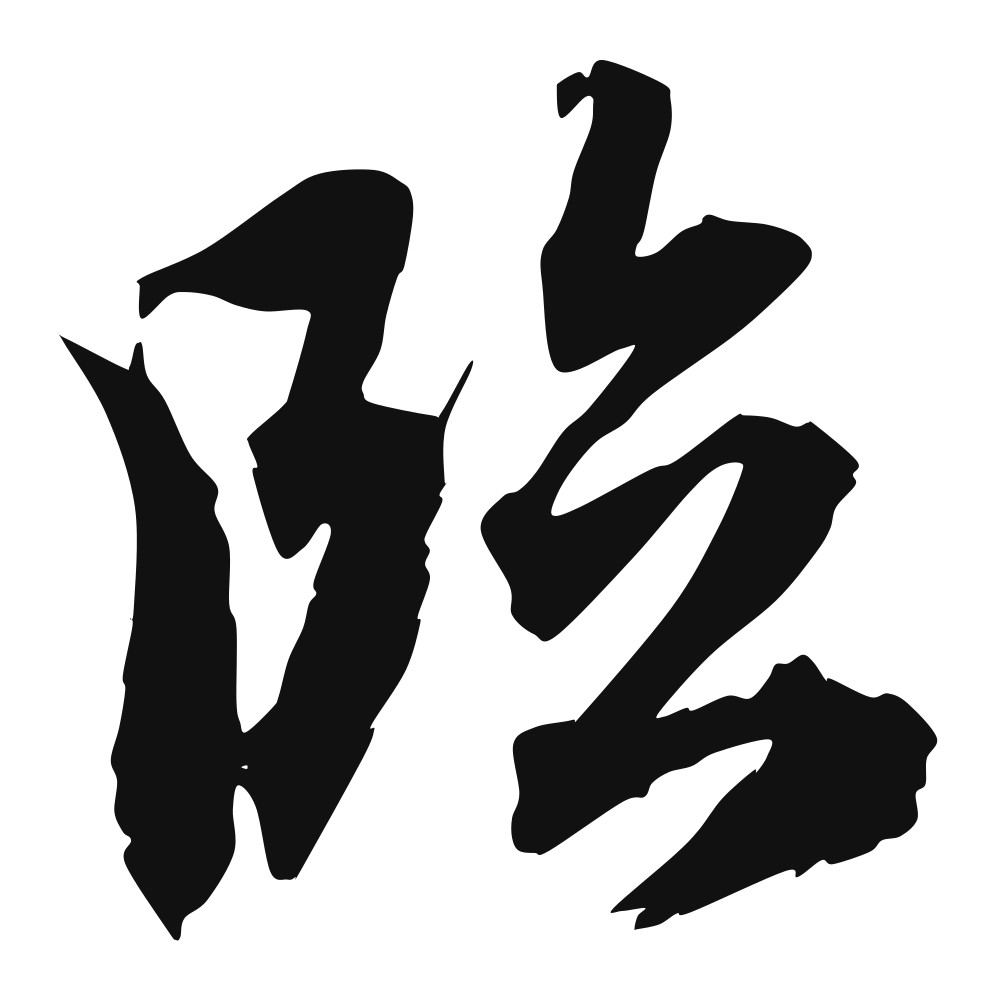
临
to face; to overlook; to arrive; to be (just) about to; just before
Closest English meanings
face·overlook·approach·arrive·descend
The Calligrapher — Liú Déshēng 刘德升
Han calligrapher credited as the father of running script.
Han calligrapher (), master of running script — known for 行书之祖. Han dynasty
Etymology & Meaning · 字义溯源
2 · The Character: 临 临 (lín, 2nd tone; traditional 臨) is, in Xu Shen, oversight: 監臨也。从臥品聲 — 'to oversee, to look down upon; from 臥 (lie/bend) and 品 (voice).' It means 'to approach, to face, to rule over.' The classics give it gravity and grandeur: the Shijing (大雅·大明) '上帝临女' (God approaches you); the Shijing (秦风·黄鸟) '临其穴' (he approaches the grave) — the funeral sense; the Lunyu (雍也) and Liji (曲礼) use 临 for solemn presence; the Yijing names a whole hexagram 临 (19) 'Approach.' As a free morpheme 临 means 'to face, approach, imminent,' positive in 临风, 临帖, 临危受命. Honest disclosure carries a funeral shadow: 临穴, 哭临 and 临终 all mean approaching death/mourning. A Western wearer should know 临 alone can evoke the deathbed (临终). For the positive 'face/overlook' sense, pair with 风 or 江; disclose the mortuary usage so the tattoo is not misread as a mourning mark.
Cultural Story
臨 drew a person bending over something to examine it, to look down upon, to approach with attention. Wang Xizhi's 蘭亭集序 was written 臨水, by the water, the most copied scroll in China. A general 臨阵 surveyed the field; a poet 臨風 composed against the wind. The character is presence at the edge of an event, the moment just before contact with what is coming.
Where a Western reader can stand: Where a Western reader can stand: 临 means 'to face, approach' — and Liu Desheng, the legendary inventor of running script (行书), lends it the quality of approach as flowing motion, the origin-story of the very script. Honest caveat: 临 has a funeral shadow (临终 the deathbed); it also names 临摹, copy-tracing a master — so the resonance is calligraphic learning as much as solemn presence. Pair with 风 for the bright sense.
Common words & phrases
- 临近 close to · approaching · near · imminent
- 面临 face · confront · be faced with · stand before
- 来临 arrive · come · approach · set in
- 临别 at parting · at departure · farewell
- 临终 at death · on one's deathbed · final
- 降临 descend · come down · arrive · befall
Read the story behind the character
临近 deadline, 面临 choice, 来临 the holiday, 临别 the hug at the gate, 临终 the hospital room, 降临 the snow. The word attends every threshold, the exam, the breakup, the last breath. It is the grammar of arrival and confrontation, the thing you stand before. You use it when something is about to happen to you, and you are, for once, paying full attention.
Why this character belongs on skin
Stand at the riverbank and the fish are there, just beneath the surface, and you have no net. 临 is to approach, to stand above and look down with full presence — the emperor who governs from the throne, the calligrapher who copies a master's stroke until it becomes his own. The Buddhists speak of the hour you stand at the edge of your own death and see clearly at last. To wear 临 is to choose presence over avoidance, to walk to the bank instead of imagining the water from far away. Life asks only that you arrive. Let this character rest where you can feel it, a small command to step closer to whatever you have been avoiding. The view from the edge is the only honest one. Come to the water. Let the ink be your arrival, permanent as the mark.
Own this character
Purchase delivers the original SVG of this glyph, brushed by Liú Déshēng 刘德升, ready to place on skin, paper, or screen.