
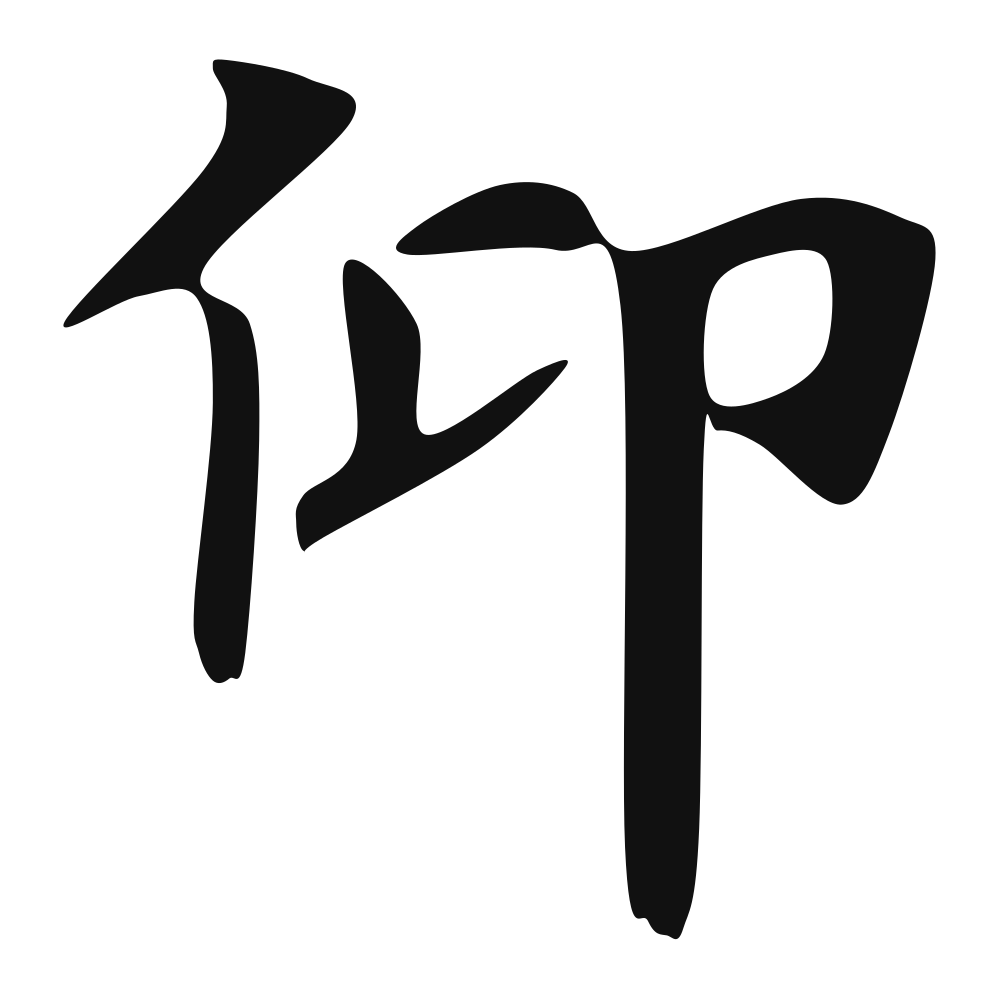
仰
仰 (yǎng) — look up, admire, rely on. Person 亻 + 卬 (raise): a person raising the head. Classical life: 仰慕 — admire; 仰望 — look up to. Grammar: free morpheme — also: surname Yang; to face upward; to look up; to admire; to rely on
Closest English meanings
look up·admire·rely
The Calligrapher — Liú Déshēng 刘德升
Han calligrapher credited as the father of running script.
Han calligrapher (), master of running script — known for 行书之祖. Han dynasty
Etymology & Meaning · 字义溯源
2 · The Character: 仰 仰 (yǎng, 3rd tone) is, in Xu Shen, the lifted head: 舉也 — 'to raise, to lift.' The classics turn the gesture into reverence and reliance: the Yizhuan (系辞) '仰以觀于天文' (look up to observe the patterns of heaven); the Shijing (小雅) '或棲遲偃仰' (now resting, now looking up); the Huainanzi (天文) '萬物仰而生' (the myriad things look up to it and live); Yue Fei's '仰天長嘯' (roar at the sky with head raised). As a free morpheme 仰 means 'to look up, to revere, to rely on,' and is positive in 仰慕, 仰不愧天, 仰望. Honest disclosure: 仰 is a verb of upward turning; on skin it is a clean, ascending character and reads well. Pair it with 天 (仰天) or 望 (仰望) for the 'reverence/aspiration' sense explicit; in Japanese it is ao / oomu. The Wuxing attribution is confident: 仰 is Wood (木), the upward growth.
Cultural Story
仰 is a man with his head back, to look up, to admire, to depend upon. The 論語, 仰之弥高, the more I look up the higher it rises. 仰慕 is the disciple's reverence; 信仰 the creed you look up into. The character is the raised face, the posture of one who sees something above him and trusts it, the teacher, the god, the mountain.
Where a Western reader can stand: Where a Western reader can stand: imagine 'looking up' at something greater — a sky, a mentor, a star — and the gesture itself becoming a virtue of reverence. Wear 仰 as the upward gaze of aspiration, not a name; alone it points at the act of lifting your eyes, and with 慕 it becomes admiration.
Energy Reading
Wood (木)
Comparative symbology, not fortune-telling.
Common words & phrases
- 仰望 look up at
- 仰慕 admire · esteem
- 信仰 faith · belief
- 仰仗 rely on · depend
- 仰视 look up · look upward
- 久仰 long admired
Read the story behind the character
仰望 is the kid at the fireworks; 仰慕 the crush and the fan. 信仰 is the belief on the form; 仰仗 the backing you lean on. 仰视 is the literal look up and the figurative deference; 久仰 the formal long admired at a first meeting. The character names the upturned face, admiration, reliance, worship. It still means the neck craned toward something higher, whether a star, a saint, or a senior you do not contradict.
Why this character belongs on skin
You tilt your face to the sky and the character is born — 仰 is to look up, to admire, to lean upon another in trust. The ancients used it for the reverence owed to a sage, the抬头 of a soldier who lifts his gaze to his commander. There is vulnerability in the upward look; you expose the throat to do it. For a Western reader it is the posture of the believer before the icon, the lover beneath the window. A tattoo of 仰 is for those who have not lost the capacity to look up — at a person, a God, a star — and mean it. It is the mark of someone still capable of awe, still willing to be lifted. Wear it where the neck meets the jaw, the exact place the head tilts back to see.
Own this character
Purchase delivers the original SVG of this glyph, brushed by Liú Déshēng 刘德升, ready to place on skin, paper, or screen.