
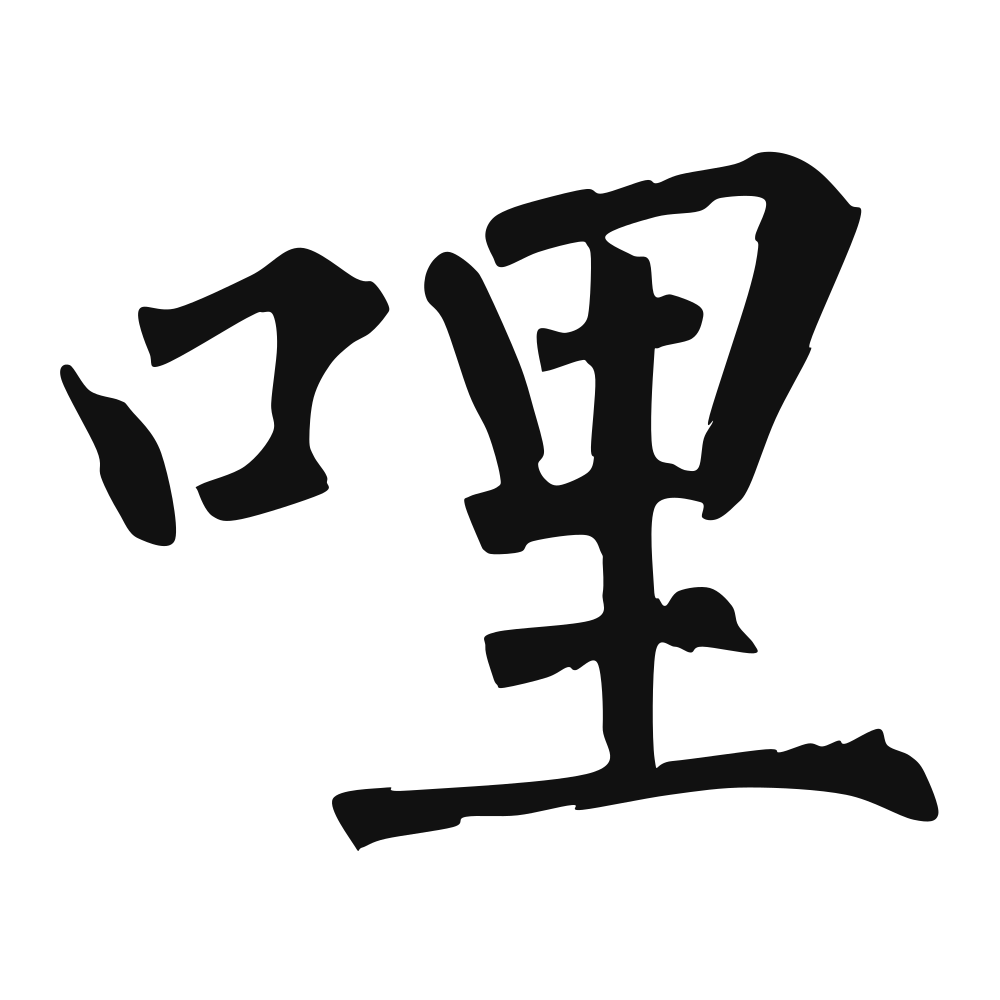
哩
mile; (modal final particle similar to 呢[ne5] or 啦[la5])
Closest English meanings
mile·sentence particle
The Calligrapher — Liǔ Gōngquán 柳公权
Tang regular-script master famed for 'bones' of strength; rival to Yan Zhenqing.
Tang calligrapher (778–865), master of regular script — Tang master of bone-strength regular script, paired forever with Yan Zhenqing as 'Yan sinew, Liu bone'. Tang dynasty
Cultural Story
In the classical tradition: 哩 is a mouth character used as a sentence particle in southern and dialect speech, and borrowed for the English 'mile.' The vernacular 哩哩啦啦 describes things dragged out in bits and pieces, dripping or straggling. Classical Chinese had no need for it in formal prose, but folk song and drama used 哩 to soften a line, the way a singer lingers on a note at the end of a phrase.
Common words & phrases
- 英哩 mile
- 哩哩啦啦 draggling · in bits and pieces
Read the story behind the character
In the modern world: Runners count 英哩 — miles — on a foreign app, and grandma says the rain came 哩哩啦啦, in bits and pieces, all afternoon. In southern chat 哩 softens a question like a gentle particle at a sentence's end. A project drags 哩哩啦啦 across the month, never quite finishing, while the dialect keeps 哩 alive as the friendly tail every casual sentence seems to need.
Own this character
Purchase delivers the original SVG of this glyph, brushed by Liǔ Gōngquán 柳公权, ready to place on skin, paper, or screen.