
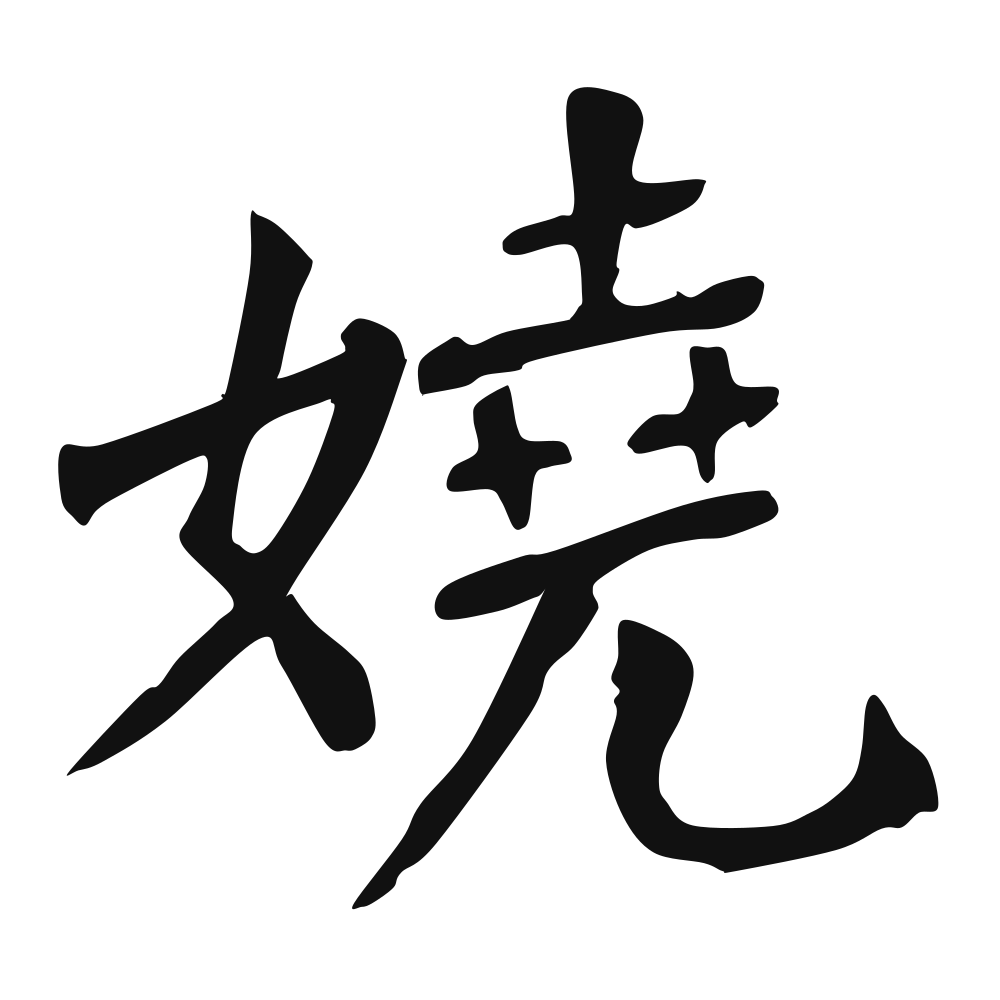
The Calligrapher — Liǔ Gōngquán 柳公权
Tang regular-script master famed for 'bones' of strength; rival to Yan Zhenqing.
Tang calligrapher (778–865), master of regular script — Tang master of bone-strength regular script, paired forever with Yan Zhenqing as 'Yan sinew, Liu bone'. Tang dynasty
Cultural Story
In the classical tradition 娆 described an enchanting, almost dangerous beauty. Paired with 妖 it formed 妖娆, the seductive allure of a legendary temptress, while 娇娆 softened it to delicate charm. The word belongs to the borderland where attractiveness shades into bewitchment in poetry and tale.
Common words & phrases
- 妖娆 enchanting · bewitching
- 娇娆 charming · delicate
Read the story behind the character
In the modern world 娆 lives in vivid compliments. A dancer's 妖娆 spin earns cheers; a spring blossom is called 娇娆 in a caption. Though literary, the word still appears in song lyrics and beauty ads promising 妖娆 glamour for a night out — old enchantment repackaged as contemporary allure.
Why this character belongs on skin
First the walk— willow-stem waist, silk moving a half-beat behind the body, the gaze that arrives before the greeting. 娆 is that grace: graceful and pliant, the charm that bends light around itself. In 妖娆 it becomes the full sensuality of a woman the world cannot file away; in 娇娆, the tender, flowering kind. The female radical makes it unmistakably hers, and the root sound also means plenty— as if beauty here were a kind of abundance, rich and unapologetic. This is desire without apology, the Confucian doctor frowning and the poet writing anyway. To wear 娆 is to claim your own gravity: not beauty performed for approval, but allure as a private power, lit from inside. Ink low on the hip or the nape of the neck, where only the chosen ever see it. Let it whisper. It works better that way.
Own this character
Purchase delivers the original SVG of this glyph, brushed by Liǔ Gōngquán 柳公权, ready to place on skin, paper, or screen.