
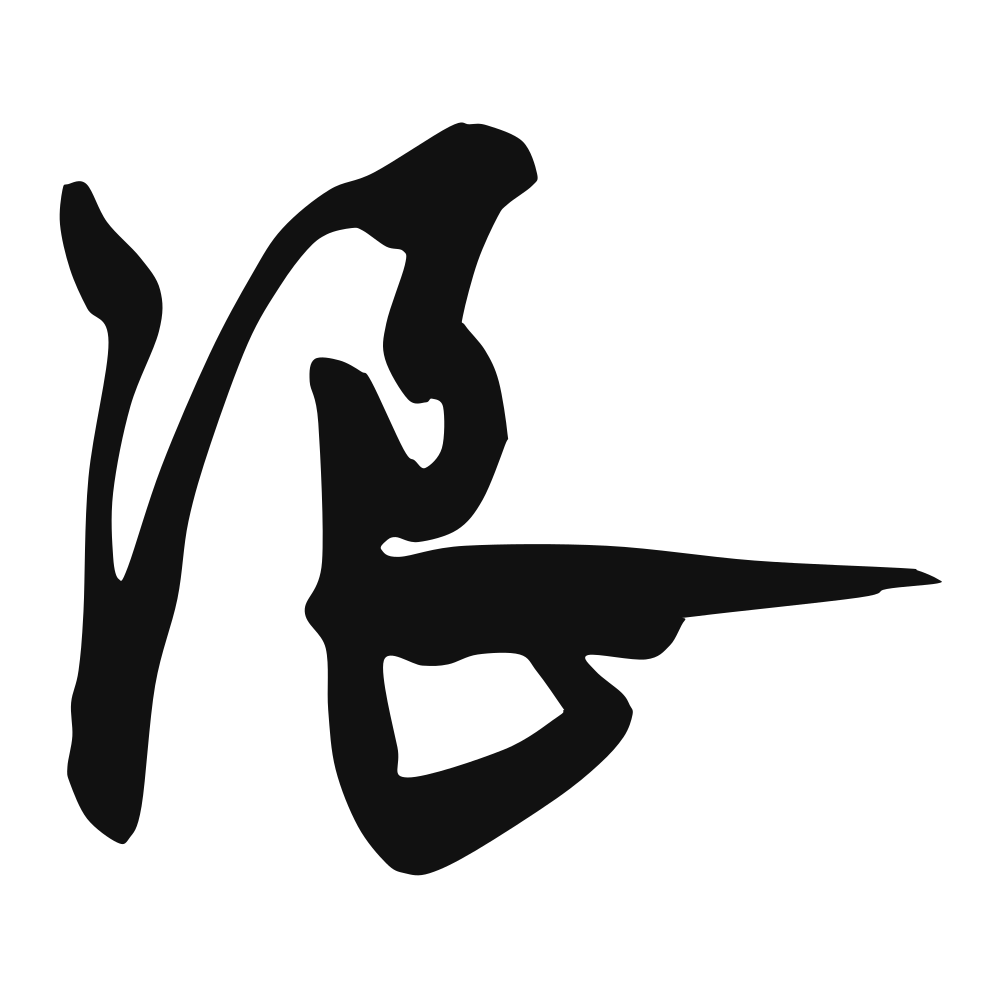
浪
浪 (làng) — wave; unrestrained. Water 氵 + 良 (good): good water in motion. Classical life: 浪子 — a prodigal/wanderer; 乘风破浪 — ride the wind and waves. Grammar: free morpheme — also: wave; breaker; unrestrained; dissipated; to stroll; to ramble
Closest English meanings
wave·billow·surge·waste·roam
The Calligrapher — Liǔ Gōngquán 柳公权
Tang regular-script master famed for 'bones' of strength; rival to Yan Zhenqing.
Tang calligrapher (778–865), master of regular script — Tang master of bone-strength regular script, paired forever with Yan Zhenqing as 'Yan sinew, Liu bone'. Tang dynasty
Etymology & Meaning · 字义溯源
2 · The Character: 浪 浪 (làng, 4th tone) was originally a place, not a wave. The Shuowen Jiezi: 「浪,滄浪水也。南入江。从水,良聲」 — the Canglang river, flowing south into the Jiang. That river carries one of the great ethical songs of Chinese literature, preserved in both 《楚辭·漁父》 and 《孟子·離婁上》: 「滄浪之水清兮,可以濯我纓;滄浪之水濁兮,可以濯我足」 — when the water is clear I wash my cap-strings, when muddy I wash my feet; the world's condition decides how you use it, and you are answerable either way. Only later did 浪 come to mean 'wave', then 'unrestrained': Wang Xizhi describes men who 「放浪形骸之外」 (《蘭亭集序》), and Su Shi's 「浪淘盡,千古風流人物」 makes it time's surf. Honest disclosure and the real hazard: in modern Chinese 浪 said of a person means loose, wanton, flirtatious (浪蕩, 浪女). Beautiful inside a phrase (波浪, 乘風破浪, 浪漫); risky as a lone character on a body.
Cultural Story
浪 means a wave, then by turn a wandering life. The Qu yuan rides the 浪 of exile, and Tang poets chase 浪 freedom beyond court. Yet 浪 also warns: to 浪 is to spend carelessly, scattering like spray. The word holds the sea's power and the heedless drift of a restless, unmoored heart.
Energy Reading
Water (水)
Comparative symbology, not fortune-telling.
Common words & phrases
- 波浪 wave · ripple · billow
- 海浪 sea wave · ocean wave · surf
- 浪花 spray · foam · waves · whitecaps
- 风浪 wind and waves · storm · turbulence
- 流浪 wander · roam · vagrant · homeless
- 浪费 waste · squander · dissipate
Read the story behind the character
Children chase 浪花 (spray, foam) at the beach while 海浪 (sea waves) tumble in, and a small boat rides the 风浪 (wind and waves) home. A 流浪 (wander, roam) musician plays the subway, and we scold a friend who 浪费 (waste, squander) money on yet another useless gadget.
Why this character belongs on skin
You have stood at the edge and felt the ocean decide things without you. A wave is freedom with a spine—it gives nothing, asks nothing, and yet it shapes coastlines and the men who watch it. The old sailors knew 浪 as both the swell and the wander, the drifting life with no port promised. There is a Confucian warning here too, of recklessness, but the body wants what the body wants: the white horses of the surf, the risk that makes the blood honest. To ink this is to keep a little chaos close, the part of you that will not be domesticated. It is salt and momentum, the refusal to settle for a still pond. Wear it like a dare to your own cautious heart, and let every tide remind you that you were built to move.
Own this character
Purchase delivers the original SVG of this glyph, brushed by Liǔ Gōngquán 柳公权, ready to place on skin, paper, or screen.