
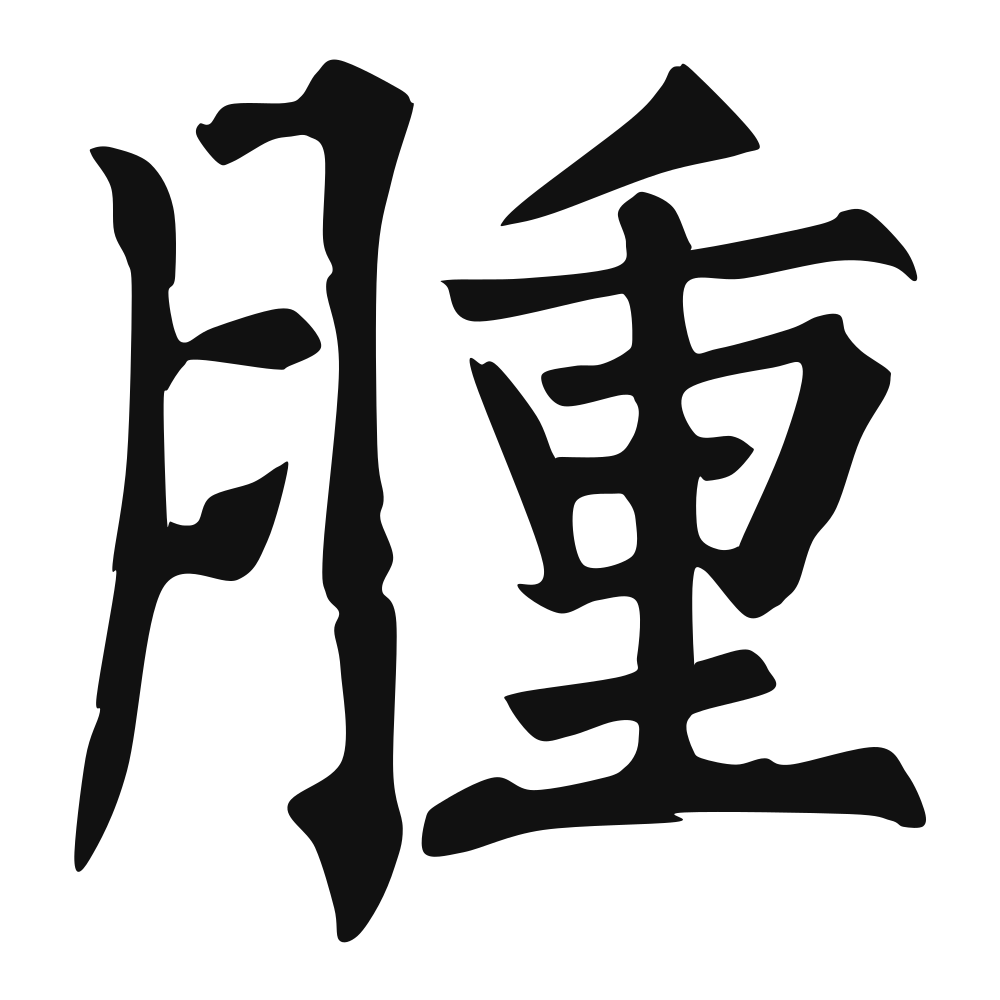
肿
to swell; swelling; swollen
Closest English meanings
swelling·swollen
The Calligrapher — Liǔ Gōngquán 柳公权
Tang regular-script master famed for 'bones' of strength; rival to Yan Zhenqing.
Tang calligrapher (778–865), master of regular script — Tang master of bone-strength regular script, paired forever with Yan Zhenqing as 'Yan sinew, Liu bone'. Tang dynasty
Etymology & Meaning · 字义溯源
### Soundzhǒng — zhǒng (3rd tone). Free-standing morpheme ### Original meaningZhǒng (3rd tone; traditional 腫). The Shuowen Jiezi defines it as 「癰也。从肉重聲」 — 'an abscess' (癰 yōng), the 肉 (flesh) radical with 重 for the sound; Duan Yucai notes that 癰 and 腫 define each other in the Shuowen, and that by extension anything swollen, bulging or grossly enlarged is called 雍腫 — he cites 《莊子》's description of a gnarled tree. 《釋名》 gives a phonetic gloss that is also a diagnosis: 「腫,鍾也,寒熱氣所鍾聚也」 — 'zhong is zhong (to accumulate): cold and hot qi gathered in one place'. The classical citations are clinical: 《周禮·天官·瘍醫》「掌腫瘍、潰瘍、金瘍、折瘍」 (Zheng Xuan: 「腫瘍,癰而上生創者」 — an abscess that breaks the surface), 《左傳·宣公十年》「公閉門而泣之,目盡腫」 — 'the duke shut the door and wept until his eyes were swollen'. 《管子·輕重篇》「無鹽則腫」 even uses it of the body bloating without salt. Honest disclosure: 腫 is a pathology word. There is no romantic reading to recover, and its modern compounds — 腫瘤 (tumour), 腫脹 (swelling), 水腫 (oedema) — make that unavoidable. ### The structure (形聲 · 从肉,重聲 — flesh (肉) for the field, 重 (zhòng) for the sound; the flesh that has grown heavy)①肉ròuflesh (radical)the field: the body and its tissues②重zhòngheavy / (phonetic)the sound-bearer; also the sense of flesh grown heavy and thick③癰yōngabscessthe Shuowen definition — 癰 and 腫 gloss each other④鍾聚zhōng jùgathered togetherthe Shiming etymology: cold and hot qi collected in one spot ### In use todayItemReading / meaningNoteReadingzhǒng (3rd tone)single syllable; traditional 腫Core senseswelling; abscessoriginally 癰, an abscess that breaks the surfaceGrammarfree morpheme腫瘤 tumour · 腫脹 swelling · 水腫 oedema · 紅腫 red and swollenTattoo fitno — a pathology word with no auspicious readinga Chinese reader reads 'swelling' or 'tumour', first and last ### Closest words in English — and what each misses - Growth — 長/生 hold growth; 腫 is growth that is wrong — swelling, an abscess, a tumour - Full / Fullness — 滿/盈 hold fullness and can be auspicious; 腫's fullness is stagnation and disease - Heavy — 重 (zhòng) is the phonetic inside 腫; heavy can be dignified, swollen cannot - Passion / Swollen with feeling — Chinese does not use 腫 metaphorically for emotion; the English 'swollen with pride' has no counterpart hereAn honest note on grammar. Free morpheme — stands alone as a verb and adjective (腫 = to be swollen); in modern Mandarin the common forms are 腫瘤 (tumour), 腫脹 (swelling), 水腫 (oedema), 紅腫 (red and swollen)Where a Western reader can stand: 肿 (zhǒng) means swelling, and the Shuowen definition is 'abscess'. The Han-dynasty etymology in the Shiming is pre
Cultural Story
肿 means swelling — flesh rising after injury or illness. Early medical texts classified swellings by their look and feel, distinguishing 红肿 red and swollen skin from pale edema; physicians pressed a fingertip to see if the pit slowly filled. The 素问 discusses 浮肿 edema as water failing to move properly in the body.
Where a Western reader can stand: 肿 (zhǒng) means swelling, and the Shuowen defines it as 'abscess'. The oldest Chinese etymology says it is breath (qi) that should have circulated but gathered and stopped in one place. Its modern words are tumour and oedema. There is no hidden good sense; the honest advice is not to wear it.
Common words & phrases
- 腫脹 swelling
- 浮腫 edema · dropsy
- 紅腫 red and swollen
Read the story behind the character
A bee sting leaves a patch 红肿 red and swollen before class; a sprained ankle balloons inside a sneaker. Grandmother's ankles show 浮肿 edema after a long flight, and the doctor recommends fewer salty snacks. The traditional spelling 腫脹 swelling still appears on clinic signs and herbal packaging alike.
Why this character belongs on skin
Something beneath the skin has risen — 肿, the swelling, the body's flag raised where injury or illness passed. It is the visible protest, the flesh announcing what the words will not: that something is wrong, that the boundary has been breached. Yet a 肿 is also proof of response, of a system fighting to contain the hurt, of life refusing to ignore the wound. To carry this character is to admit the bruise, the place that rose and throbbed and finally, slowly, went down. We all carry swellings — some under the skin, some under the story. Let it be inked as an honest mark of the hurt that healed, the bump that taught you tenderness. Not every mark must celebrate victory; some should honor the wound that did not kill you, the swelling that receded and left you, quietly, still here.
Own this character
Purchase delivers the original SVG of this glyph, brushed by Liǔ Gōngquán 柳公权, ready to place on skin, paper, or screen.