
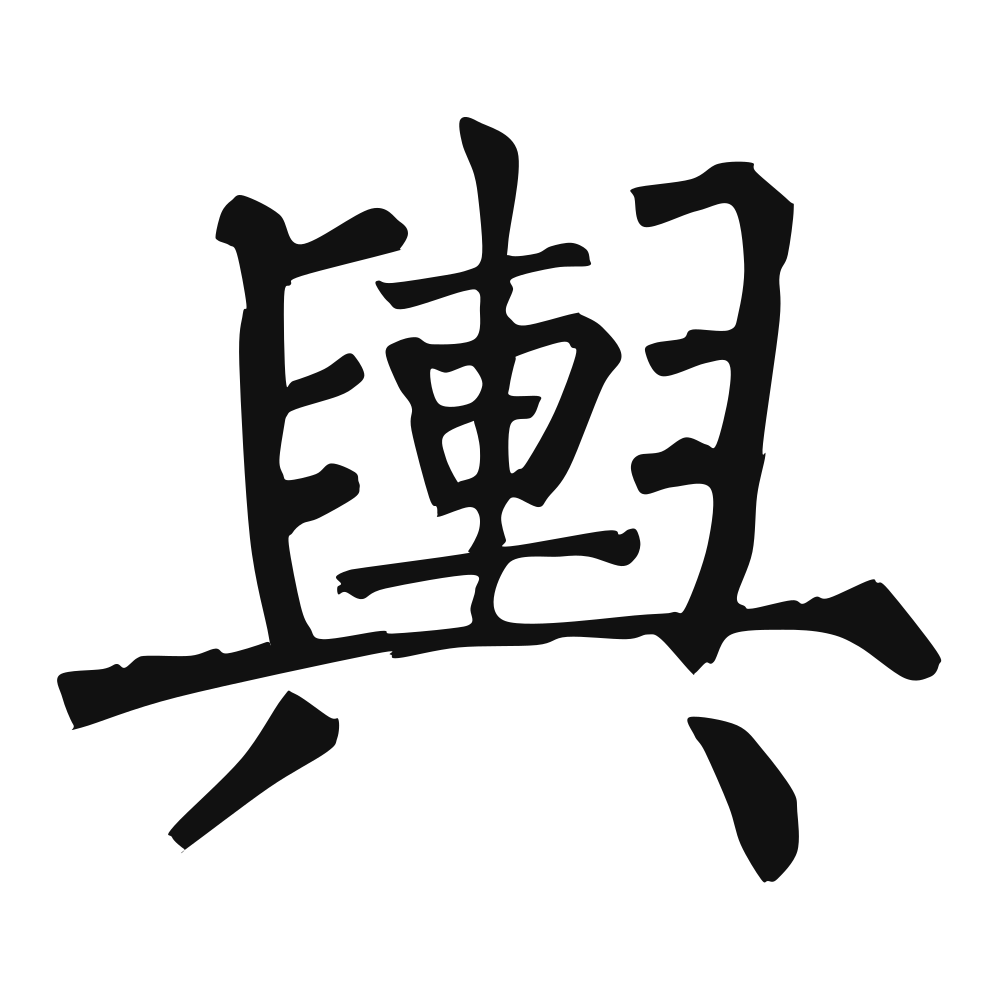
舆
(literary) chassis of a carriage (contrasted with the canopy 堪[kan1]); (literary) (fig.) the earth (while the carriage canopy is a metaphor for heaven); land; territory; (literary) carriage; (literary) sedan chair; palanquin; (bound form) the multitudes; the people; the public
Closest English meanings
public·carriage
The Calligrapher — Liǔ Gōngquán 柳公权
Tang regular-script master famed for 'bones' of strength; rival to Yan Zhenqing.
Tang calligrapher (778–865), master of regular script — Tang master of bone-strength regular script, paired forever with Yan Zhenqing as 'Yan sinew, Liu bone'. Tang dynasty
Cultural Story
舆 is a carriage — specifically the box-like carriage body that carried officials and, in another sense, the crowd of those who carried others: 舆人, the many, the multitude. From that crowd comes 舆论, public opinion, and 舆情, public sentiment — the state's oldest worry. Emperors commissioned 舆图, maps of the realm, drawn for the throne's eyes, while the rich traveled by 肩舆, the sedan chair.
Common words & phrases
- 舆论 public opinion
- 舆情 public sentiment
- 舆图 map
- 肩舆 sedan chair
Read the story behind the character
Your professor traces 舆论, public opinion, from sedan chairs to social media, and the class debates whether 舆情, public sentiment online, can really be steered. At the exhibition you photograph an old 舆图, an antique map of the empire, and a sedan chair, 肩舆, once carried up Mount Tai by hired shoulders.
Why this character belongs on skin
A chariot, its wheels turning, many hands lifting — 舆 began as the carriage of kings and became the word for the crowd that carries things: 舆论, public opinion; 舆图, the map of the realm. There is a truth hidden in the character's anatomy — it contains hands. Everything weighty in civilization is carried by many hands together: emperors ride, but sedan chairs need shoulders; ideas rule, but only where people lift them. The Greeks would have understood; demos means the same thing. This is a character about being carried and carrying in return, about the strange pact we make to bear each other. To wear 舆 is to admit interdependence without shame — I am held up, and I hold up others, and the wheels keep turning because neither of us lets go. Ink it on the back or the upper arm, where the shoulders do their work, a quiet monument to every hand that has ever lifted you, and every one you have lent in return.
Own this character
Purchase delivers the original SVG of this glyph, brushed by Liǔ Gōngquán 柳公权, ready to place on skin, paper, or screen.