
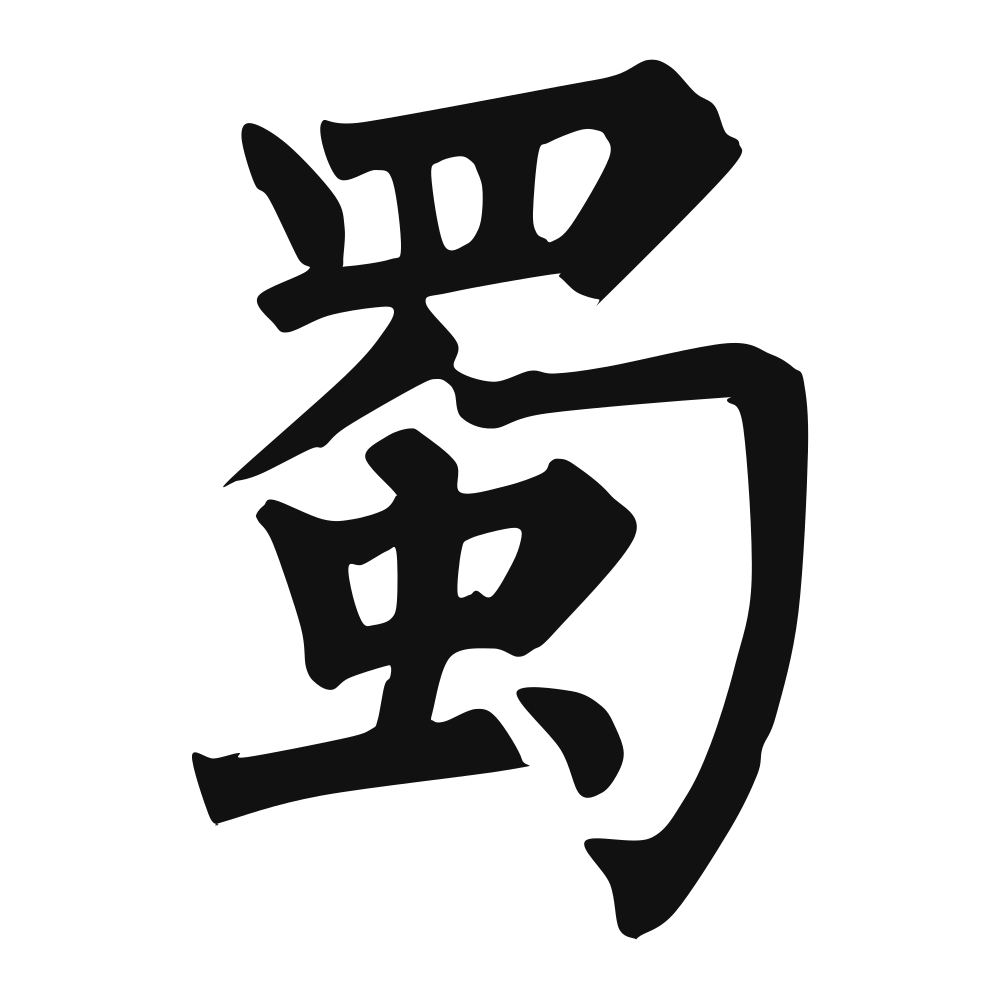
蜀
short name for Sichuan 四川[Si4 chuan1] province; one of the Three Kingdoms 三國|三国[San1 guo2] after the Han dynasty, also called 蜀漢|蜀汉[Shu3 Han4], situated around what is now Sichuan province
Closest English meanings
Shu·Sichuan
The Calligrapher — Liǔ Gōngquán 柳公权
Tang regular-script master famed for 'bones' of strength; rival to Yan Zhenqing.
Tang calligrapher (778–865), master of regular script — Tang master of bone-strength regular script, paired forever with Yan Zhenqing as 'Yan sinew, Liu bone'. Tang dynasty
Etymology & Meaning · 字义溯源
### Soundshǔ — shǔ (3rd tone). Free-standing morpheme ### Original meaningShǔ (3rd tone). The Shuowen Jiezi gives one of its most pictographic definitions: 「蜀,葵中蠶也。从虫,上目象蜀頭形,中象其身蜎蜎。《詩》曰:蜎蜎者蜀」 (卷十三·虫部) — 'the caterpillar in the mallow'; the 目 at the top pictures its head, the coil beneath pictures its curling body; the Odes line is 《詩·豳風·東山》, which the received text prints as 「蜎蜎者蠋」. Duan Yucai notes that the Erya's 釋文 quotes the first word as 桑 (mulberry) and that Mao's commentary calls 蠋 a 桑蟲 — so even the plant is a textual crux, not settled fact. 《淮南子·說林訓》 sharpens the point: 「蠶與蜀狀相類,而愛憎異也」 — the silkworm and the Shu caterpillar look alike, and people love one. Two further classical senses matter: 《爾雅·釋山》「獨者,蜀」 — a solitary mountain is called 蜀, the standard entry for taking 蜀 as the old word for 獨 'alone'; and 《管子·形勢篇》「抱蜀不言而廟堂既脩」, where the 字彙補 glosses 蜀 as a sacrificial vessel. Then history took the name: 巴蜀, 蜀郡 (Qin), the Shu of the Three Kingdoms. Honest disclosure: to a modern Chinese reader 蜀 means Sichuan first and a caterpillar second; it is a place name, not an emblem. ### The structure (象形 · 从虫,上目象蜀頭形,中象其身蜎蜎 — Xu Shen reads it as a picture: a snake/caterpillar radical whose 目 is the creature's head and whose coil is its body)①目mùeye (as the head)Xu Shen: the top pictures the caterpillar's head②虫huǐ / chóngcreature radicalthe body beneath, curled 蜎蜎③蠋zhúcaterpillarthe later form of the Shuowen's 蜀④獨dúsolitary《爾雅》: 獨者,蜀 — the lonely peak ### In use todayItemReading / meaningNoteReadingshǔ (3rd tone)single syllableCore senseShu (Sichuan) / caterpillarplace and state name first in modern useGrammarfree morpheme (proper name)巴蜀 Bashu; 蜀锦 Shu brocade; 蜀道 the Shu roadsTattoo fitcaution — reads as a province, not a virtue得陇望蜀 / 乐不思蜀 are unflattering idioms ### Closest words in English — and what each misses - Silkworm — 蠶 is the silkworm people love; 《淮南子》 says the Shu caterpillar only looks like one — and is not loved - Alone / Solitary — 獨 holds solitude in writing; 蜀 is the older word the Erya records for a solitary mountain - Transformation — 化 holds change; the caterpillar's becoming is never stated in the Shuowen's 蜀 entry - Mountain — 山 holds mountains; a lone one could be called 蜀, but the character's everyday job is SichuanAn honest note on grammar. Free morpheme as a place and state name (巴蜀, 蜀郡, 蜀汉, 蜀锦); in the Shuowen sense it is the caterpillar whose later form is 蠋; the Erya also glosses it 獨 'solitary'Where a Western reader can stand: 蜀 (shǔ) is Shu — the old kingdom and today Sichuan. That is the meaning a Chinese reader will take fi
Cultural Story
蜀 is Shu — the Sichuan basin's ancient kingdom, walled by mountains that poets found impassable. Li Bai sang the Shu road harder than climbing to blue heaven. In the Three Kingdoms era, Liu Bei founded 蜀漢 there, and 诸葛亮 governed it into legend; when the basin's fog hid the sun, locals quipped that even Shu's dogs barked at it.
Where a Western reader can stand: 蜀 (shǔ) is Shu — the old kingdom and today Sichuan, the meaning a Chinese reader takes first. The Shuowen instead defines a caterpillar curled in a leaf, and the Erya calls a lone mountain 蜀, the root of 独 'solitary'. So it holds caterpillar, solitude, and a province, with no particular virtue. As a tattoo it works only as a claimed homeland or, honestly, as 'the solitary peak'.
Common words & phrases
- 蜀國 Shu kingdom
- 蜀漢 Shu Han
- 巴蜀 Ba-Shu
- 蜀犬吠日 Sichuan dog barking at the sun
Read the story behind the character
Today the name is a brand of spice and ease. Trains blast through tunnels Li Bai could not have dreamed, and 蜀 (Shu, Sichuan) identity sells hotpot, mahjong, and giant-panda diplomacy. Tourists trace 蜀國 (Shu kingdom) sites at Wuhou Shrine, gamers build 蜀漢 (Shu Han) factions in strategy titles, and 巴蜀 (Ba-Shu) food channels retell the 蜀犬吠日 (Sichuan dog barking at the sun) joke whenever rare sunshine arrives.
Why this character belongs on skin
Some characters are places pretending to be words. 蜀 is Sichuan—the old kingdom of Shu, ringed by mountains so sheer that Li Bai wrote the road there was harder than climbing to heaven. A caterpillar wriggles beneath the radical; the eye above watches. It was real country: the Three Kingdoms generals fought over it, poets went into exile among its mists, and its silkworms—caterpillars again—dressed emperors. Shu meant the far place, the gorgeous, difficult place everyone said was unreachable, and that is its romance. Everyone has a Shu: the city you fled to, the life you built behind mountains of your own, reachable only by the hard road and worth every switchback. Mountains that guard also keep. This character is for the geography of your own refusal to stay put—a remote, radiant kingdom, written on the body like a border crossed.
Own this character
Purchase delivers the original SVG of this glyph, brushed by Liǔ Gōngquán 柳公权, ready to place on skin, paper, or screen.