
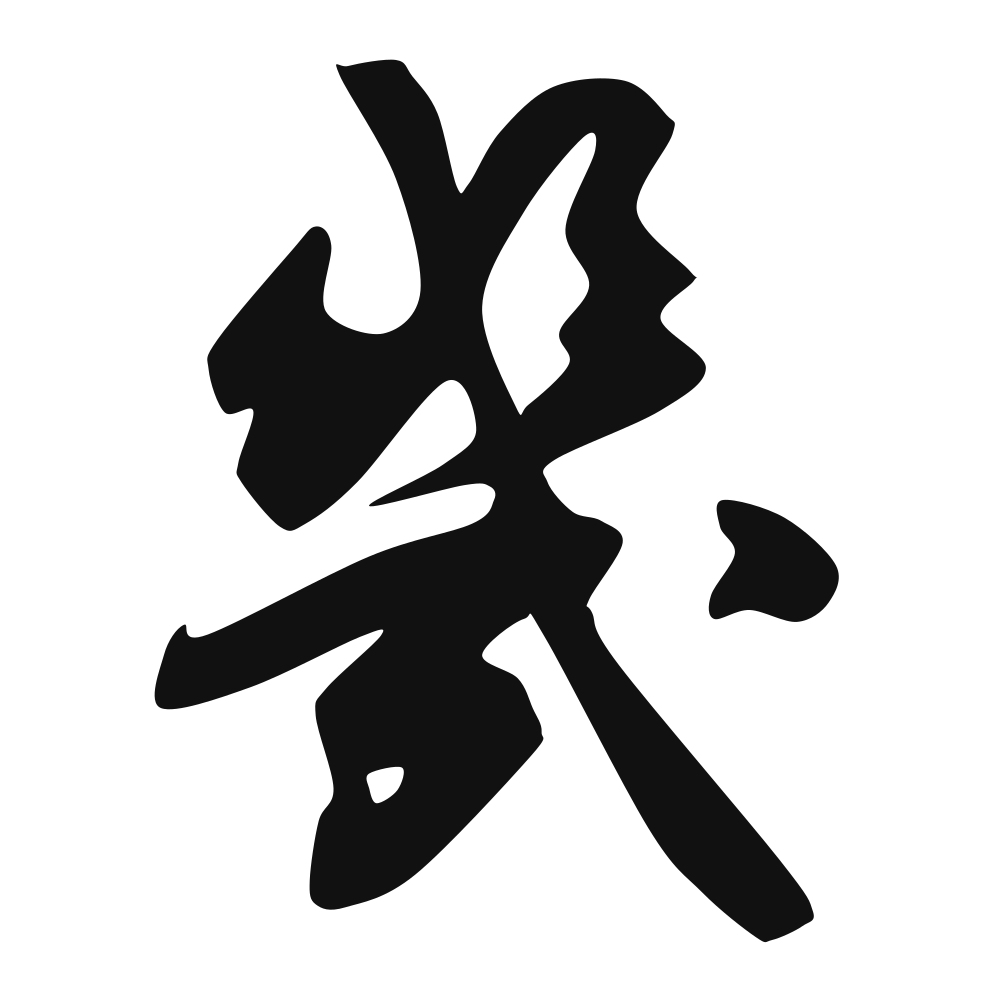
几
small table; (literary) almost; how many; how much; several; a few
Closest English meanings
how many·several·a few·near·small table
The Calligrapher — Liú Yōng 刘墉
Qing minister famed for rounded, 'cotton-hidden-iron' running script.
Qing calligrapher (), master of regular script/running script — known for 浓墨宰相. Qing dynasty
Etymology & Meaning · 字义溯源
2 · The Character: 几 Jǐ / jī. The character wears two faces that the simplification of 1956 fused into one. As 几 (jī) it is a small table — the Shuowen Jiezi: 「踞几也。象形」, the low armrest table of the ancients; it survives in 几案 (desk), 茶几 (tea table), and 几乎 (jīhū, 'almost', 'nearly'). As the simplified form of 幾 (jǐ / jī), it carries a completely different soul: 幾 means 'the subtle, the tiny, the omen'. The Yijing says it best: 《易·系辞下》 「知幾其神乎」 — to know the subtle is to be divine — and 「幾者,動之微,吉之先見者也」 — the subtle is the first stirring of movement, where good fortune first shows itself. The whole tradition of 见微知著 (see the small, know the great) lives in this character. The modern everyday reading 几 (jǐ) is the question word 'how many'. Honest disclosure: simplified 几 merges the table and the subtle-omen into one graph; a lone 几 on skin will be read as 'how many' or 'almost' before it is read as the Yijing's subtle thread.
Cultural Story
The form was a small table, 几, and 'how many'. The Yijing asks 几何, how much, of the changing lines. The Odes count 几个 travellers at the ford. A 茶几 held the cup in the scholar's chamber. The word measured the few and the near before it measured the rest.
Where a Western reader can stand: A small table — and the subtle thread of fate. Western readers should know the Yijing's 知幾 (knowing the subtle) is the soul worth wearing — but in its traditional form 幾, because simplified 几 reads 'how many?'
Common words & phrases
- 几个 how many · a few · several
- 几乎 almost · nearly · virtually
- 几何 geometry · how much · how many
- 茶几 tea table · side table
- 几时 when · what time
- 无几 very few · hardly any
Read the story behind the character
A note asks 几个, how many; the reply is 几乎, nearly. The boy learns 几何, geometry, at school. The 茶几 holds the remote and a cup. The letter asks 几时, when. The count is 无几, hardly any left. The word means a table, a number, and a near thing — all small.
Why this character belongs on skin
几 is a small table, the low kind you set a cup on while the evening does its slow work. But say it the other way and it becomes a question: how many? How many winters, how many mistakes, how many people you let close? The character folds the object and the inquiry into one shape — as if the ancients suspected that what we set our things on is really what we count. To carry 几 is to honor the small surfaces of a life: the nightstand, the desk, the altar of ordinary days. It is also to stay curious, to keep asking the tally instead of assuming it. Some of us measure ourselves in accomplishments; this mark measures in tables and evenings. Ink it where you'll see it at the end of the day, a quiet reminder that the most important number was never your age or your score. It was how many moments you actually noticed.
Own this character
Purchase delivers the original SVG of this glyph, brushed by Liú Yōng 刘墉, ready to place on skin, paper, or screen.