
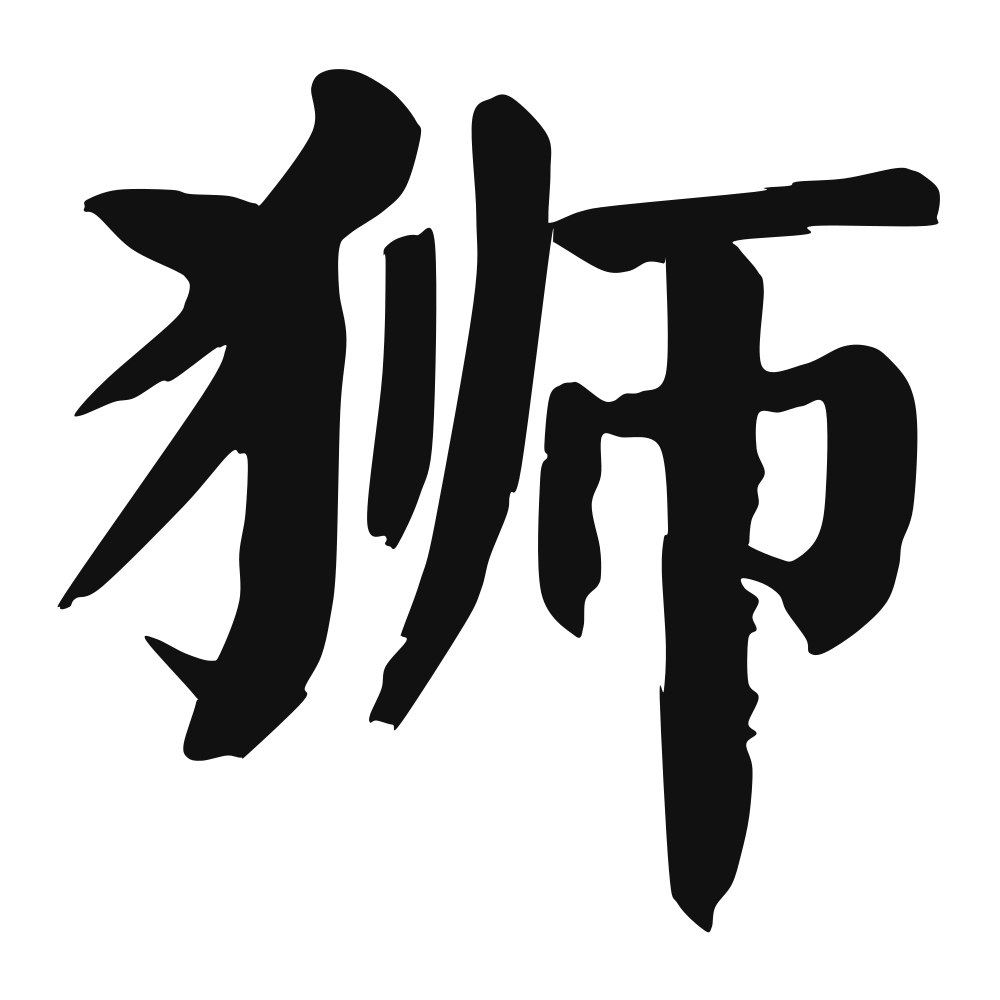
The Calligrapher — Lù Jī 陆机
Jin calligrapher of clerical-cursive script, author of the Pingfu Letter (Pingfu tie), earliest surviving work.
Jin calligrapher (), master of cursive script — known for 《平复帖》(存世最早墨迹). Jin dynasty
Cultural Story
The lion was no native of China; 獅 entered Chinese through Buddhist scriptures and Silk Road tribute, where live lions arrived as gifts to the Han and Tang courts. Tang artists carved guardian 獅子 before tombs, and 獅子舞 became a festival dance to chase away evil spirits and bless the harvest.
Common words & phrases
- 狮子 lion
- 狮王 lion king
- 狮群 lion pride
- 海狮 sea lion
Read the story behind the character
Children grow up with 狮子 (lion) cartoons and the 獅王 (lion king) who rules the savanna. At the zoo a 獅群 (lion pride) dozes in the sun, while on the coast a 海獅 (sea lion) claps for fish. During Spring Festival, dancers wave a giant lion head through the streets for luck.
Why this character belongs on skin
He does not explain his kingship. 狮 is the lion, the beast the Silk Road carried east as a symbol of majesty no human crown could match — the guardian at temple gates, the couchant figure beneath a Buddha's feet, tame and terrible at once. There is a sovereign calm in the lion, the animal that rests because it has nothing to prove. To carry 狮 is to claim that calm for yourself, the quiet authority that needs no roar. It is sensual in its abundance of muscle and restraint, the king who lingers. Ink it across the chest or shoulder, a vow of self-possession: I am not loud to be strong. I rule my own ground and rest upon it. The lion sleeps in plain sight. Let the mark be your throne, worn close, worn for life, worn without apology, the way a king wears his own silence.
Own this character
Purchase delivers the original SVG of this glyph, brushed by Lù Jī 陆机, ready to place on skin, paper, or screen.