
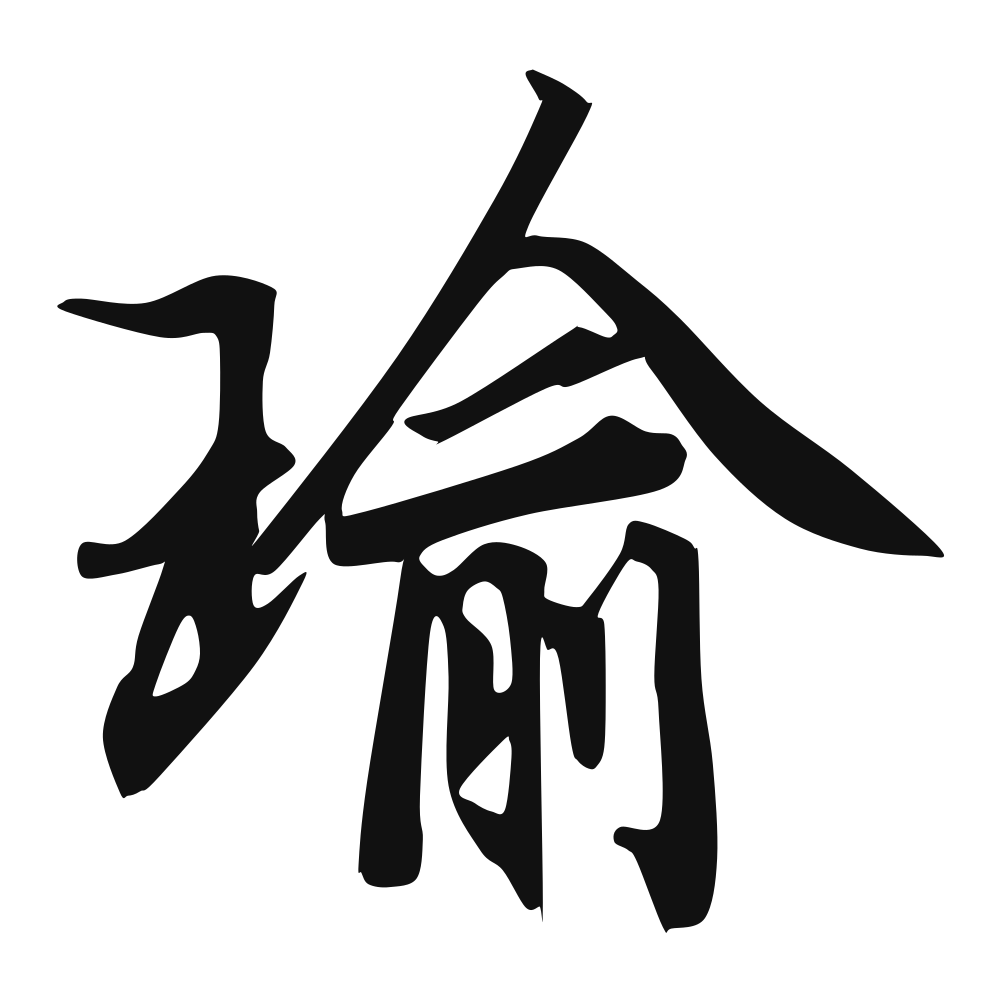
瑜
excellence; luster of gems
Closest English meanings
fine jade·virtue
The Calligrapher — Lù Jiǎnzhī 陆柬之
Tang calligrapher and nephew of Yu Shinan; his running-script 'Essay on Literature' survives
Tang calligrapher (), master of running script — known for 《文赋》. Tang dynasty
Cultural Story
Yu is fine jade and, by extension, the virtue shining within a person. The Book of Rites gives the jade-lover's maxim 瑕不掩瑜, flaws cannot obscure the jewel; the Songs of Chu praises the worthy 怀瑾握瑜, clutching jade to the breast. History added Zhou Yu, the dashing strategist of the Three Kingdoms.
Common words & phrases
- 瑜伽 yoga
- 瑾瑜 fine jade
- 瑕不掩瑜 flaw cannot hide jade
Read the story behind the character
Contemporary Chinese borrowed the character for 瑜伽, yoga — studios line city streets with the word. Parents still press 瑜 into children's names hoping for jade-bright character, and when something is imperfect yet worthy, the old idiom 瑕不掩瑜 does the apologizing.
Why this character belongs on skin
瑜 is jade at its best—warm, translucent, glowing from within rather than glinting from without. The classics argue about it beautifully: 瑾瑜匿瑕, even the finest jade hides a flaw—and its twin proverb, 瑕不掩瑜, the flaw cannot eclipse the jade. Together they are the most forgiving sentence in the language. Perfection was never the standard; radiance was. And there is Zhou Yu, the Three Kingdoms commander history records as handsome, brilliant, and gracious, whose name still means the stone of stones. Jade in China was never decoration—it was virtue made mineral: Confucius listed eleven of jade's qualities, from its warm luster (kindness) to its hardness at the core (wisdom). You have a flaw; you've checked, there it is. And you have the glow. This character rules on the dispute permanently: the glow wins. Ink 瑜 where light will find it, and let it be your standing verdict—cracked, yes; radiant, undeniably; and the crack, seen honestly, only proves the jade is real.
Own this character
Purchase delivers the original SVG of this glyph, brushed by Lù Jiǎnzhī 陆柬之, ready to place on skin, paper, or screen.