
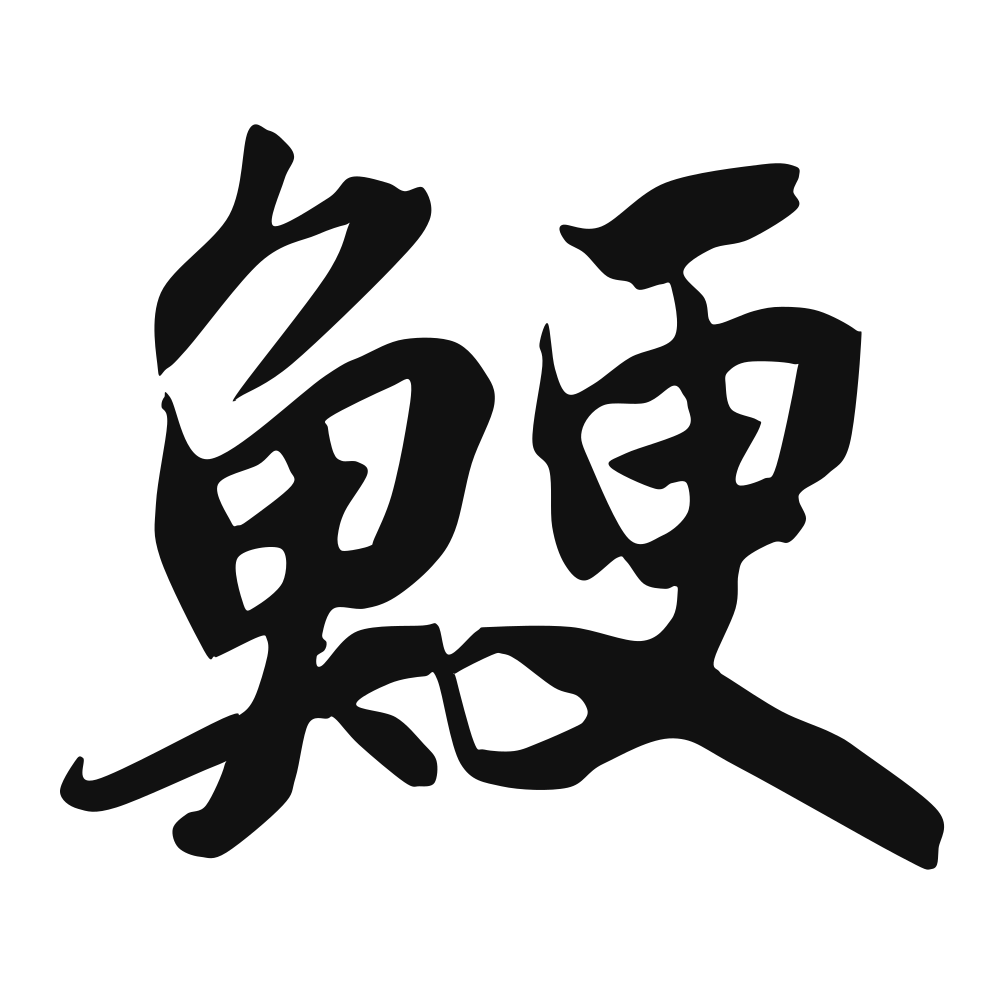
鲠
to choke on a piece of food; (literary) a fish bone lodged in one's throat
Closest English meanings
fish bone·choke·upright
The Calligrapher — Lù Jiǎnzhī 陆柬之
Tang calligrapher and nephew of Yu Shinan; his running-script 'Essay on Literature' survives
Tang calligrapher (), master of running script — known for 《文赋》. Tang dynasty
Cultural Story
鲠 joins 鱼 with 更 and means a fish bone. Because a bone caught in the throat chokes speech, it came to mean both "to choke" and, by praise, an upright, blunt honesty that will not swallow lightly.
Common words & phrases
- 骨鲠 fish bone · upright · blunt
- 鲠直 upright · honest
- 如鲠在喉 like a bone in the throat
Read the story behind the character
鲠 is the fish bone: 骨鲠, and 如鲠在喉, "like a bone stuck in the throat," for words one must speak. 鲠直 is upright and honest. The character bridges the dinner-table hazard and the counselor who tells the ruler the hard truth.
Why this character belongs on skin
Every fish has a spine, and every spine has its warnings. Gěng is the fish bone caught in the throat—that small, sharp fact that stops all conversation, the whole body suddenly devoted to one obstruction. The ancients used it for more than dinner. A minister whose honest words stuck in a ruler's ear was called a bone in the throat of the state: annoying, indispensable, impossible to swallow. There is pride in that. Some truths are meant to lodge, to prick, to make comfortable people wince until they change. To wear gěng is to accept the role with open eyes—the one who says the unsayable, whose presence is felt precisely because it cannot be smoothed away. Be the bone. A table of silence is cleaner without you, and far less true.
Own this character
Purchase delivers the original SVG of this glyph, brushed by Lù Jiǎnzhī 陆柬之, ready to place on skin, paper, or screen.