
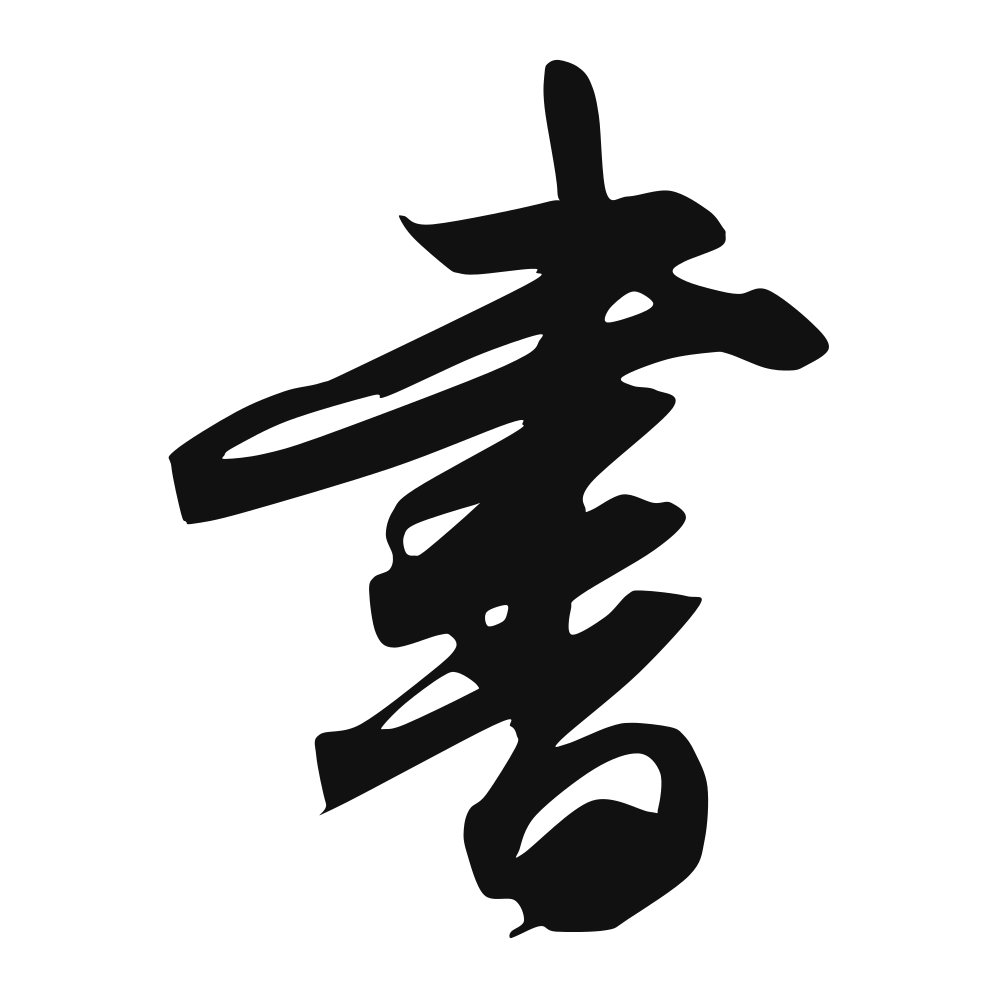
书
书 (shū) — book; to write. Pictograph of a hand holding a brush over marks. Classical life: 书法 — calligraphy, literally 'the method of writing'; 书 is the scholar's root. Grammar: free morpheme — also: book; letter; document; to write
Closest English meanings
book·write·letter·document
The Calligrapher — Mǐ Fú 米芾
Song eccentric genius of dynamic, 'flying' running script.
Song calligrapher (1051–1107), master of running script — Song eccentric genius ('crazy Zhang, idiot Mi') whose running script alternates discipline with glee. Song dynasty
Etymology & Meaning · 字义溯源
2 · The Character: 书 书 (shū, 1st tone), traditional 書, is 'to write, a document, a book.' The Shuowen Jiezi gives 箸也。从聿者声 — 'to set down; from 聿 (a writing-brush hand) and 者 as phonetic.' Its cultural charter is the Yijing, Xici zhuan: 上古结绳而治,后世圣人易之以书契,百官以治,万民以察,盖取诸夬 — 'in high antiquity they governed by knotting cords; later sages replaced this with written records (书契), and the hundred offices were ordered and the myriad people scrutinized — drawn from the hexagram Guài (Breakthrough).' The Shuowen's own gloss 著于竹帛谓之书 — 'what is put on bamboo and silk is called 书' — seals its identity as the inscribed word. From the Lunyu copied by every schoolchild to the vast 四库全书, 书 is civilization's memory. Honest disclosure: simplified 书 is NOT the same glyph as 書; count Kangxi strokes on 書 (10, 曰部). Wuxing: Metal (金) — the cutting edge of the brush. Kangxi: 10 strokes.
Cultural Story
書 showed a hand with a brush marking the tally or the petition, to write, to record. The 史記 was 書; Confucius 述而不作, transmitted but did not author, yet his name rides on the books that followed. 書法, the way of the brush, turned writing into the highest art. The character is the mark made to outlast the mouth, the letter, the record, the leaf that remembers.
Energy Reading
Metal (金)
Comparative symbology, not fortune-telling.
Common words & phrases
- 书本 book · books · volumes
- 读书 read · study · attend school
- 书法 calligraphy · penmanship · handwriting
- 书店 bookstore · bookshop · book shop
- 书信 letter · correspondence · epistle
- 看书 read a book · read books · do reading
Read the story behind the character
书本 is the textbook and the novel; 读书 the child at the lamp and the degree you chase. 书法 is the hobby and the framed scroll; 书店 the shrinking storefront. 书信 is nearly extinct, killed by the app; 看书 the thing you do instead of sleeping. The brush has become the screen, but the character still means the written word and the act of taking it in, the page, the letter, the hand that once held the brush.
Why this character belongs on skin
书 is the act of writing and the thing written — a letter, a book, the slow drag of ink that turns a thought into a thing that outlives the thinker. The classical root is "to record," to fix the fleeting in strokes. Before printing, a book was a body: bound, carried, worn close. To put 书 on your skin is to become the page yourself — to say that your life is worth the telling, that you are not a passing noise but a sentence with weight. Writers have always known the charged silence of the written word, the way a private line can outlast empires. Carry it where only you will read it, or where strangers will. Either way it means: I am still being written. The story is not finished. Pick up the brush.
Own this character
Purchase delivers the original SVG of this glyph, brushed by Mǐ Fú 米芾, ready to place on skin, paper, or screen.