
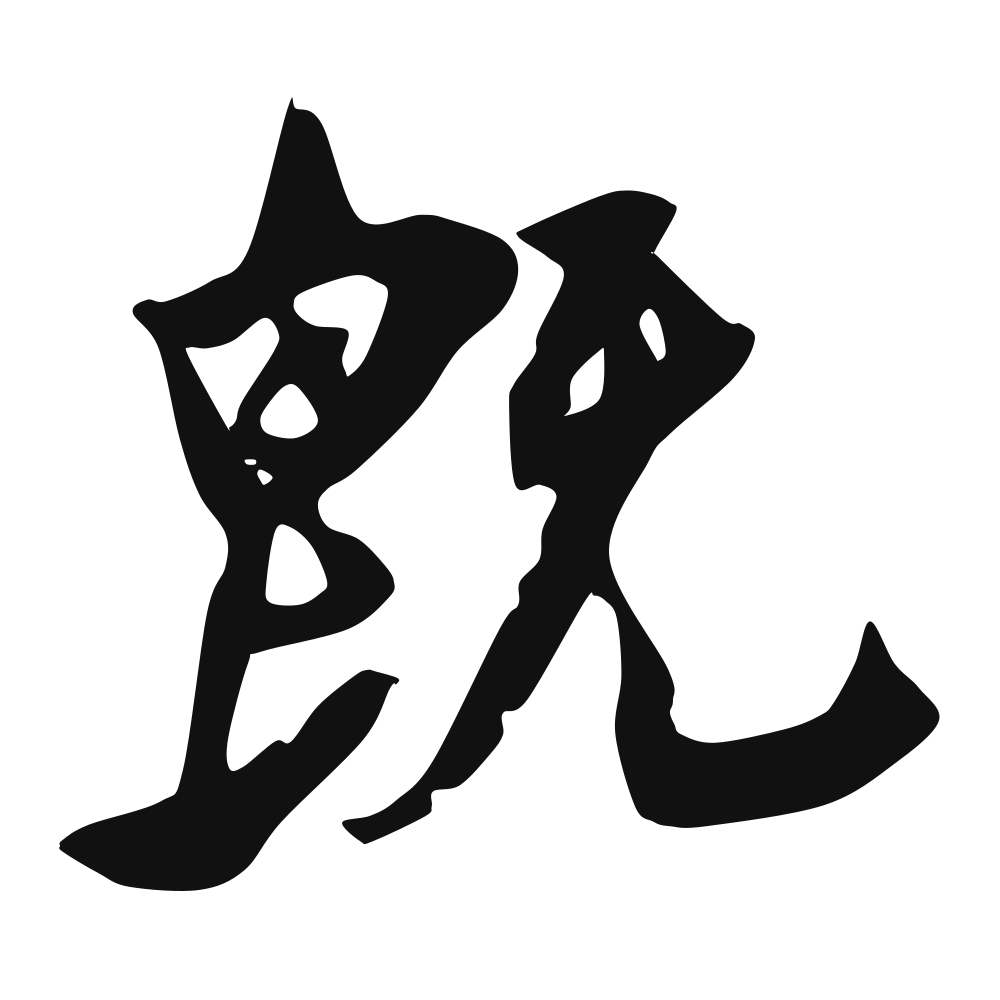
既
already; since; both... (and...)
Closest English meanings
already·since·both
The Calligrapher — Ní Yuánlù 倪元璐
Ming running-script master who died a loyalist's death, one of the late-Ming 'three trees'.
Ming calligrapher (), master of running script — late-Ming calligrapher-painter of jagged, personal running script. Ming dynasty
Etymology & Meaning · 字义溯源
2 · The Character: 既 Ji (4th tone). The Shuowen Jiezi reads 「既, 小食也」 — a small meal, i.e. having eaten and turned away; the bronze graph shows a man by a vessel, his head already turned from it. From 'having eaten' came 'already, finished'. The Analects, Ba Yi, teaches 「成事不说, 遂事不谏, 既往不咎」 (what is done, do not discuss; what is past, do not blame) — 既往 as 'what has already gone'. The Odes use 既 for completion (「既醉以酒」). Name-lore assigns Wood (木) and nine Kangxi strokes (无/皀部). As a free morpheme 既 means 'already', a marker of closure. Honest route: 既 is retrospective and slightly final; pair it with 往 (既往) or 今 so the piece reads as acceptance of the past, not as a dead end.
Cultural Story
既 is the done deed. 既然 'since it is already so' opens the argument; 既往 the past we're told not to recall. The bronze inscriptions say 既 the rite is finished. The word is the line drawn behind the moment — what has occurred stands, and the adviser builds on it. 既成 is the fact too late to unmake.
Where a Western reader can stand: Where a Western reader can stand: 既 is the turned-away head after the meal — iam, 'already', a full stop. Alone it reads as closure; pair with 往 or 今. The hand is Ni Yuanlu, a Ming loyalist whose dry-brush running-cursive shows defiant resolve; his hand is real, the caveat is the character's finality.
Common words & phrases
- 既然 since · now that · as
- 既而 afterwards · later · then
- 既往 past · former · what has passed
- 既得 already obtained · vested
- 既成 already accomplished · established
Read the story behind the character
既然 is the 'well, since' of the quarrel; 既而 the 'and then' of the recap. 既往 the amnesty; 既得 the interest. 既成 the fact. The word closes the door on the before and opens the after — the already-decided we argue from, the vested thing no petition will now undo. From the text to the trust, 既 marks what's fixed.
Why this character belongs on skin
The Buddhists speak of already—the thing that has come to pass and cannot be unmade. 既 means already, the meal already eaten, the step already taken, the word already spoken into the air. In its oldest form it shows a person bowed before a full bowl, sated, the moment complete. There is a solemn freedom in accepting what is already so, the way the Psalms concede, it is finished. You cannot un-live the love or the loss; you can only stand in the ruin and call it true. To wear 既 is to make peace with the irreversible, to stop bargaining with yesterday. It is a mark for the one who has survived something and refuses to pretend otherwise. Let it sit on your body like a seal on a letter—proof that you were here, that it happened, that you carry the weight and do not look back. The ink is your amen to the past.
Own this character
Purchase delivers the original SVG of this glyph, brushed by Ní Yuánlù 倪元璐, ready to place on skin, paper, or screen.