
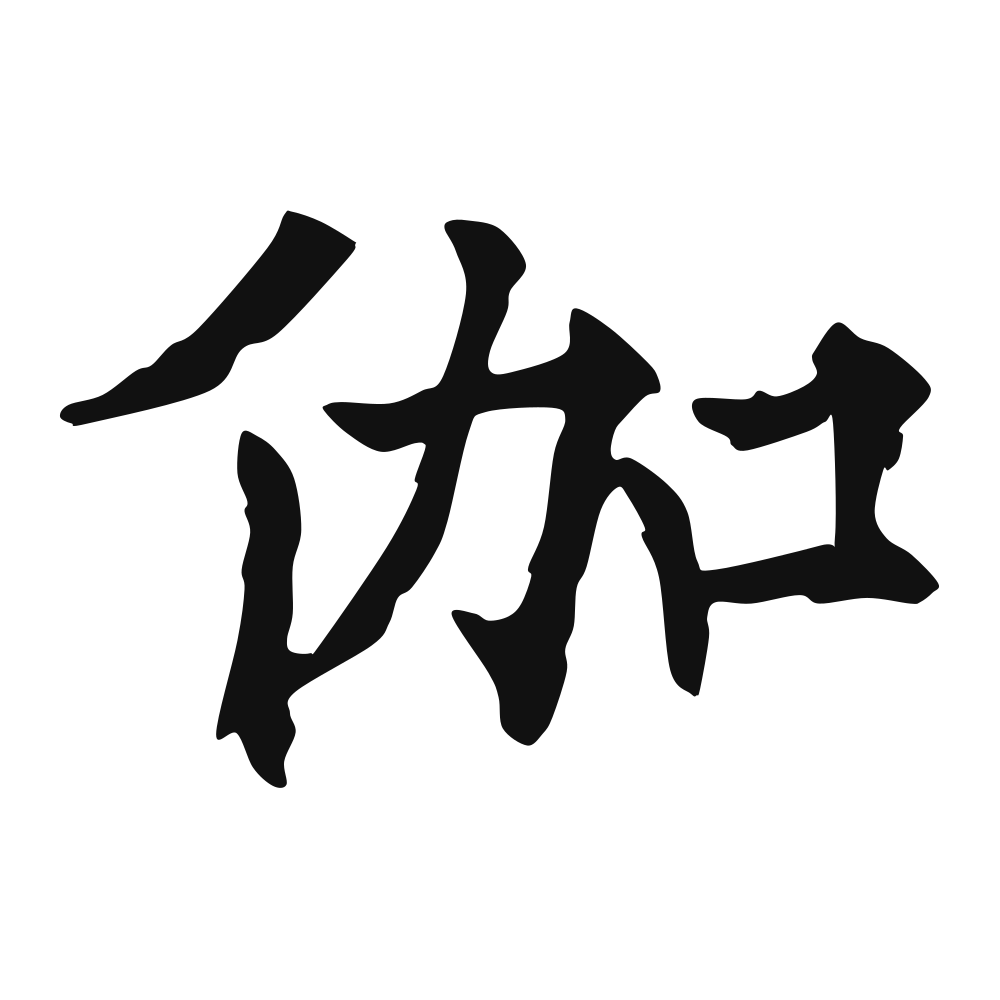
伽
traditionally used as phonetic for "ga"; used to transliterate Sanskrit "gha"
Closest English meanings
(Sanskrit translit)·gamma
The Calligrapher — Ōuyáng Tōng 欧阳通
Tang regular-script master known for powerful, square strokes.
Tang calligrapher (?–691), master of regular script — known for 《道因法师碑》. Tang dynasty
Etymology & Meaning · 字义溯源
### Soundqié · jiā · gā — qié (2nd, Buddhist / aloeswood) · jiā (1st, 伽倻) · gā (1st, 伽馬射線). Often a bound morpheme — needs a partner word ### Original meaningQié (2nd tone), jiā (1st), gā (1st). The honest first sentence: 伽 is not a Chinese word — it is a sound borrowed to write Sanskrit. It has no Shuowen entry; Xu Shen worked before the great age of translation, and the graph does not appear in his dictionary. The Kangxi Dictionary (人部 + 5, 7 strokes) explains it entirely from Buddhist transcription: 「伽藍,神名」; 「梵書:那伽,龍也;竭伽,犀也;僧伽藍,衆園也。譯云園,取生植義,今浮屠所居是也。凡稱釋氏曰僧伽」 — saṃghārāma, the garden where the community dwells, hence a monastery; nāga 那伽 is the dragon, khaḍga 竭伽 the rhinoceros, saṃgha 僧伽 the order. It also gives 瑜伽 (yoga): 《舊唐書·柳公綽傳》「精釋典《瑜伽》、《智度》大論,皆再鈔」. Read qié it is also 伽南香, aloeswood. Read jiā it is 伽倻, the Korean gayageum; read gā it is 伽馬射線, the gamma ray. Its one real home in Chinese literature is a title: 楊衒之's 《洛陽伽藍記》, the Record of the Monasteries of Luoyang, and Tang poems such as 韓愈《送僧澄觀》「僧伽後出淮泗上」. ### The structure (形聲 · 从人,加聲 — 人 added because translators used the graph for names (dictionaries: 翻譯佛經多用為人名,故从人); the signific is a convention, not a meaning)①亻rénpersonthe translators' convention: foreign names get the person radical②加jiāto addthe phonetic — the graph was built for its sound③伽藍qiélánmonastery (saṃghārāma)「衆園也…今浮屠所居是也」 — the garden of the community④瑜伽yújiāyogathe yoke, the discipline; 《舊唐書》 records it among the scriptures ### In use todayItemReading / meaningNoteReadingqié · jiā · gāthree readings, three unrelated wordsCore sensenone alone — a transcription syllable伽藍 monastery · 瑜伽 yoga · 伽南香 aloeswoodGrammarbound loan-syllable; no Shuowen entryalso 伽倻 (gayageum) and 伽馬射線 (gamma ray)Tattoo fitcaution — empty aloneuse 瑜伽, 伽藍 or 僧伽 if the Buddhist sense is the point ### Closest words in English — and what each misses - Temple — 寺/刹 hold 'temple'; 伽 is one syllable of 伽藍 = saṃghārāma, 'the garden of the community' - Monk — 僧 holds 'monk'; 伽 appears inside 僧伽 (saṃgha, the order) but never means a monk on its own - Yoga — 瑜伽 is yoga; 伽 alone is half a loanword and unreadable outside it - Peace — 靜/安 hold peace; 伽 suggests a Buddhist setting, and does not name a state of mindAn honest note on grammar. Bound transcription graph: it occurs only inside loans (伽藍 monastery, 瑜伽 yoga, 僧伽 saṃgha, 伽南香 aloeswood, 伽倻 gayageum, 伽馬射線 gamma ray). It has no independent sense and no classical grammar of its ownWhere a Western reader can stand: 伽 is not a word — it is a syllable Chinese borrowed to write Sanskrit, the 'gha' in 伽藍 (monastery, from s
Cultural Story
伽 is a phonetic borrowed from Sanskrit, 人 with 加, used to transcribe Buddhist terms: 伽藍, saṅghārāma, the monastery, 伽陀, gāthā, the verse, 伽倻 the Korean zither. The 說文 has no entry; the character is a missionary's tool, the sound of India written in Chinese skin. It is the graph as a phonogram, the syllable borrowed to carry the sutra.
Where a Western reader can stand: 伽 is not a word but a syllable Chinese borrowed to write Sanskrit — the 'gha' in 伽藍 (monastery, from saṃghārāma), 瑜伽 (yoga) and 僧伽 (the sangha, the order). It has no Shuowen entry because it did not exist yet, and the Kangxi explains it purely as transcription. It is read three ways depending on the word, so 伽 alone says nothing — 瑜伽 or 伽藍 say something.
Common words & phrases
- 伽藍 monastery · sangharama
- 伽倻 Kayagum (zither)
- 伽陀 gatha (verse)
Read the story behind the character
伽藍 is the monastery in a Buddhist text; 伽陀 the verse in a scripture. 伽倻 names the Korean kayagum and a few place-words. The character is inert outside these loanwords; you will not meet it in daily speech. It is the Sanskrit echo in Chinese dress, the monastery, the verse, the zither, the phonogram that carried the Dharma across the mountains and stayed as a sound.
Why this character belongs on skin
This character exists because Buddhism walked into China carrying foreign sounds that no native word could hold — so translators built a vehicle: the person radical plus a phonetic, a glyph invented purely to be a vessel for Sanskrit. It appears in qiélan, from sangha, the community of practitioners; in yoga's old Chinese rendering; in names of temples where incense has risen for fifteen hundred years. It is one of the characters that has no life outside the borrowed — pure bridge, pure welcome. There is a lesson hiding in that humility. A whole glyph that does nothing but receive another tradition and carry it forward, the way the great translation monks like Xuanzang spent lifetimes carrying meaning across deserts one syllable at a time. Every practice you have ever adopted from elsewhere rested on someone's version of this character: the vessel that says come in, we will find a shape for you. Ink it as a small salute to the open hand — the self that makes room for what arrives from far away.
Own this character
Purchase delivers the original SVG of this glyph, brushed by Ōuyáng Tōng 欧阳通, ready to place on skin, paper, or screen.