
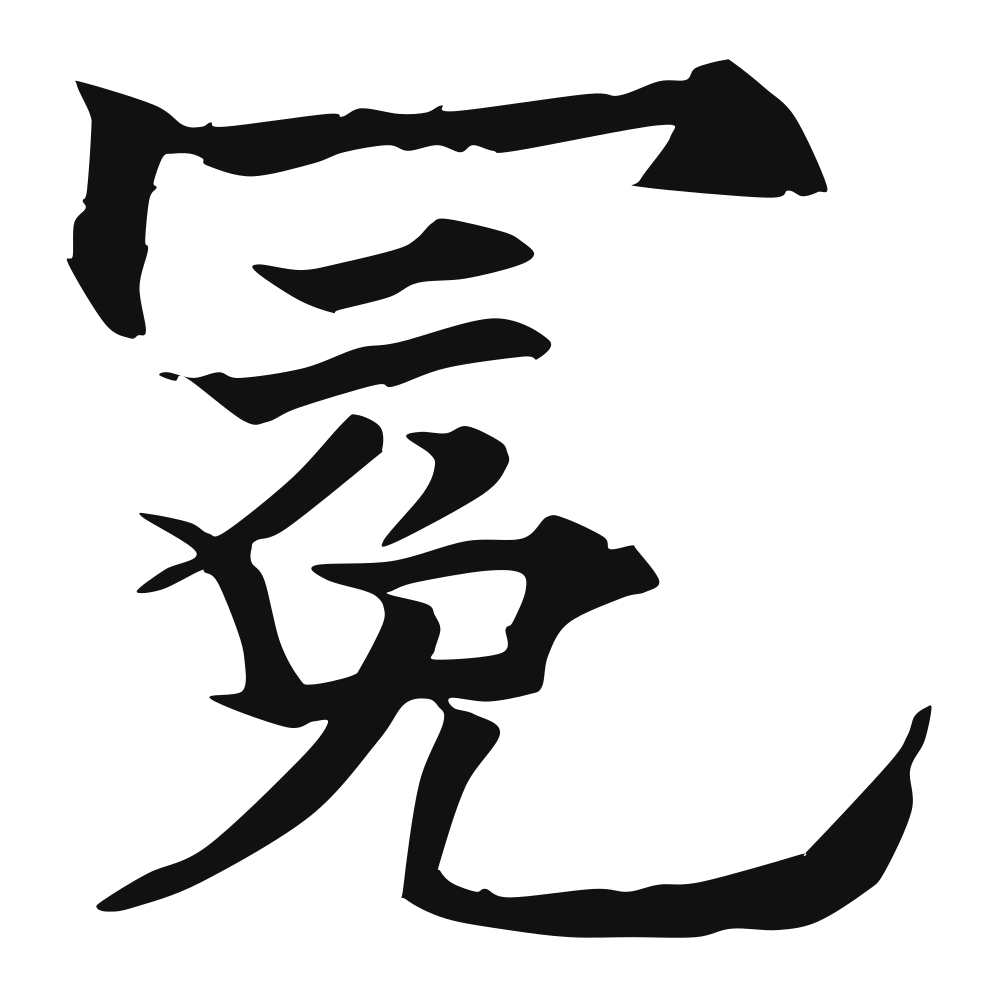
冕
crown in the form of a horizontal board with hanging decorations; imperial crown
Closest English meanings
crown·ceremonial hat
The Calligrapher — Ōuyáng Tōng 欧阳通
Tang regular-script master known for powerful, square strokes.
Tang calligrapher (?–691), master of regular script — known for 《道因法师碑》. Tang dynasty
Etymology & Meaning · 字义溯源
### Soundmiǎn — miǎn (3rd tone). Often a bound morpheme — needs a partner word ### Original meaningMiǎn (3rd tone). The Shuowen Jiezi defines it as 「大夫以上冠也。从冃免聲」 — 'the cap worn by officers of the rank of dafu and above', built from 冃 (the cap) with 免 as sound. The classical tradition holds that the Yellow Emperor first made the mian crown (黄帝初作冕), and the form is fixed in the Rites: the emperor's crown carries twelve jade-bead tassels hanging before and behind, the number of strands falling in step with rank. 冕 is not a hat in the everyday sense — it is the crown of ceremony and of the office that ceremony confers. ### The structure (形聲 · 从冃免聲 — the cap (冃) with 免 as sound; the crown that covers the head of office)①冃màocap / coverthe crown that sits the head②免miǎnsound elementthe phonetic that gives miǎn③冕miǎnceremonial crownthe crown of rank④旒liújade tasselsthe twelve strands of the emperor ### In use todayItemReading / meaningNoteReadingmiǎn (3rd tone)single syllableCore senseceremonial crown of officenot an everyday hatGrammarbound morpheme加冕 to crown; 卫冕 to defend a titleTattoo fityes-standalone — formal and officialreads as dignity tied to duty ### Closest words in English — and what each misses - Crown (monarchy) — 冕 is the crown of a *rank and obligation*, not a western royal romance - Hat / Cap — 帽/冠 are everyday headwear; 冕 is specifically the ceremonial crown - Tiara / Diadem — those are ornament; 冕 is office — the number of beads states your rank - Glory — 榮 holds glory; 冕 holds the crown that is worn *with* duty, not for its shineAn honest note on grammar. Bound morpheme in modern use — it needs a partner (加冕 to crown, 皇冠/冕旒 the crown and its beads); it appears alone mainly in 冠冕 and 卫冕 (to defend a title).Where a Western reader can stand: 冕 (miǎn) is the ceremonial crown of ancient office — worn not for its sparkle but because it states what its wearer owes. The emperor's had twelve jade strands, and every rank below wore its own number. As a tattoo it is dignity bound to duty: the weight of a position, worn as a mark.
Cultural Story
The 冕 was the ritual crown of the Son of Heaven, hung with twelve beaded fronts, 冕旒, that hid his face from flatterers. A king was 加冕 on the altar steps. To 卫冕 was to keep a hard-won title. The cap marked the man above others, its weight a duty as much as a glory.
Where a Western reader can stand: 冕 is the crown of rank and duty from ancient China: twelve jade strands for the emperor, a set number for each office below. As a tattoo it is authority held straight — dignity that carries obligation rather than vanity.
Common words & phrases
- 加冕 crown
- 冠冕 crown · halo
- 冕旒 imperial crown
- 衛冕 defend a title
Read the story behind the character
A champion is 加冕 on the podium; the 冠冕 sits in the museum case. The team 卫冕 its league after a thin win. The 冕旒 of an emperor is drawn in the textbook, beads straight. A bride's tiara is joked as a 冕; the word now rests mostly in sport and in paint.
Why this character belongs on skin
A circle of weight, worn willingly. This character is the ceremonial crown — the cap of kings, of scholars ranked at court, of emperors whose tasseled beads hung exactly low enough to blur the unworthy from view. The old ritual texts are strangely tender about it: the crown must be worn with straightness, because a crowned man who sways shames the sky he claims to face. Yet every tradition that ever crowned anyone also mistrusted the object. Monks traded theirs for shaved heads. Christ, offered kingdoms, declined the coronation and accepted thorns. The Taoist sage keeps his hair unbound. So the character carries a double inheritance — honor and its renunciation, the crown you accept and the one you lay down. To ink it is to claim the first without forgetting the second. Carry your authority quietly, the way a heavy thing is carried best: close to the skull, without swagger.
Own this character
Purchase delivers the original SVG of this glyph, brushed by Ōuyáng Tōng 欧阳通, ready to place on skin, paper, or screen.