
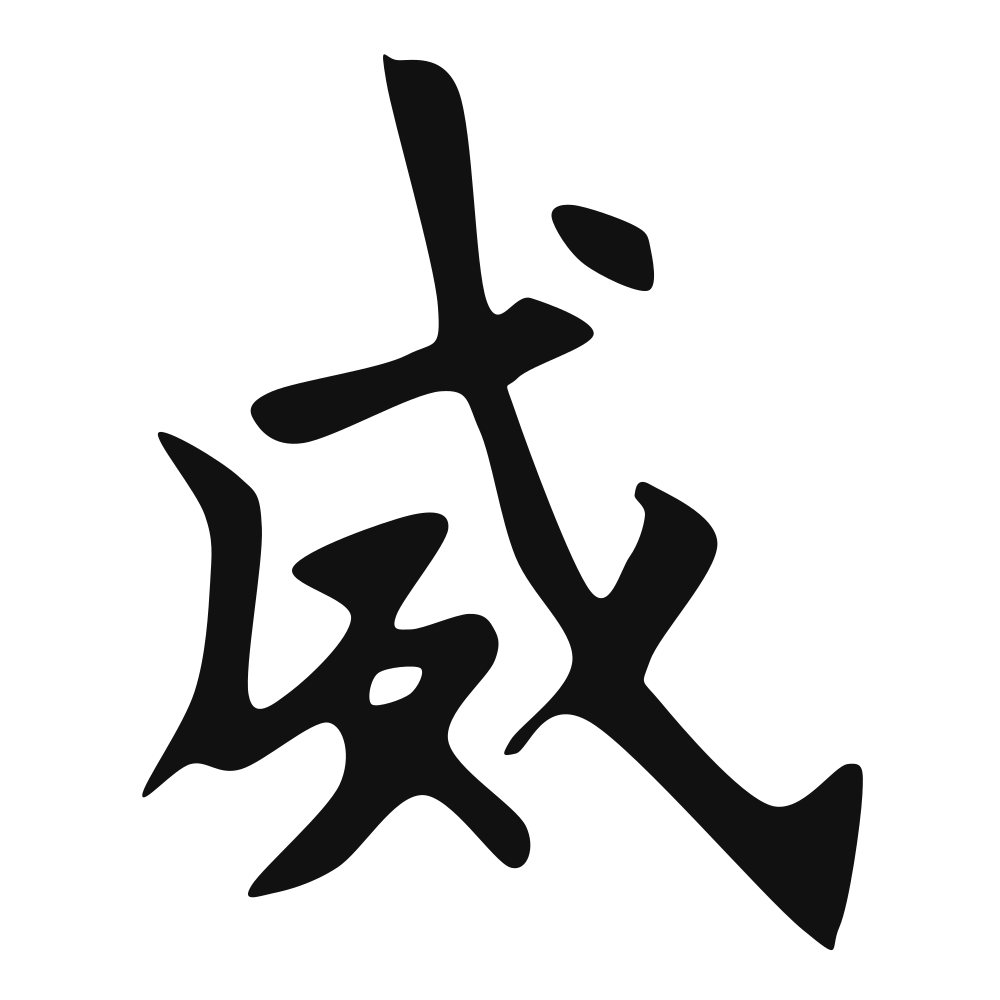
威
power; might; prestige
Closest English meanings
power·might·awe·prestige
The Calligrapher — Ōuyáng Tōng 欧阳通
Tang regular-script master known for powerful, square strokes.
Tang calligrapher (?–691), master of regular script — known for 《道因法师碑》. Tang dynasty
Etymology & Meaning · 字义溯源
2 · The Character: 威 威 (wēi, 1st tone). Shuowen Jiezi startles modern readers: 威,姑也。从女从戌。漢律曰:婦告威姑 — 'the husband's mother; from 女 and 戌 (a halberd). The Han code says: a wife accuses her wēi-gū.' The awe-inspiring sense we now take as primary was the extension: authority felt in the household before it was named in the state. The Yijing places it exactly: 《易·家人》上九 '有孚威如,終吉' — hold sincerity, and be awe-inspiring: in the end, fortune. Confucius makes it a by-product of weight, not volume: 《論語·學而》 '君子不重則不威' — a gentleman who is not grave commands no awe. The Shijing keeps its religious edge: 《詩·周頌·我將》 '畏天之威'. 威 is a free morpheme (威嚴, 威望, 權威). Honest disclosure: it also generates 威脅 (to threaten), 威逼 (to coerce), and 淫威 (abusive power) — the same character covers earned dignity and applied force.
Cultural Story
In the classical tradition 威 joined "woman" and a halberd, suggesting awe that commands without noise. The 論語 advises, "君子不重则不威" — the gentleman who is not grave lacks authority. 威 was the dignified power of rulers and rites, feared and respected, the quiet force that held order together.
Where a Western reader can stand: Where a Western reader can stand: 'awe, dignity' — gravity that commands without volume, in the sharpened Ou-family regular script of Ouyang Tong. Honest caveat: the same character heads 威胁 (to threaten) and 淫威 (abusive power) — pair it (威望, 威严).
Common words & phrases
- 威严 majestic · dignified · awe-inspiring
- 威力 power · might · force
- 威信 prestige · authority · credibility
- 权威 authority · authoritative · power
- 威胁 threaten · menace · intimidate
- 示威 demonstrate · protest · show strength
Read the story behind the character
In the modern world 威 is power in many registers. A boss's 威严 fills a meeting room; a storm's 威力 knocks out the power. We trust a leader's 威信, defer to 权威 in a field, and read of a nation 威胁 its neighbor. Citizens 示威 in the square to show collective strength — the old awe rendered as public force.
Why this character belongs on skin
Before a king or a storm, the body knows 威 before the mind does—a stillness, a hush, the hair rising. The character joins 女 and 戌, an axe at dusk, the awe that comes not from noise but from quiet, terrible composure. Confucian lords cultivated 威仪, a dignity that needed no shout. Real power, the ancients knew, is the room going silent when you enter it. To bear this mark is to refuse the loud and claim the formidable, the man whose presence is its own argument. Let it be ink across your chest, a permanent assertion that you have chosen restraint as your weapon. The West mistakes volume for strength; this character corrects the record. Wear 威 and you carry an old, armored grace—the kind that does not need to prove anything, because the proof is already standing in the room.
Own this character
Purchase delivers the original SVG of this glyph, brushed by Ōuyáng Tōng 欧阳通, ready to place on skin, paper, or screen.