
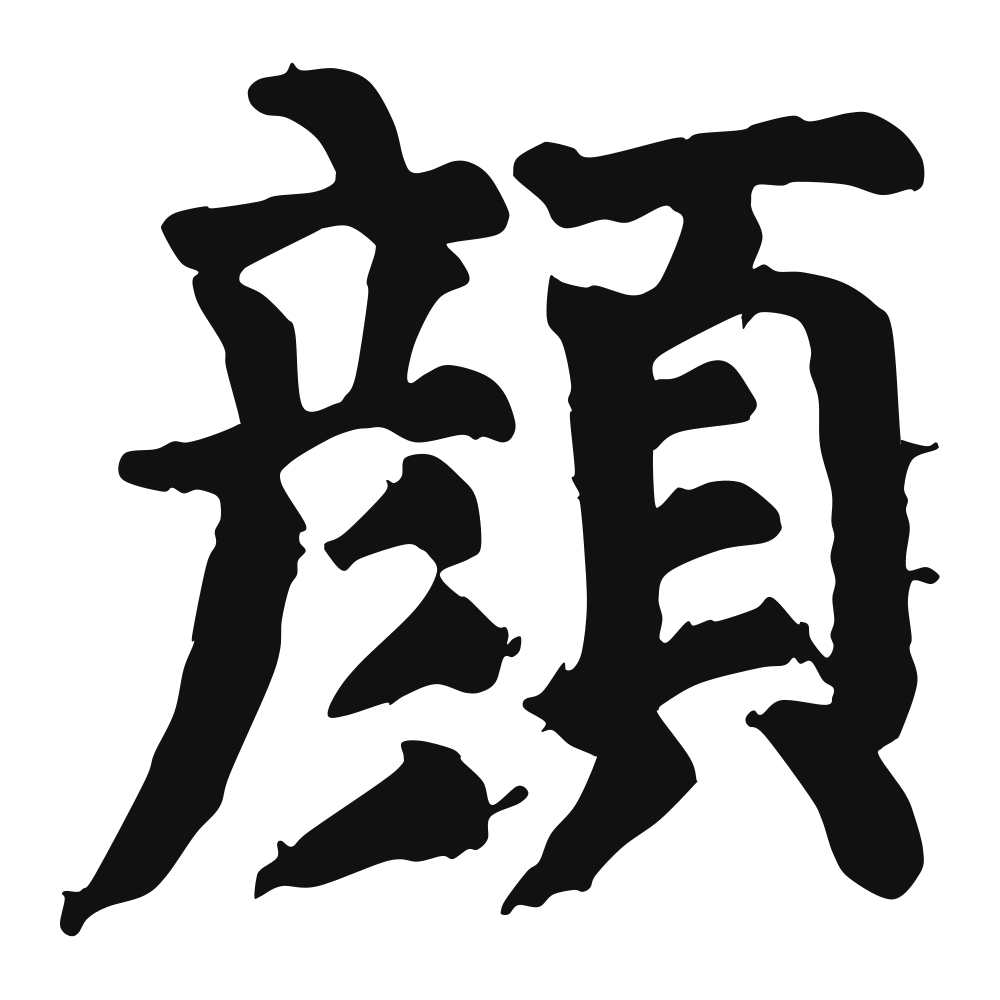
颜
surname Yan; color; face; countenance
Closest English meanings
face·color·dignity·appearance
The Calligrapher — Ōuyáng Tōng 欧阳通
Tang regular-script master known for powerful, square strokes.
Tang calligrapher (?–691), master of regular script — known for 《道因法师碑》. Tang dynasty
Cultural Story
颜 builds on 頁 'head' with 彥 as sound, meaning the forehead and, by extension, the face and its color. 《說文》新附 gives 顏 as 'between the brows.' A face shows feeling; its color betrays shame or joy, and 颜 came to mean one's dignity.
Common words & phrases
- 颜色 color · hue
- 颜面 face · dignity · prestige
- 容颜 appearance · facial looks
- 笑颜 smiling face · smile
Read the story behind the character
颜 is face, color, and dignity: 颜色 a color or hue, 颜面 one's face and self-respect, 容颜 a person's looks, 笑颜 a smiling face. To lose 颜面 is to lose face; a grandparent's 笑颜 at dinner is the room's warm center.
Why this character belongs on skin
Yan Hui was Confucius's favorite student—poor enough to live in a dirt lane, radiant enough that the master mourned him like a son. His name holds this character: 颜, the face, the countenance, the color that rises in a cheek. It is what the world reads first and cannot fake for long: the flush of shame, the pallor of fear, the glow that no cosmetics reproduce because it comes from a life honestly led. The phrase 颜面—face, dignity—reminds us the ancients understood reputation as something worn on the skin. But 颜 is also simply color: the hue of a sunrise, the tint a lover's voice brings to your face across a crowded room. Wear this and wear it as a question that answers itself daily: what does your face say, and is it true?
Own this character
Purchase delivers the original SVG of this glyph, brushed by Ōuyáng Tōng 欧阳通, ready to place on skin, paper, or screen.