
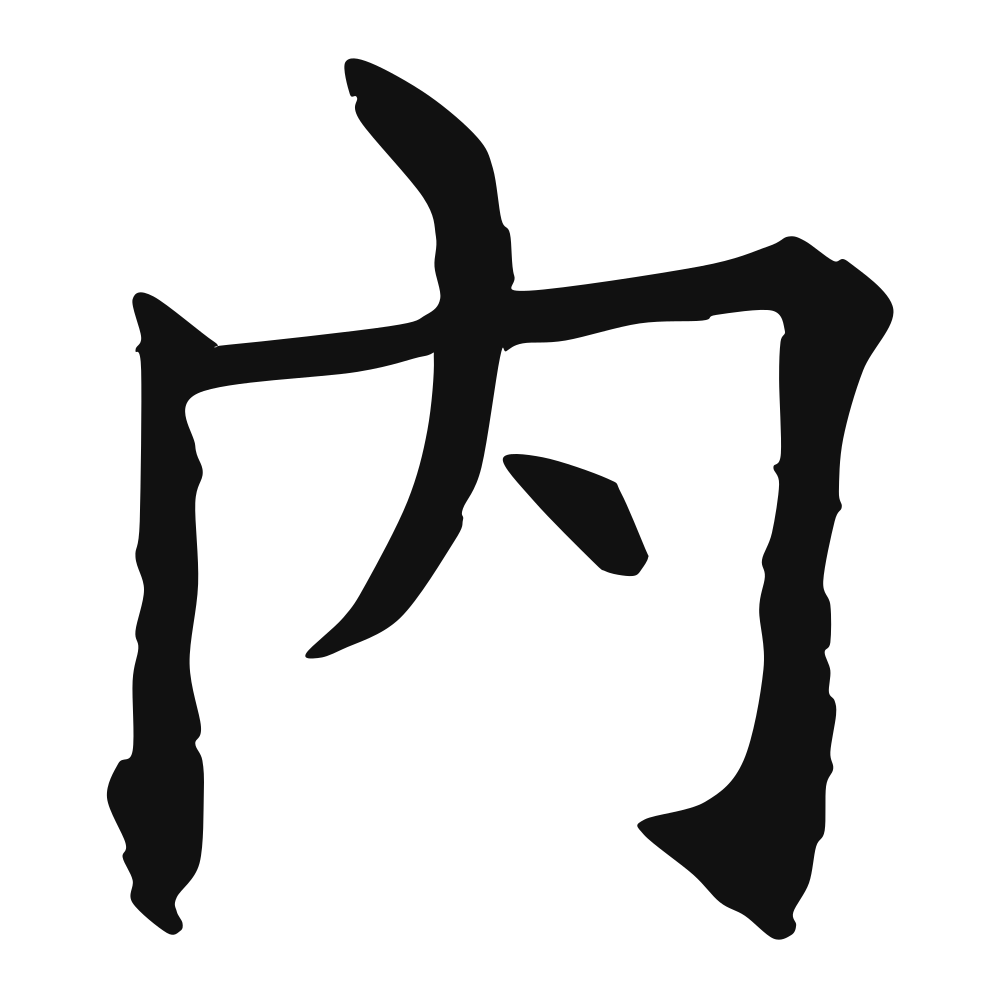
內
inside; inner; internal; within; interior
Closest English meanings
inside·inner·internal
The Calligrapher — Ōuyáng Xún 欧阳询
Tang regular-script master whose 'Ouyang style' is a basic learning model.
Tang calligrapher (557–641), master of regular script/running script — Tang codifier of regular script; crisp, architectural strokes you could measure with a ruler. Tang dynasty
Etymology & Meaning · 字义溯源
### Soundnèi (also nà) — nèi (4th tone); nà when it means 'to take in'. Free-standing morpheme ### Original meaningNèi (4th tone); read nà when it means 'to take in'. The Shuowen Jiezi defines it as 「入也。从冂,自外而入也」 — 'to enter': the covering shape 冂 with 入 entering beneath it, the picture of something passing from outside to inside. That is still the shape of it and still the sense. The line every classical reader reaches for comes from 《易·坤·文言》 — 「君子敬以直內,義以方外」 — 'the noble person reverently straightens what is within, and with rightness squares what is without', the oldest pair in Chinese ethics: inner truth and outer conduct measured against each other. The Kangxi shows how far the word travelled once inside: 內 = the inner room (「房室曰內」), the palace precinct (「天子宮禁曰內」, with the Tang's three palace precincts named after it), the treasury official 《周禮》 calls 職內, and finally the organs and the wife: 「五內,五中也」 (the five interiors — heart, liver, spleen, lungs, kidneys) and 「妻妾」. The sobering note is that the Scripture itself uses the same graph to mean 'receiving': read nà, it is the old form of 納 — 「《孟子》:若己推而內之溝中」 ('as though one had pushed him into the ditch oneself'). So 內 means interiority and also the act of admitting something. ### The structure (會意 · 从冂从入 — the covering (冂) with 入 entering beneath: the picture of something passing from outside to inside)①冂jiōngcovering / borderthe roof over what is hidden②入rùto enterthe thing coming in under the cover③內nèiinsidethe Shuowen headword: 入也,自外而入也④外wàioutsidethe other half — 內 and 外 are read together in every classical sentence ### In use todayItemReading / meaningNoteReadingnèi (4th tone); nànà = the old form of 納, 'to receive'Core senseinside; the inner lifeShuowen root is 'to enter'Grammarfree morpheme (noun / locative)內心 · 內省 · 內在 · 內部 · 內人Tattoo fityes-standalone — clean and classicalpair with 外 if you want the full sentence ### Closest words in English — and what each misses - Peace / Calm — 靜/安 hold quietness; 內 is location — the peace in 《文言》 comes from how the two halves are worked - Soul — 魂/靈 hold the soul; 內 is the inside of anything, a room as much as a mind - Home — 家 holds home and family; 內 held the inner room and the palace precinct, neither freely chosen - Secret — 密/隱 hold concealment; 內 is simply what lies within, hidden or notAn honest note on grammar. Free morpheme — 內 stands alone as 'inside' and heads 內部, 內心, 內省, 內在; read nà it is the archaic form of 納 (to receive, to admit, to pay in).Where a Western reader can stand: 內 (nèi) means 'inside' — the interior, the inner life, historically
Cultural Story
The form sets a person inside a boundary, 內, what lies within the wall. The Rites of Zhou split the realm into 內 and 外, court and frontier. A letter marked 內容 was read only by the household. The histories speak of 內政, the affairs kept from envoys — who married whom, who inherited what.
Where a Western reader can stand: 內 (nèi) means 'inside' — the interior, the inner life, historically also the inner rooms and the palace precinct. The Shuowen describes the picture directly: something passing from outside to within. Its great sentence is from the Yijing: with reverence, straighten what is within; with rightness, square what is without. That pairing is the honest way to wear it: 內 is not calm by itself but the half that must be worked. Read another way (nà) it is the old form of 納, 'to take in'. Clean, classical, safe to stand alone.
Common words & phrases
- 內部 interior · inside
- 內心 inner heart
- 內容 content
- 國內 domestic · internal
- 內政 internal affairs
Read the story behind the character
A label reads 內容 warning, do not open. The 內心 of a matter stays unspoken at dinner. A reporter covers 國內 news on the front page. The 內部 memo circulates only among staff; 室內 plants line the office window, and no one waters them on time.
Own this character
Purchase delivers the original SVG of this glyph, brushed by Ōuyáng Xún 欧阳询, ready to place on skin, paper, or screen.