
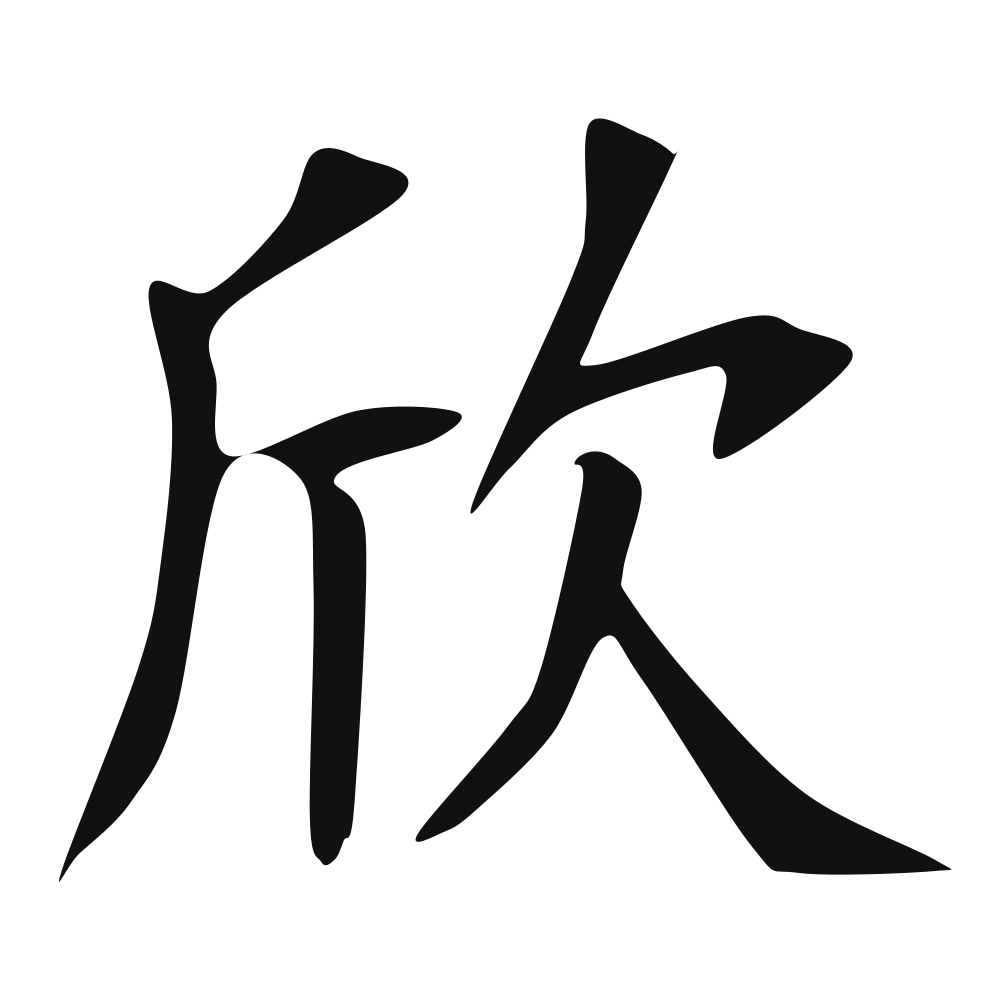
欣
欣 (xīn) — joyful, glad. Heart 斤 + 欠: the heart lifted. Classical life: 欣欣向荣 — thriving and flourishing; 欣 is bright joy. Grammar: free morpheme — also: happy
Closest English meanings
glad·joyful·pleased·appreciate·thriving
The Calligrapher — Ōuyáng Xún 欧阳询
Tang regular-script master whose 'Ouyang style' is a basic learning model.
Tang calligrapher (557–641), master of regular script/running script — Tang codifier of regular script; crisp, architectural strokes you could measure with a ruler. Tang dynasty
Etymology & Meaning · 字义溯源
2 · The Character: 欣 欣 (xīn, 1st tone) is glossed in the Shuowen Jiezi as 「欣,笑喜也。从欠,斤聲」 — 'to laugh with joy', a phonetic compound built on 欠 (an open, exhaling mouth) with 斤 supplying sound. The graph encodes joy as something audibly breathed out, not merely felt inside. Classical usage is warm and un-ironic. The Chuci 《九歌·東皇太一》 sings 「君欣欣兮樂康」 ('the lord is glad, at ease and well'), and Tao Yuanming's 《歸去來兮辭》 gives the most quoted line: 「木欣欣以向榮,泉涓涓而始流」 — 'the trees flourish gladly, the springs begin to trickle'. Wang Xizhi uses it twice in 《蘭亭集序》 — 「欣於所遇」 and 「向之所欣」 — joy pinned to a moment already passing. Grammatically 欣 was a free morpheme in Classical Chinese and is a strong bound morpheme today (欣喜, 歡欣, 欣然); alone it still reads as clear, literate gladness. Honest disclosure: 欣 is extremely common in given names, so Chinese readers may see a person's name before an abstract virtue. There is no funeral or negative reading.
Cultural Story
欣 meant glad and thriving, a joy that looked outward at the world. The Shuowen reads it as a joyful rising, and the poet Tao Qian wrote of 木欣欣以向荣 — trees flourishing lush and green — to capture spring's renewal. To 欣赏 was to savour beauty with a calm heart, and 欣然 was to do something with willing pleasure rather than duty.
Energy Reading
Wood (木)
Comparative symbology, not fortune-telling.
Common words & phrases
- 欣赏 appreciate · enjoy · admire · taste
- 欣喜 glad · joyful · delighted · pleased
- 欣然 joyfully · with pleasure · gladly
- 欢欣 joy · rejoice · delight
- 欣慰 gratified · pleased · relieved
- 欣欣向荣 thriving · flourishing · prosperous
Read the story behind the character
Modern Chinese use 欣 constantly: we 欣赏 appreciate a friend's painting, feel 欣喜 glad at an acceptance letter, and agree 欣然 joyfully to a trip. A parent is 欣慰 gratified seeing a child graduate, a nation speaks of 欢欣 joy at a win, and the phrase 欣欣向荣 thriving describes a booming business. From a quiet smile to a rising market, 欣 names growth gladly met.
Why this character belongs on skin
The guest arrives and the host's face opens like a window thrown wide to spring — this is 欣, gladness, the quiet joy that is relief's gentler cousin. 欣赏 is to appreciate, to take pleasure in another's shape; 欣喜 is the fuller delight. This is not the loud happiness of the festival but the inward light when something good is simply, unexpectedly true. The Dao finds 欣 in the natural order enjoyed without grasping — the blossom seen, not picked. There is a generosity in joy that asks nothing back; the joyful man feeds the room. If you have known the rare calm happiness that needs no occasion, this is your character. Wear 欣 where a smile would touch, near the mouth or the cheek, a permanent warmth in skin. Joy is the rarest ink. Let it mark you as one who noticed the good and let it in. Ink 欣 as the face you choose to turn toward the world.
Own this character
Purchase delivers the original SVG of this glyph, brushed by Ōuyáng Xún 欧阳询, ready to place on skin, paper, or screen.