
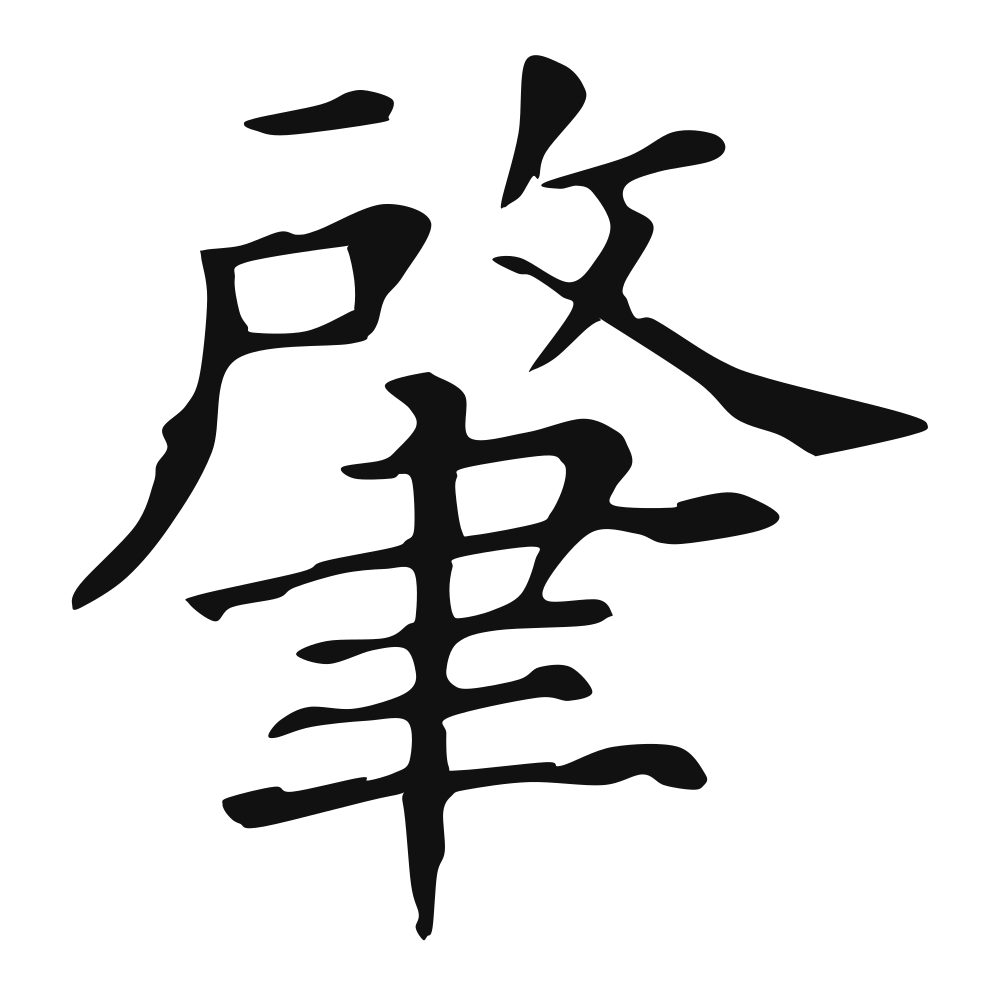
肇
at first; devise; originate
Closest English meanings
begin·initiate·cause
The Calligrapher — Ōuyáng Xún 欧阳询
Tang regular-script master whose 'Ouyang style' is a basic learning model.
Tang calligrapher (557–641), master of regular script/running script — Tang codifier of regular script; crisp, architectural strokes you could measure with a ruler. Tang dynasty
Etymology & Meaning · 字义溯源
### Soundzhào — zhào (4th tone). Free-standing morpheme ### Original meaningZhào (4th tone; traditional 肈/肇, 聿部). The Shuowen Jiezi defines it as 「擊也」 — 'to strike'. It is a 形聲 character built on 攴 (the hand holding a stick — the same element in 政, 效, 敎) with 肇省聲, so the written form itself pictures a hand doing something by force. The Kangxi dictionary opens with that 說文 gloss and then immediately gives the sense everyone actually uses: 《廣韻》「始也」, with 《書·舜典》「肇十有二州」 (Kong's commentary: 肇,始也 — 'he began [by establishing] the twelve provinces') and 《書·仲虺之誥》「肇我邦于有夏」. 《爾雅·釋言》「肇,敏也」 and 《詩·大雅》「肇敏戎公,用錫爾祉」. There is also a ritual reading: in 《詩·大雅》「以歸肇祀」 and 《商頌》「肇域彼四海」 the commentators (鄭箋, 孔疏) say 肇 should be read as 兆 — the altar-site, the marked boundary of the sacrificial field. Honest disclosure: the Shuowen root is 'to strike', the classical sense is 'to begin', and modern Chinese most often pairs it with trouble — 肇事 (to cause an accident), 肇禍 (to bring disaster), 肇端 (to originate, often of something unwelcome). ### The structure (形聲 · 从攴,肇省聲 — the hand with a stick (攴) plus the shortened 肇 as sound; an act done by force)①攴pūto tap / strike (radical)the hand holding a stick — the element of 政, 效, 敎②聿yùthe brush / (phonetic)the sound-bearer; the brush that records what has begun③擊jīto strikethe Shuowen definition — the literal root of the word④兆zhàothe altar-boundarythe ritual reading in the Odes: 肇 read as 兆, the marked site of sacrifice ### In use todayItemReading / meaningNoteReadingzhào (4th tone)single syllable; traditional 肈 also existsCore senseto begin; to found; (root) to strikeclassical 肇始 / 肇造 are dignifiedGrammarformal, mostly bound (modern)肇事 to cause an accident · 肇禍 to bring disaster · 肇端 to originateTattoo fitcaution — classical 'to begin', modern 'to cause trouble'buyers should hear 肇事 before they commit ### Closest words in English — and what each misses - Begin — 始/初 hold plain beginning; 肇 is a beginning made by a blow — founding, not dawning - Omen — 兆 holds the omen and the portent; 肇 is read as 兆 only in specific Odes passages, and its own root is 擊 - Create — 創/造 hold making; 肇 is the first act that makes the rest possible, not the making itself - Accident / Incident — 肇事 is the modern compound for causing an accident; that is the character's modern shadow, not its classical meaningAn honest note on grammar. Free morpheme in classical usage (肇十有二州, 以歸肇祀); in modern Mandarin it is formal and mostly bound — 肇事 (to cause an accident), 肇端 (to originate), 肇始 (to begin); also a surnameWhere a Western reader can stand: 肇 (zhào) means 'to
Cultural Story
Shuowen says 肇 means to strike. But the strike begins things: chronicles use 肇始 to mark the first spark of dynasties, plagues, and fashions, dating a war's outbreak to a single border raid. When blame is needed the same character turns ominous — the肇事 driver, the one who struck first and will not stop.
Where a Western reader can stand: 肇 means 'to begin' in classical Chinese, and its written form shows why: it contains a hand holding a stick, the same part found in words for governing and teaching. The oldest texts use it for founding provinces and dynasties. Be aware that modern Mandarin most often attaches it to accidents and disasters, so the tattoo says 'a beginning' only if the context supports it.
Common words & phrases
- 肇事 cause trouble · make an accident
- 肇始 begin · start
- 肇祸 cause an accident
- 肇庆 Zhaoqing
Read the story behind the character
Traffic news uses it nightly: the 肇事 (cause trouble, make an accident) driver leaves the scene; insurers hunt the 肇祸 (cause an accident) scooter; a bridge-collapse report names a corroded cable as the 肇始 (begin, start) of the failure. Meanwhile a city in Guangdong keeps the bright sense in its name — 肇庆 (Zhaoqing), inaugurating celebration — founded on an emperor's auspicious reign title.
Why this character belongs on skin
Every dynasty kept records that began with this word: 肇—herein starts. The character shows the hand of a door; strike it and things open. It means to begin in the formal, fateful sense—not the small start of a morning but the origin point historians circle in red. Your life has such moments. The letter you almost didn't send. The city you stepped into with one suitcase and no map. 肇 honors them retroactively, the way a grown tree honors the first root that found water. We rarely know we are beginning something; we only know it later, looking back along the grain. So choose the meaning forward: live as if today were the sentence a chronicle someday opens with. Strike the door. Sign the start.
Own this character
Purchase delivers the original SVG of this glyph, brushed by Ōuyáng Xún 欧阳询, ready to place on skin, paper, or screen.