
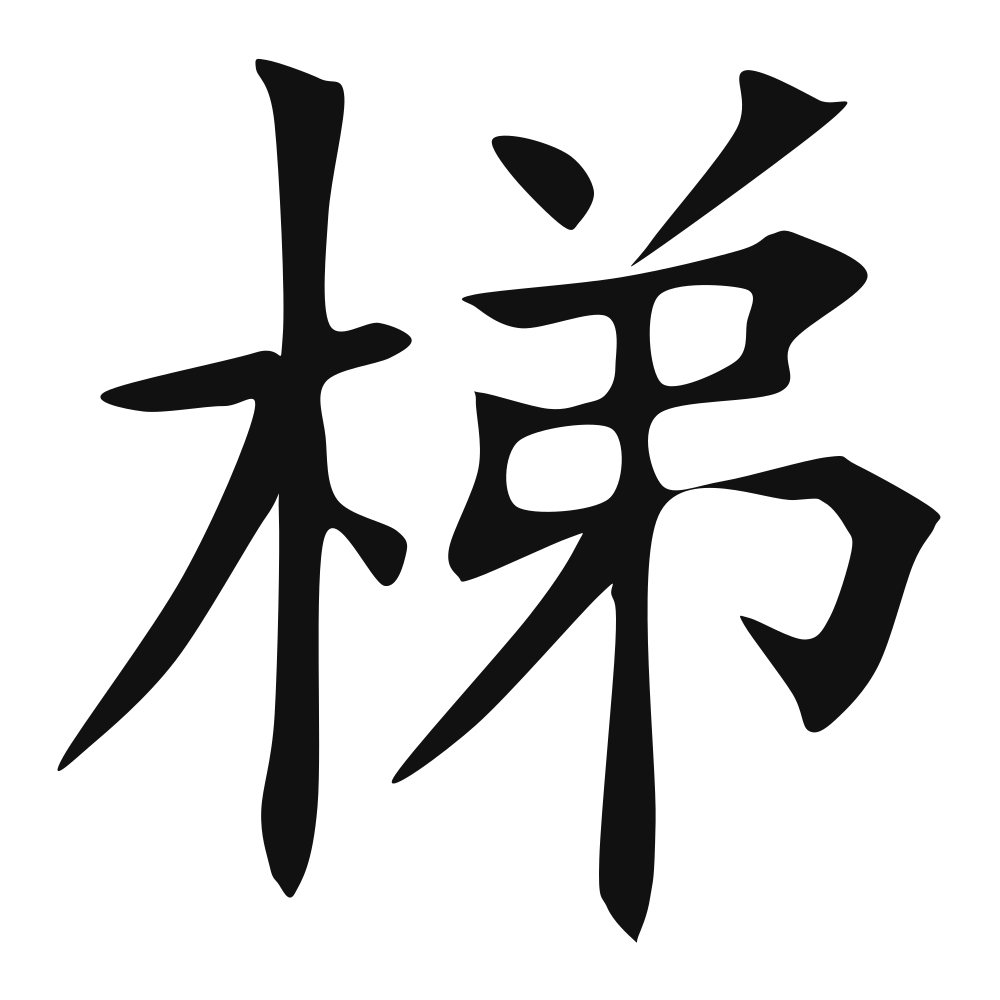
梯
(bound form) ladder; stairs
Closest English meanings
ladder·stairs
The Calligrapher — Péi Xiū 裴休
Tang chancellor and calligrapher; author of the Guifeng Stele in regular script.
Tang calligrapher (), master of regular script — known for 《圭峰碑》. Tang dynasty
Cultural Story
梯 is a ladder of 木, the notched climb to the roof or the wall — and by extension any means of ascent. The character is the stair made portable, the thing you lean against a difficulty to get above it. It is vertical hope, the rungs between here and the high place you mean to reach.
Common words & phrases
- 梯子 ladder
- 楼梯 stairs · staircase
- 电梯 elevator · lift
- 阶梯 steps · staircase
- 梯田 terraced fields
Read the story behind the character
梯 is the climb in many forms: 梯子 the thing a painter sets, 楼梯 the building's spine, 电梯 the box that does the work. 阶梯 is the rung on a career; 梯田 the rice terraces carved into a mountain. The character is ascent literal and social, the ladder you climb or simply ride up in.
Why this character belongs on skin
There is a ladder leaned against the moon in every old story, and the one who climbs it trades the solid earth for a view that cannot be unseen. Tī is the ladder, the stair, the means by which the low reaches the high—not by leap but by patient rung after rung. The Daoist climbed his mountain one step at a time to touch the clouds; the lover climbed his lady's tower the same way. I have felt the particular humility of ascent, the thigh burning, the top still distant, and known that the climb was the point all along. To carry tī is to refuse the myth of the shortcut, to honor effort as its own grace. The ink rises like a spine on the skin, a quiet vertical faith—proof you believe the height is real and the climb is yours, that you would rather arrive slowly than never arrive at all.
Own this character
Purchase delivers the original SVG of this glyph, brushed by Péi Xiū 裴休, ready to place on skin, paper, or screen.