
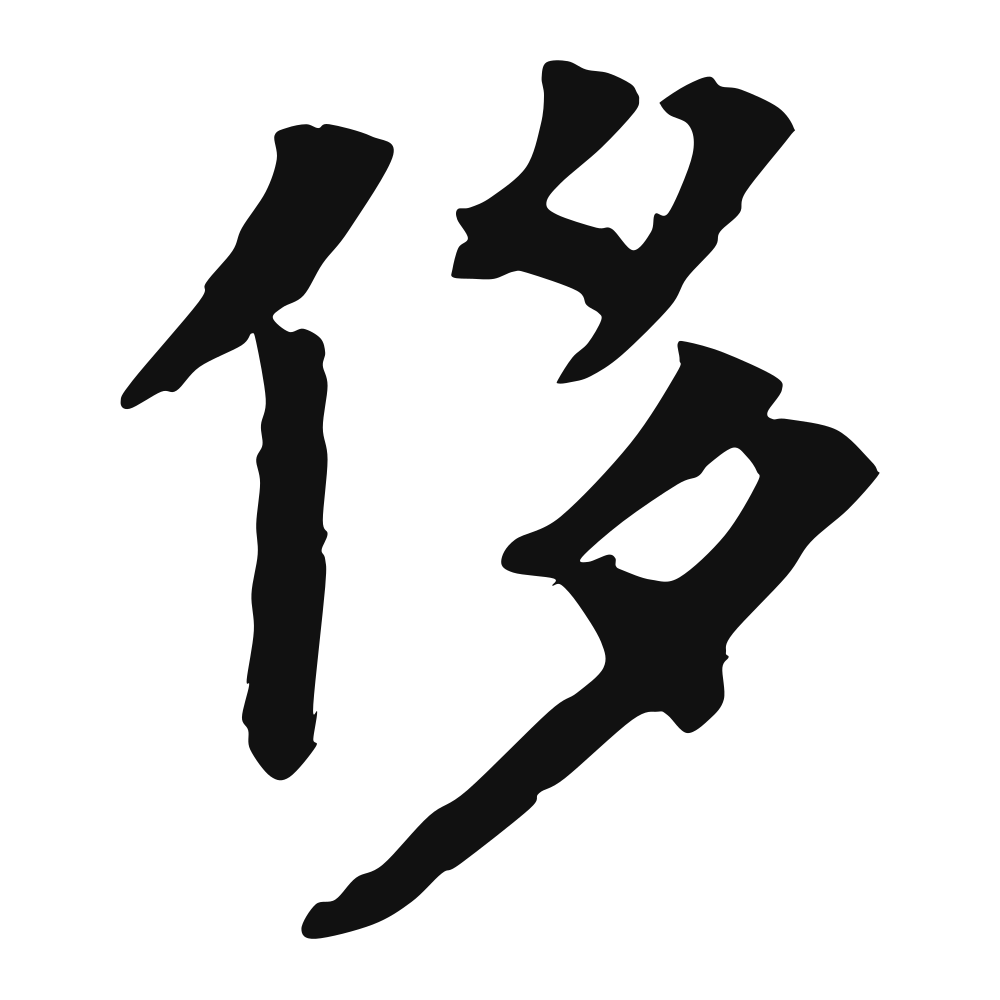
侈
extravagant; wasteful; exaggerating
Closest English meanings
wasteful·extravagant
The Calligrapher — Qú Lìngwèn 瞿令问
Tang seal-script master famed for his suspended-needle seal (xuanzhen).
Tang calligrapher (), master of seal script — known for 《峿台铭》. Tang dynasty
Etymology & Meaning · 字义溯源
2 · The Character: 侈 侈 (chǐ, 3rd tone) means 'extravagant, excessive, wasteful' — the character built from 亻 (person) and 多 (duō, 'many, much'): a person with too much. In classical Chinese it warned against excess (俭侈 the mean between thrift and waste), and it survives in 奢侈 (luxurious, extravagant) and 侈靡 (wasteful display). For a tattoo it is a double-edged mark: read plainly it says 'wasteful'; reclaimed it can mean 'live large,' abundance without apology. Handle with care.
Cultural Story
侈 is excess. The 左传 warns that 奢侈 rots a state; a king's 侈靡 buried bronze he never used. To 侈谈 was to speak big and do little. The 豪侈 feast of a prince is told as caution, not praise. To be 侈 is to spend past the need and past the sense.
Where a Western reader can stand: Where a Western reader can stand: 侈 (chǐ) means 'extravagant, excessive, wasteful' — built from 'person' and 'many/much.' In Chinese it is a cautionary word, the opposite of thrift; some wearers reclaim it as 'live large,' but the native reading is negative. Qu Lingwen was an 8th-century Tang master who carved inscriptions in ancient seal and clerical scripts (the Wutai Ming stele). His 侈 looks carved in stone — monumental, knowing. Wear it only with full awareness of what it says; never as a bland 'abundance' tattoo.
Common words & phrases
- 奢侈 luxurious · wasteful
- 侈靡 extravagant
- 侈谈 talk big · prate
- 豪侈 luxurious · extravagant
Read the story behind the character
A blogger mocks a 奢侈 bag; a meeting 侈谈 a plan with no budget. The 豪侈 suite sits empty while guests book the standard room. Spending past the point — a price tag, a speech, a wasted room — is what this character faults in the present day.
Why this character belongs on skin
He builds the roof wider than the rain requires and calls it glory — this is 侈, extravagance, the excess that spills past need into sheer display. 奢侈 is luxury, but the character itself leans toward the dangerous edge where abundance forgets restraint. The Dao warns that the swollen thing invites its own breaking; the Confucian distrusts the man whose appetite outruns his gratitude. Yet there is also a boldness in 侈, a refusal to apologize for wanting more than survival — the poet who gilds the cup though the wine is plain. If you have ever been accused of too much, this may be your character after all. Wear 侈 where the eye lingers, a mark of the portion of you that will not be trimmed to fit. Excess can be a kind of honesty. Ink it as the part of you that refuses the small life, even at the cost of the spare.
Own this character
Purchase delivers the original SVG of this glyph, brushed by Qú Lìngwèn 瞿令问, ready to place on skin, paper, or screen.