
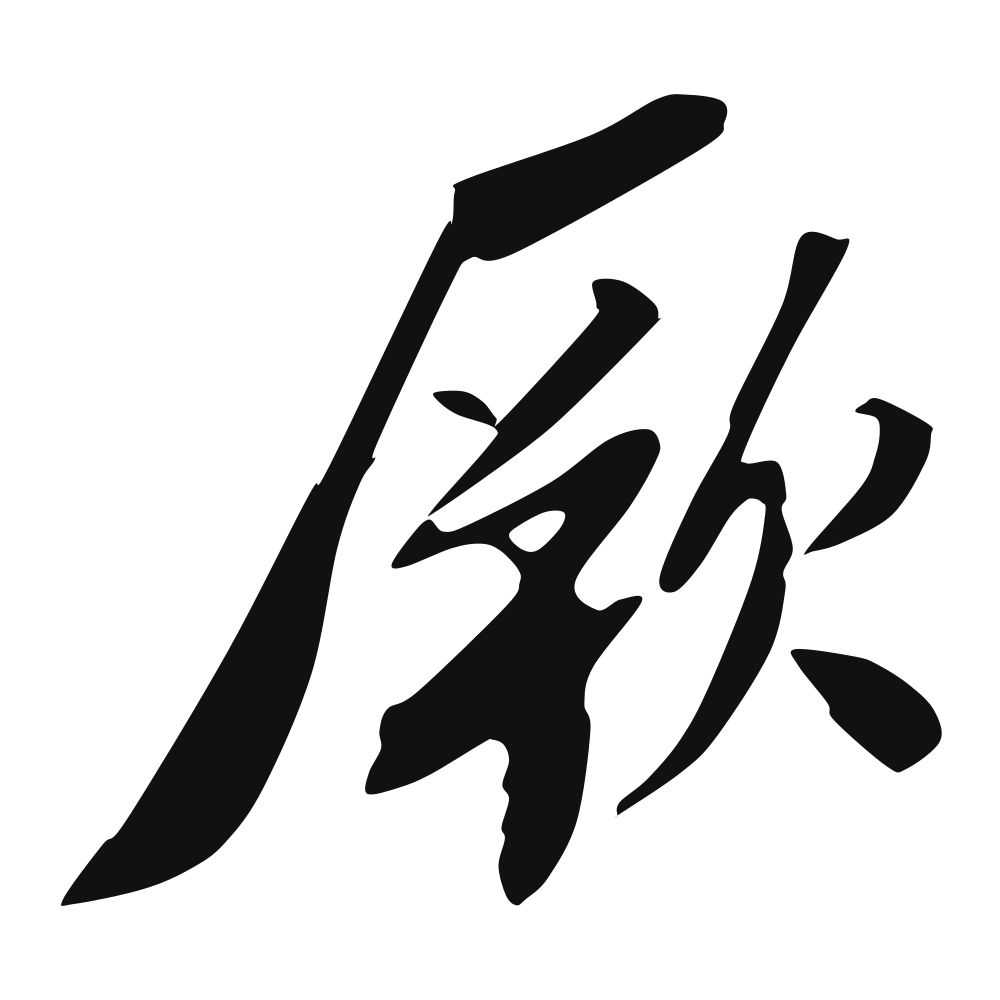
厥
to faint; to lose consciousness; his; her; its; their
Closest English meanings
his·its·to faint·thereafter
The Calligrapher — Sū Shì 苏轼
Song literatus whose spontaneous running script shaped the literati ideal.
Song calligrapher (1037–1101), master of running script/regular script — Song poet-statesman and polymath whose expressive running script made personality, not rules, the point. Song dynasty
Cultural Story
厥 was a classical pronoun meaning "his" or "its". The Documents has it throughout -- "its tribute", "his people". Han Yu later mocked those who "let loose his words" -- 大放厥词. In medicine it named a fainting fit: 痰厥, a loss of sense from phlegm, described in the Inner Canon. The word is old, formal, and oddly alive in both scripture and the clinic.
Common words & phrases
- 惊厥 convulsions · febrile seizure
- 厥后 thereafter · afterwards
- 痰厥 phlegm fainting · syncope
Read the story behind the character
In a pediatric emergency a child is treated for 惊厥, a febrile seizure. An older text uses 厥后 to mean "thereafter". A TCM practitioner names 痰厥 when a patient faints and the pulse is slippery. The word survives in the chart and the footnote more than in talk; it marks a faint in the records and a "his" in the Book of Documents, two lives a millennium apart.
Why this character belongs on skin
The stone catches the toe mid-stride, the world tilts, and for half a heartbeat the body is a kingdom without a ruler—this character is that moment: to stumble, to faint, to fall forward into unknowing. The ancients also used it in bronze inscriptions as a formal pronoun, his, its, the word of kings and ancestors, so that majesty and collapse share one shape. There is no accident in that sharing. Every tradition has a story of the great one brought low—Saul on the road, struck blind; Xiang Yu at the river; the empire that stumbles on its own hem. Falling is the tuition of standing. The Buddhists go further and call it a gift: the faint is a small rehearsal of ego-death, the body demonstrating that consciousness is lent, not owned. So when you go down—and you will—the ink on your skin is a prior instruction. A stumble is a comma, not a period. Get up slowly. Kings have risen from worse.
Own this character
Purchase delivers the original SVG of this glyph, brushed by Sū Shì 苏轼, ready to place on skin, paper, or screen.