
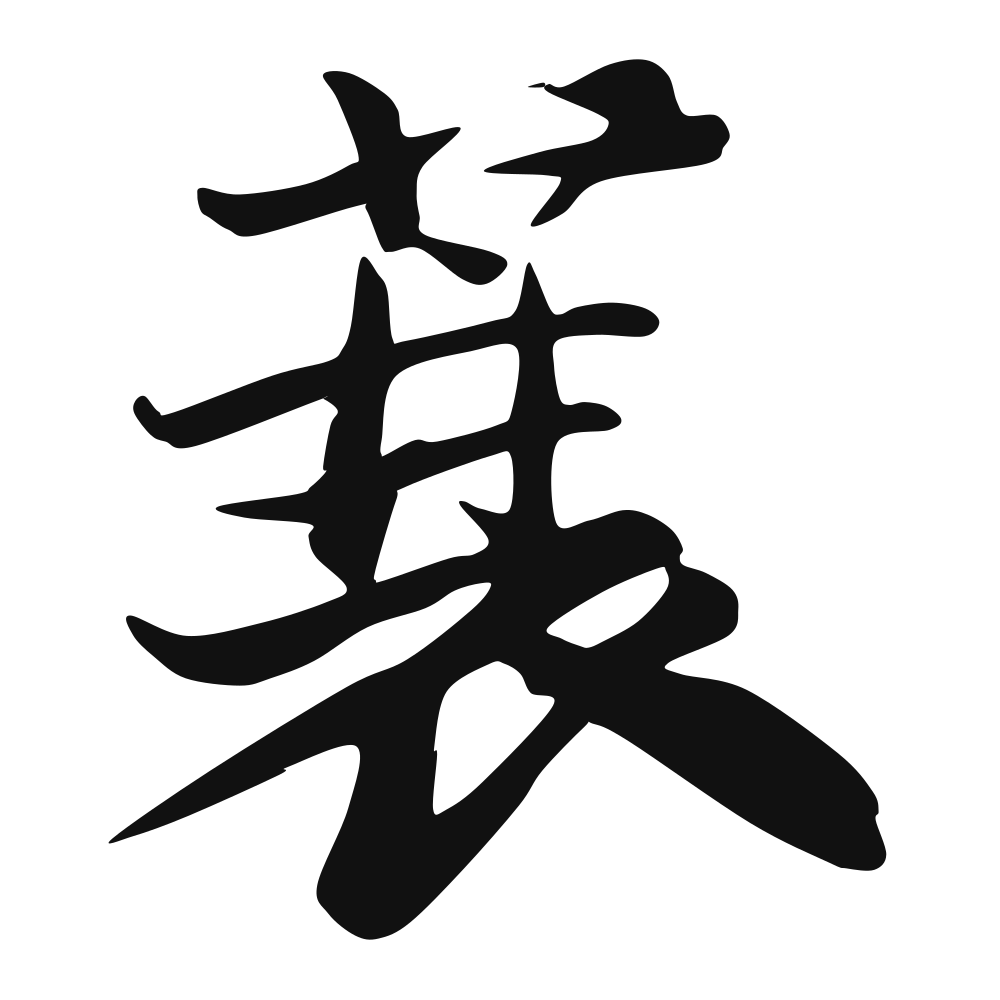
蓑
rain coat made of straw etc
Closest English meanings
straw raincoat
The Calligrapher — Sū Shì 苏轼
Song literatus whose spontaneous running script shaped the literati ideal.
Song calligrapher (1037–1101), master of running script/regular script — Song poet-statesman and polymath whose expressive running script made personality, not rules, the point. Song dynasty
Cultural Story
蓑 is the straw raincoat, woven from grass or palm bark, that kept farmers and fishermen dry for millennia. With its companion bamboo hat it forms 蓑笠, cape and hat — the classic silhouette of the lone angler. Liu Zongyuan's immortal snow poem fixes it forever: a single boat, an old man in 蓑笠 fishing alone in the cold river snow, all the world buried in white. Later poets made the 蓑衣 the uniform of the free fisherman-recluse who owed nothing to office.
Common words & phrases
- 蓑衣 straw raincoat
- 蓑笠 straw cape and hat
Read the story behind the character
蓑 now hangs in memory and museums. A fisherman sculpture in a lakeside park wears a straw 蓑衣, raincoat, unchanged in a thousand years; an opera stage dresses a hermit in 蓑笠, cape and hat, for the snow scene. A craftsman on a heritage livestream weaves a 蓑衣 from palm bark and sells out his stock. Tourists in the rain buy plastic ponchos printed with the old straw cape, wearing the poem without knowing it.
Why this character belongs on skin
There is a famous Tang painting: an old fisherman alone on a cold river, straw cloak dusted with snow, fishing in a patience that outlasts the weather. Suō is that cloak—woven grass, the humblest armor ever devised, and the uniform of every recluse who chose the rain over the court. The poets kept returning to it. To wear suō was to be beyond ambition's reach, to let the storm land on you and pass through, unbothered as water off straw. The Stoics would have understood instantly; so would any monk. But there is sensuality in it too—the weight of wet grass on shoulders, the smell of rain on dried fields, the intimacy of being weathered rather than protected. Suō is not a vow of misery. It's a declaration that you can stand in what falls and remain soft inside it. Some ink is a wish. This is a posture, worn on the shoulder where the cloak would sit.
Own this character
Purchase delivers the original SVG of this glyph, brushed by Sū Shì 苏轼, ready to place on skin, paper, or screen.