
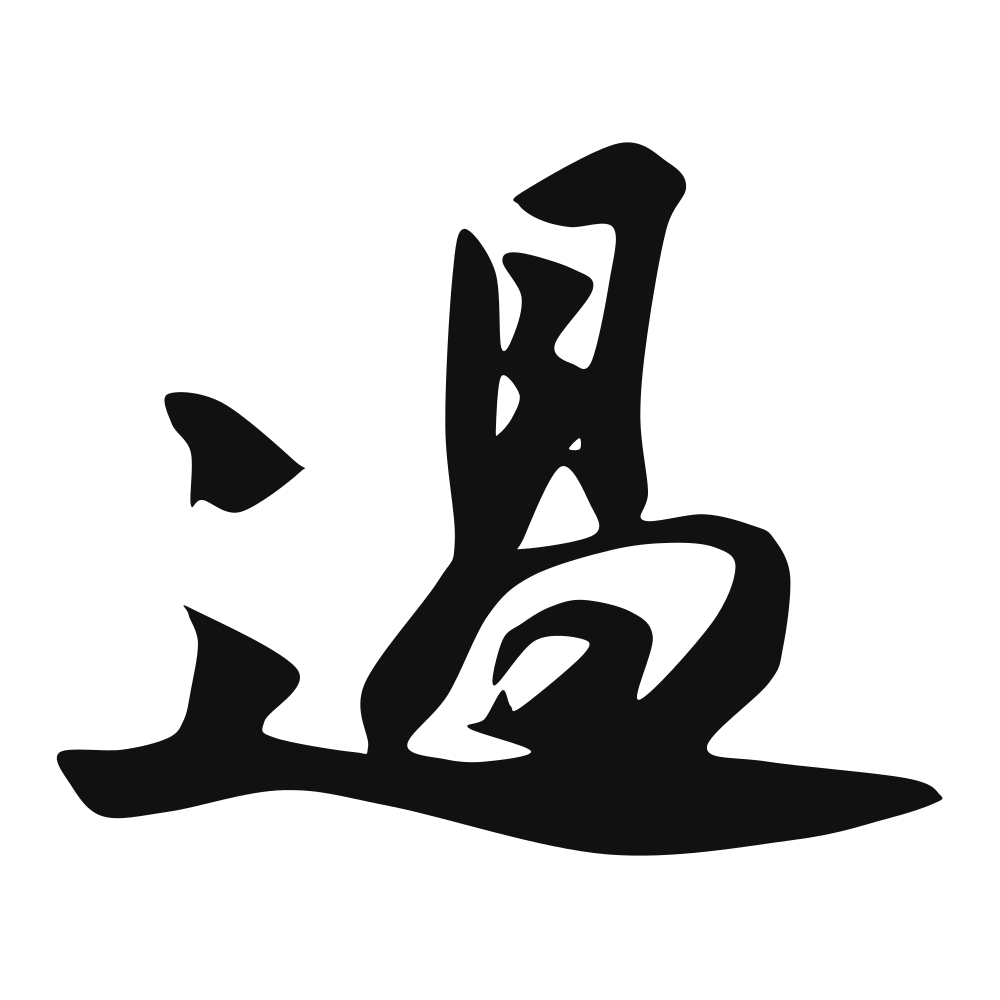
过
surname Guo; to cross; to go over; to pass (time); to celebrate (a holiday); to live; to get along; excessively; too-; (experienced action marker)
Closest English meanings
pass·cross·too
The Calligrapher — Sū Shì 苏轼
Song literatus whose spontaneous running script shaped the literati ideal.
Song calligrapher (1037–1101), master of running script/regular script — Song poet-statesman and polymath whose expressive running script made personality, not rules, the point. Song dynasty
Etymology & Meaning · 字义溯源
2 · The Character: 过 过 (過, guò) is 辵 (walking) with 咼 as phonetic. The Shuowen Jiezi (《说文解字》 辵部) glosses it '過,度也' — to pass over, to cross. Two branches grow from that single act. One is spatial and temporal: to pass by, to pass through, 过江, 过年, 过客. The other is moral, because whatever oversteps the measure is a fault. The Analects (《论语·学而》) commands '过则勿惮改' — having erred, do not shrink from correcting it — and 《论语·卫灵公》 sharpens it: '过而不改,是谓过矣', the real fault is the uncorrected one. The Zuo Zhuan (《左传·宣公二年》) gives the most quoted line in the language on failure: '人谁无过?过而能改,善莫大焉'. 过 is a free morpheme. Honest disclosure: standing alone, a modern Chinese eye reads 过 first as 过错/过失, a fault, and 过世/过身 is an ordinary euphemism for dying. It is a superb second character (跨过, 过人, 改过, 过尽千帆) and a risky solo one.
Cultural Story
Confucius answers a disciple who asks whether outdoing beats falling short: 'To go too far is as bad as not to reach' — 过犹不及, in the Analects. The character 过 is to pass, to cross, to exceed the mark. 过去 is what has gone by; 通过 the way through; 过程 the course a thing runs. The word warns that the right place is often just before the line, not past it and gone.
Common words & phrases
- 过去 past · formerly
- 通过 pass · through
- 经过 pass by · via
- 过程 process
- 过来 come over · come up
- 过度 excessive · over-
Read the story behind the character
A commuter 通过 the gate and watches the 过去 week on a calendar; a project's 过程 is logged step by step, and a manager warns against 过度 work that breaks the team. To 经过 a town is to pass it; to go 过来 is to make it across the bridge at last. The character that taught balance now times the shift, the deadline, and the caution — the crossing that is only right when it stops short of too much at the end.
Why this character belongs on skin
Nothing stays on this side forever. 过 is to pass — a foot stepping over a threshold, the crossing of a river, the moment that becomes memory. It means to exceed, to go too far, and simply to be past. The Buddhists count each thought as it arises and passes, and call that freedom; the traveler knows the only true home is the road behind. To wear 过 is to make peace with movement itself, to stop clutching the bank. It is the mark of someone who has crossed something — a grief, a border, a year that tried to kill them — and kept walking. On the skin it is a quiet reassurance: this too will pass, and you with it. Let it sit where the body bends, a small doorway worn into the flesh, always open, always forward.
Own this character
Purchase delivers the original SVG of this glyph, brushed by Sū Shì 苏轼, ready to place on skin, paper, or screen.