
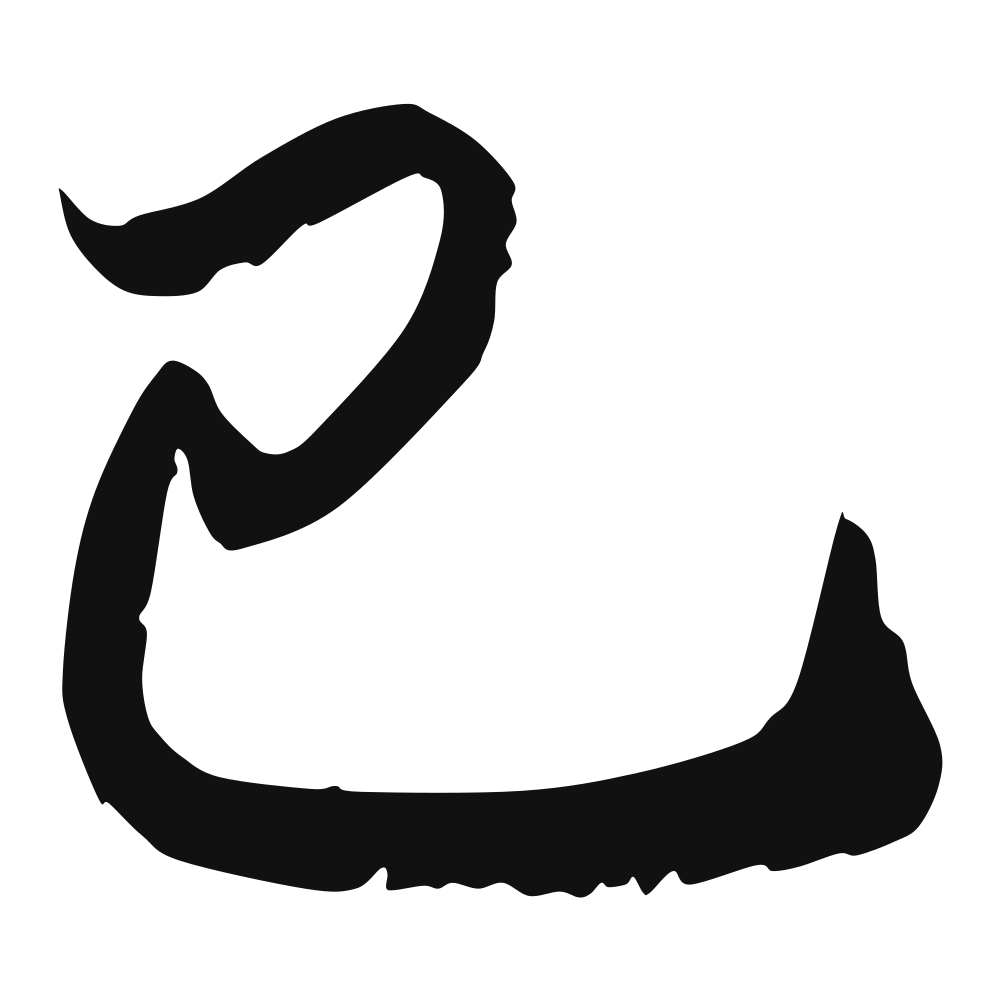
己
self; oneself; sixth of the ten Heavenly Stems 十天干[shi2 tian1 gan1]; sixth in order; letter "F" or Roman "VI" in list "A, B, C", or "I, II, III" etc; hexa
Closest English meanings
self·oneself·one's own
The Calligrapher — Sūn Guòtíng 孙过庭
Tang cursive master and author of the key treatise 'Shu Pu'.
Tang calligrapher (约646–691), master of cursive script — known for 《书谱》. Tang dynasty
Etymology & Meaning · 字义溯源
2 · The Character: 己 Jǐ (3rd tone). The Shuowen Jiezi places 己 at the centre of the cosmos: 「己,中宫也。象万物辟藏诎形也。己承戊,象人腹」 — 'the central palace; it pictures the myriad things folded away in storage; 己 follows 戊, and resembles a human belly.' As the sixth of the ten Heavenly Stems, 己 is Yin Earth, the centre — this is not a naming-table guess but the Shuowen's own words. Borrowed for the reflexive pronoun, it became one of the most-used characters in Confucian ethics. 《论语·颜渊》 「克己复礼为仁」 — 'to master the self and return to ritual is benevolence.' 《论语·卫灵公》 「己所不欲,勿施于人」 — 'do not impose on others what you do not want yourself.' 《论语·宪问》 「古之学者为己」 — 'the ancients studied for their own sake.' Disclosure, and it matters for tattoos: 己 is one stroke away from 已 (already) and 巳 (the sixth branch, the snake). A sloppy line changes the word. Element: Earth (土).
Cultural Story
Ji is the self, one's own person, the Shuo Wen picturing a coiled thread and glossing it oneself. The Lun Yu urges the gentleman to examine ji (himself) thrice a day, and zhi ji (bosom friend) is the rare one who truly knows you. Li ji (self-interest) warns of selfishness, while yi ji (dissenting) names those the court purged. The character is the center each person must govern.
Where a Western reader can stand: Where a Western reader can stand: 'self' — the Confucian discipline, 克己复礼, and the golden rule stated as a negative, 己所不欲勿施于人; Sun Guoting applied it to his own brush. Honest caveat: the one-stroke trap — insist on a clean glyph.
Common words & phrases
- 自己 oneself · self · one's own
- 知己 bosom friend · confidant
- 己见 one's own opinion
- 利己 self-interest · egoistic
- 异己 dissenting · those who disagree
Read the story behind the character
You remind yourself to be kind to zi ji (oneself, self) after a hard day, and a zhi ji (bosom friend, confidant) texts just when you need it. A debate respects ji jian (one's own opinion) but listens too, and a critic warns against pure li ji (self-interest). History class reads of yi ji (dissenting) voices silenced, and you journal know your ji nightly.
Why this character belongs on skin
己 is the self you answer to when no one is watching — the one who knows the truth before you've found the language for it. Confucius taught 克己, master yourself, but the deeper gift is gentler: to be kind to 己, the self that survived the awkward years, the wrong names, the rooms where you shrank. You owe yourself that tenderness. The world will hand you a thousand scripts — be smaller, be quieter, be easier to love — and 己 is the part that quietly declines. Chosen family, your person, the people who see you: they love this self, not the performance. Carry 己 close, a small vow that you are the one you finally came home to. The ink is just the proof you arrived.
Own this character
Purchase delivers the original SVG of this glyph, brushed by Sūn Guòtíng 孙过庭, ready to place on skin, paper, or screen.