
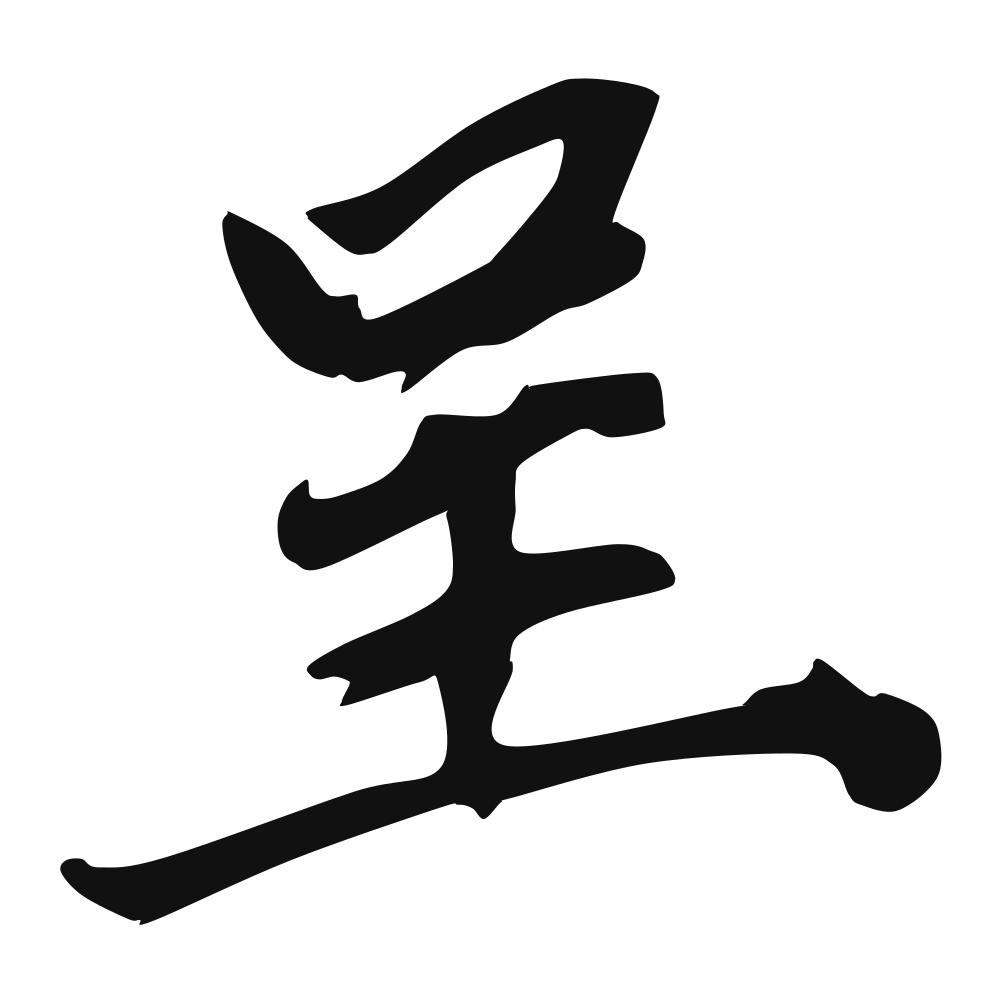
呈
to present to a superior; memorial; petition; to present (a certain appearance); to assume (a shape); to be (a certain color)
Closest English meanings
present·show·submit·display·offer
The Calligrapher — Táng Yín 唐寅
Ming 'Talented' painter-calligrapher of elegant running script.
Ming calligrapher (1470–1524), master of running script — known for 《落花诗册》. Ming dynasty
Etymology & Meaning · 字义溯源
2 · The Character: 呈 Chéng (2nd tone). 《说文·口部》: 「呈,平也。从口,壬声。」 — the root sense is levelness, evenness. 《玉篇》 then records the usage that took over: 「呈,示也」 — to show, to make manifest. Cao Zhi's 《洛神赋》 uses it at its most beautiful: 「延颈秀项,皓质呈露」 — 'her neck lifted, her fair flesh disclosed.' From 'to show' grew the administrative sense of showing something upward: 呈报, 呈请, 呈文 — to submit a document to a superior. The auspicious set-phrase 龙凤呈祥 ('dragon and phoenix present good fortune') keeps the older, warmer usage alive on wedding goods. Honest disclosure: the office sense now dominates. Standing alone, 呈 reads to a modern Chinese eye like a truncated official verb — 'to submit to…' — still waiting for its object. Its risk is incompleteness rather than offence; pair it with 祥, 现 or 露.
Cultural Story
呈 shows 口 (to speak) beneath 王 (jade/king, a phonetic), to present or submit respectfully. In imperial times officials 呈报 (reported/submitted) to the throne and 呈献 (offered/proffered) tribute and poems. A scholar would 呈 his writing to a patron. The character carries the bowed posture of offering—something laid before a higher authority with both hands and good words, the ritual of respectful presentation in old China's courts.
Where a Western reader can stand: Make it level, then let it show: 呈 is the wedding idiom 龙凤呈祥 (dragon and phoenix presenting fortune) and the poet's 皓质呈露 — but in modern Chinese it is mostly bureaucratic paperwork. Western readers should wear the pair, never the bare form-word.
Common words & phrases
- 呈现 present · appear · show · emerge
- 呈报 report · submit · inform · notify
- 呈献 offer · present · dedicate · proffer
- 呈请 submit · request · petition · ask
- 辞呈 resignation · letter · notice · quit
Read the story behind the character
An employee files a 辞呈 (resignation letter) and 呈请 (submits a request) for leave; a report must 呈报 (be reported/submitted) to headquarters. A gift is 呈献 (offered/dedicated) at a ceremony, and data 呈现 (presents/emerges) a clear trend on screen. The character keeps its courtly courtesy in offices and forms—the act of laying something before others, from quitting a job to unveiling a result to bosses.
Why this character belongs on skin
The character 呈 means to present, to submit, to lay something before another's eyes — a petition offered to a lord, a performance offered to the world. It is the word for what becomes visible, what takes shape and steps forward. To wear 呈 is to promise yourself you will show up. So many of us hide the work, the feeling, the true face, waiting for a permission that never comes. The mark is the refusal of that hiding. It says: here, I present this — my art, my body, my bruised and honest self — without apology and without the question of whether it was wanted first. There is a quiet courage in offering, in the open hand that does not clinch into a fist. Ink it where you most want to be seen, the chest or the forearm you extend in greeting, and let it hold the resolve to keep offering the world what only you can give, even when the room is silent, even when the only witness is the mirror.
Own this character
Purchase delivers the original SVG of this glyph, brushed by Táng Yín 唐寅, ready to place on skin, paper, or screen.