
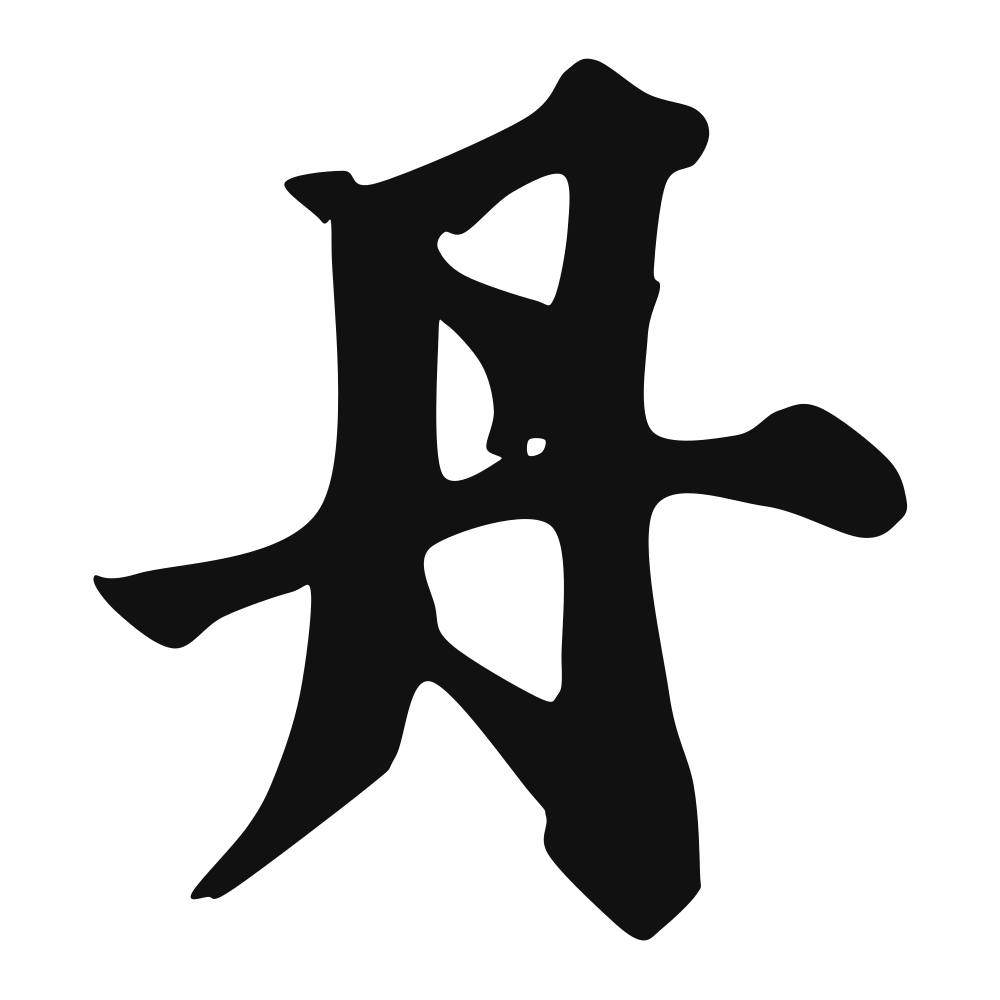
丹
red; pellet; powder; cinnabar
Closest English meanings
cinnabar·red·vermilion
The Calligrapher — Wáng Wénzhì 王文治
Qing running-script master known as 'light-ink tanhua', paired with the 'heavy-ink' Liu Yong.
Qing calligrapher (), master of running script — known for 淡墨探花. Qing dynasty
Etymology & Meaning · 字义溯源
2 · The Character: 丹 丹 (dān, 1st tone) is, in Xu Shen, mineral and colour at once: 巴越之赤石也。象采丹井,一象丹形 — 'the red stone of Ba and Yue; the form shows a cinnabar well, and the one stroke is the cinnabar.' It is vermilion, the sacred red of elixirs and imperial seals. The classics redden with it: the Shujing (禹贡) taxes '丹' from the hills; the Shijing (秦风·终南) praises '顏如渥丹' (a face like steeped cinnabar); the Zhouli (考工记) and Xunzi (正论) use 丹 for lacquer and sincerity. As a free morpheme 丹 means 'cinnabar, red, sincere,' and is wholly auspicious — 丹心, 丹青, 一片丹心. Honest disclosure: 丹 is a pigment and a metaphor for the loyal heart; on skin it is a balanced, attractive character and reads cleanly. Pair it with 心 or 青 if you want the 'loyal heart / painting' senses explicit; in Japanese it is ni. The Wuxing attribution is confident: 丹 is Fire (火), the colour of flame and the south.
Cultural Story
丹 is cinnabar, the red ore ground for the emperor's seals and the alchemist's dream of immortality. 丹心, a heart of cinnabar red, is the loyalist's vow, Wen Tianxiang's line dying unbroken. Daoist 丹药 promised endless life from a furnace in the hills. The 說文 calls it the color of the southern fire. Red was truth because it did not fade.
Where a Western reader can stand: Where a Western reader can stand: 丹 means 'cinnabar, vermilion red, sincere' — the sacred red of elixirs and a loyal heart (丹心) — and Wang Wenzhi's airy, pale 'light-ink' running script gives it an ethereal, faint glow. Honest caveat: 丹 is cinnabar red specifically, not just any red, and 丹药 means an alchemical elixir, not a common pill; the pale script may soften its usual fire.
Common words & phrases
- 牡丹 tree peony · peony
- 丹心 loyal heart · patriotism
- 丹药 elixir · pill of immortality
- 丹田 dantian (energy center)
- 灵丹 magic pill · wonder drug
Read the story behind the character
牡丹 is the peony whose blooms stop a Xi'an garden in April; 丹田 the spot below your navel the tai chi teacher tells you to breathe into. 丹药 and 灵丹 survive as jokes about miracle cures and energy drinks. 丹心 shows up in patriotic slogans and old poems. The mineral has become a flower, a breath point, and a metaphor for loyalty that still burns red when the occasion calls for it.
Why this character belongs on skin
Grind the red stone and the mountain gives up its blood. 丹 is cinnabar, the vermilion the ancients believed held the secret of lasting—painted on palace walls, sealed in the alchemist's crucible, swallowed in the desperate search for a life without end. The Daoist seekers roasted minerals into elixirs; the emperors stamped their edicts in 丹 vermilion, the color of imperial truth. To wear it now is to wear the oldest pigment of desire: not for mere length of days, but for intensity within them. Red on skin, skin gone red—the boundary blurs. This is a tattoo that admits what others hide, that you would trade comfort for a single vivid hour. Let it glow at the throat or the heart. The stone is ground, the color set. Some marks are meant to burn.
Own this character
Purchase delivers the original SVG of this glyph, brushed by Wáng Wénzhì 王文治, ready to place on skin, paper, or screen.