
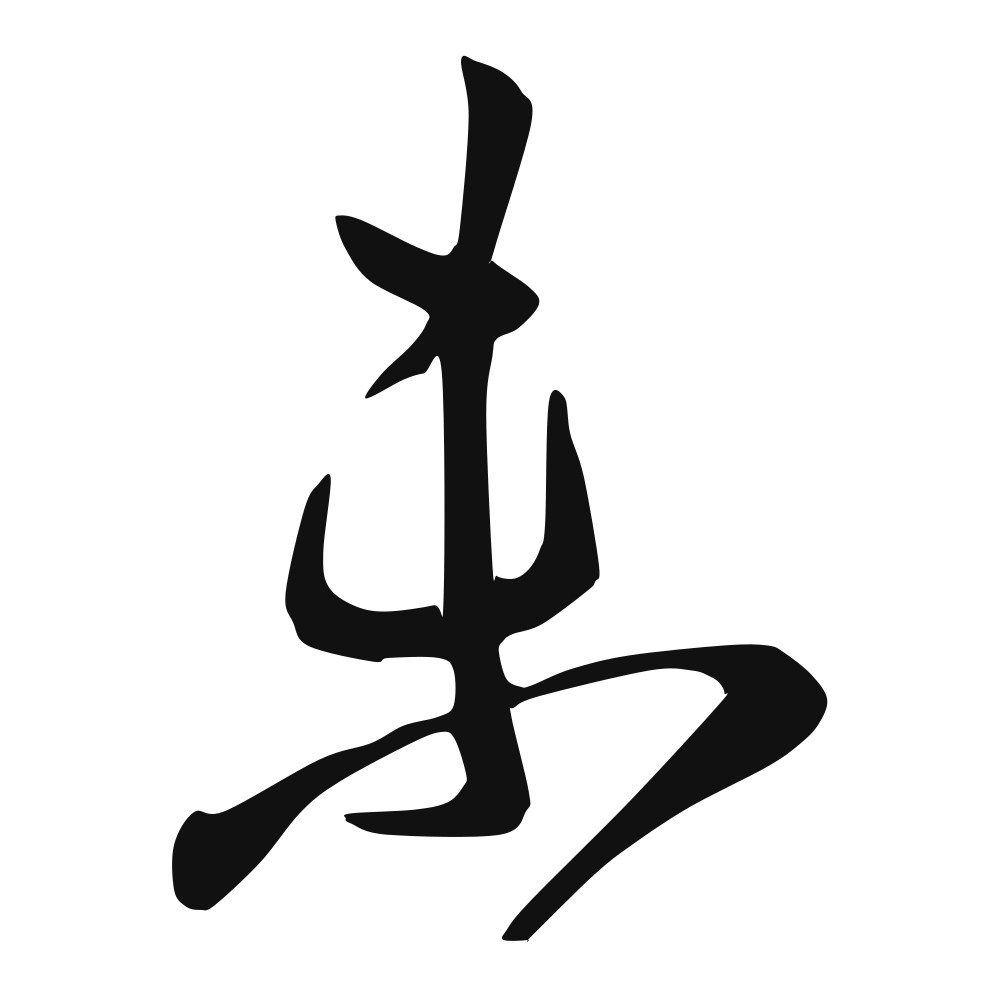
未
not yet; did not; have not; not; 8th earthly branch: 1-3 p.m., 6th solar month (7th July-6th August), year of the Sheep; ancient Chinese compass point: 210°
Closest English meanings
not yet·not·eighth earthly branch
The Calligrapher — Wáng Xīzhī 王羲之
The 'Sage of Calligraphy'; his running script has set the standard for 1,700 years.
Eastern Jin calligrapher (303–361), master of running script/cursive script/regular script — the Sage of Calligraphy; his Orchid Pavilion Preface is the most celebrated work in the tradition, and nearly every later master traces lineage to his hand. Eastern Jin dynasty
Cultural Story
未 is the eighth earthly branch and, in the 易經, the sign of late afternoon, the day not yet done. The 論語 records Confucius saying he is 未知生, still unsure of life, let alone death. The character pairs with 来 to point always forward — the not-yet that is also the not-known, a humble posture before time.
Common words & phrases
- 未来 future
- 未必 not necessarily · maybe not
- 未曾 never · have not
- 未知 unknown · unexplored
- 未免 rather · somewhat · truly
- 尚未 not yet · still not
Read the story behind the character
未 drives the forward tense of ordinary speech: 未来 is the five-year plan and the teenager's career; 尚未 means the train has not yet left; 未必 softens a boast. In a lab 未知 names the unsolved problem. The word is the small brake on every certainty, the syllable that keeps a sentence honest about what has not happened.
Own this character
Purchase delivers the original SVG of this glyph, brushed by Wáng Xīzhī 王羲之, ready to place on skin, paper, or screen.