
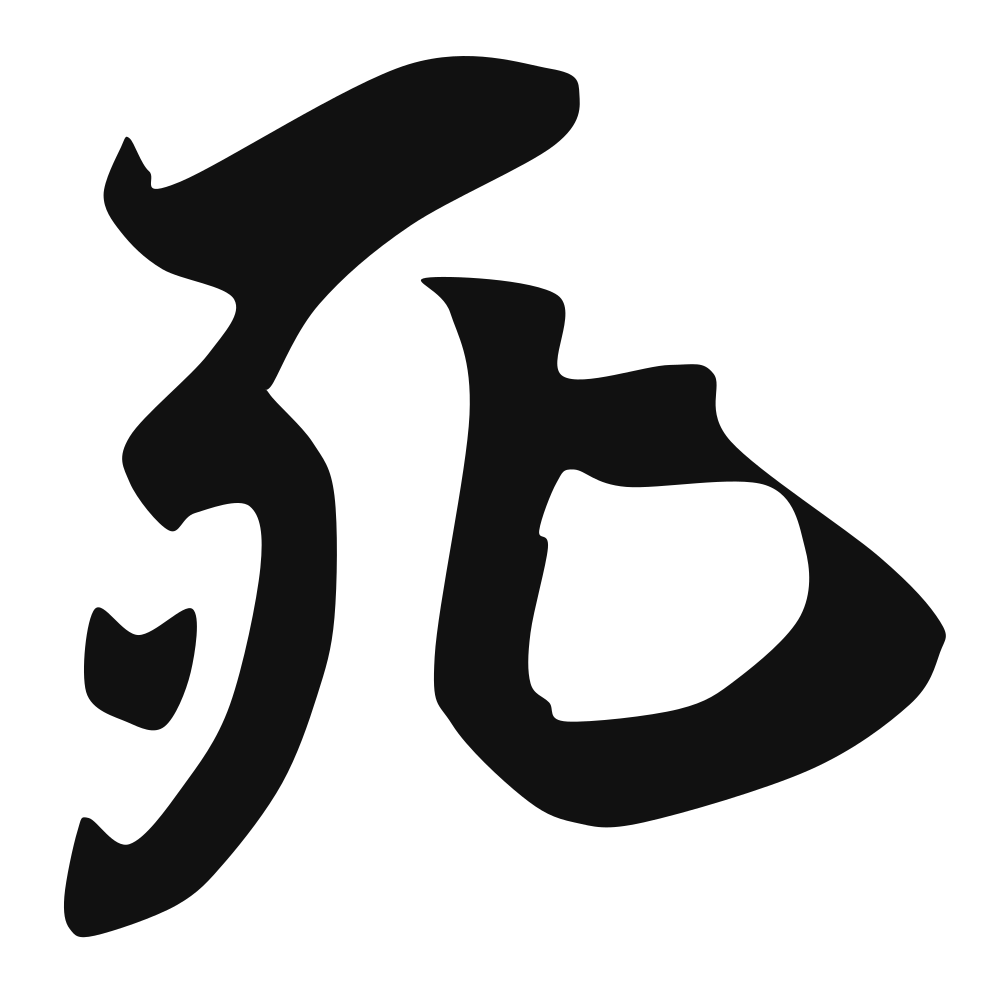
死
死 (sǐ) — death. A person 人 by a bones 歺 (corpse) sign. Classical life: 生死 — life and death; 死 appears in Buddhist 生死轮回. Grammar: free morpheme — also: to die; impassable; uncrossable; inflexible; rigid; extremely; damned
Closest English meanings
die·death·dead·to perish
The Calligrapher — Wáng Xīzhī 王羲之
The 'Sage of Calligraphy'; his running script has set the standard for 1,700 years.
Eastern Jin calligrapher (303–361), master of running script/cursive script/regular script — the Sage of Calligraphy; his Orchid Pavilion Preface is the most celebrated work in the tradition, and nearly every later master traces lineage to his hand. Eastern Jin dynasty
Etymology & Meaning · 字义溯源
2 · The Character: 死 死 (sǐ, 3rd tone) is defined in the Shuowen Jiezi as 「死,澌也,人所離也。从歺从人」 — 'death is 澌, the running-dry of water; it is what a person departs from', written with 歺 (a splintered bone) beside 人 (a person). The graph is literally a living figure kneeling beside skeletal remains. Classical Chinese uses it without euphemism, and sometimes tenderly: 《詩經·邶風·擊鼓》 gives the language's most famous vow, 「死生契闊,與子成說;執子之手,與子偕老」 — 'in death or life, apart or together, I made this promise with you'. 《易·繫辭上》 reasons 「原始反終,故知死生之說」. Wang Xizhi refuses Zhuangzi's equanimity in 《蘭亭集序》: 「固知一死生為虛誕」, and insists 「死生亦大矣」. Grammatically 死 is a free morpheme — and that is exactly the problem. It is the blunt, everyday word for 'dead', it is funeral vocabulary, and it appears in curses (該死). Honest disclosure: this reads as a death notice, not as edgy aesthetics, to anyone Chinese-literate.
Cultural Story
死 meant death, the end that all classical thought circled warily. The Shuowen reads it through the decaying bone and lost breath, and philosophers weighed it: Zhuangzi laughed at 死亡 as a transformation, while Confucius stayed silent on the dead to focus on the living. To face 生死 life and death was the ultimate test of a person's courage and meaning.
Energy Reading
Water (水)
Comparative symbology, not fortune-telling.
Common words & phrases
- 死亡 death · die · decease
- 死活 life and death · anyway · at all costs
- 死人 dead person · corpse · the dead
- 该死 damn · go to hell · blast
- 病死 die of illness · die from disease · death by disease
- 生死 life and death · fate · vital
Read the story behind the character
Death still surrounds 死 in daily talk: we read of 死亡 in the news, say 生死 life and death in a crisis, and call a 死人 dead person with quiet respect. A patient may 病死 die of illness, a curse mutters 该死 damn, and families weigh 死活 life and death at a hospital bed. From a funeral to a heated argument, 死 is the word for the end we cannot joke away.
Why this character belongs on skin
The leaf lets go. Not in terror but in completion, returning what it borrowed to the tree and the wind. 死 is death — the character the anxious West too often forbids itself to speak. But to know death honestly is to love life at full volume. The Daoists bowed to it as part of the great turning; the Buddhists saw it as the teacher that lends every moment its weight. To wear 死 is not morbidity. It is clarity. It is the tattoo that makes every sunrise cost more and every grudge worth less. Carry it and you carry a secret with the ancients: that only the mortal creature can truly live. The character is a memento, not a threat — a reminder that your time is precious precisely because it ends.
Own this character
Purchase delivers the original SVG of this glyph, brushed by Wáng Xīzhī 王羲之, ready to place on skin, paper, or screen.