
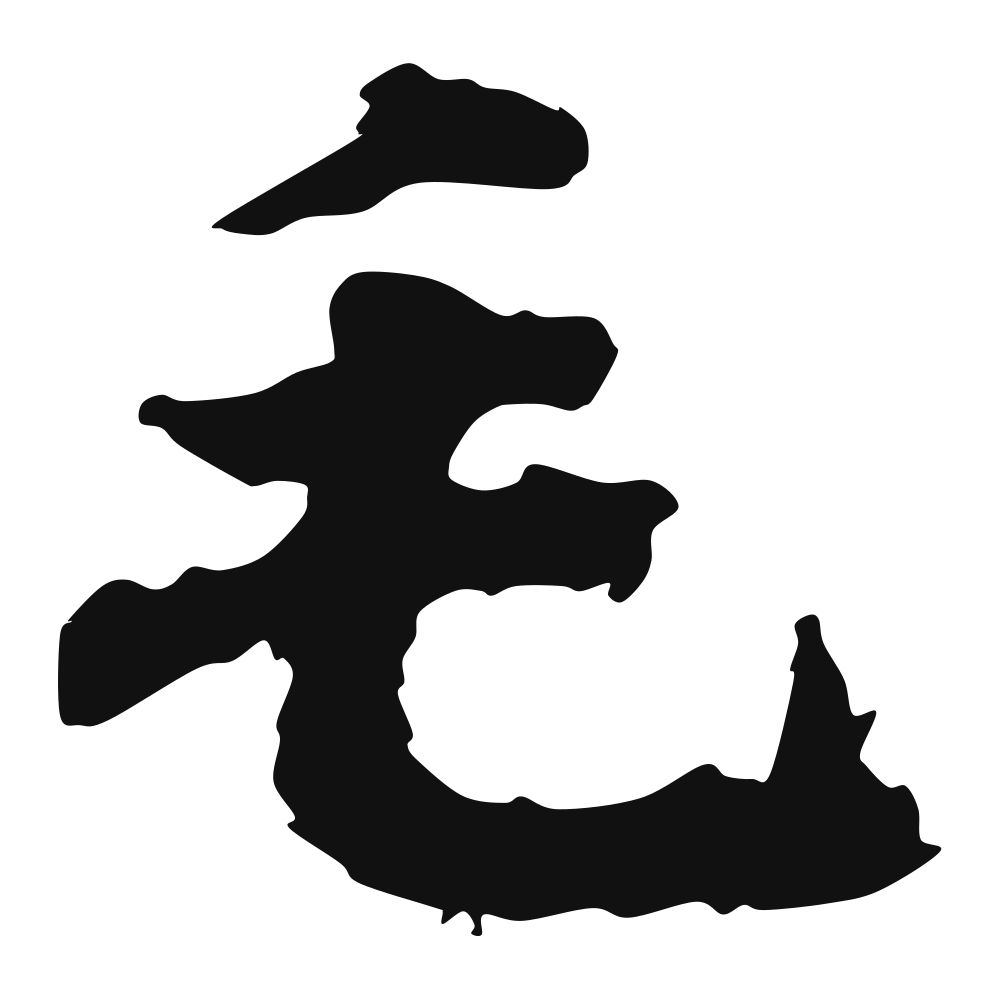
毛
surname Mao; hair; feather; down; wool; mildew; mold; coarse or semifinished; young; raw; careless; unthinking; nervous; scared; (of currency) to devalue or depreciate
Closest English meanings
hair·feather·fur·rough
The Calligrapher — Wáng Xīzhī 王羲之
The 'Sage of Calligraphy'; his running script has set the standard for 1,700 years.
Eastern Jin calligrapher (303–361), master of running script/cursive script/regular script — the Sage of Calligraphy; his Orchid Pavilion Preface is the most celebrated work in the tradition, and nearly every later master traces lineage to his hand. Eastern Jin dynasty
Cultural Story
毛 in oracle bone script pictures a tuft of hair; the 說文解字 calls it '眉髮之屬', what belongs to brows and hair. It meant hair, fur, and feathers alike. Ancient texts used 毛 for the fine fur of animals and for rough, unfinished cloth. To be without 毛 was to be bare; 毛 was the smallest, most ordinary covering.
Common words & phrases
- 毛衣 sweater · woolen sweater
- 毛巾 towel · washcloth
- 毛笔 writing brush · brush pen
- 毛病 problem · fault · illness
- 羽毛 feather · plumage
- 毛利 gross profit · margin
Read the story behind the character
毛 is everywhere: a winter 毛衣 (sweater) keeps you warm, a 毛巾 (towel) wipes the face, a 毛筆 (brush pen) writes calligraphy. A car with a 毛病 (problem, fault) goes to the shop; a shopkeeper counts 毛利 (gross profit). Even 羽毛 (feathers) on a pillow remind us of the word's soft origin.
Own this character
Purchase delivers the original SVG of this glyph, brushed by Wáng Xīzhī 王羲之, ready to place on skin, paper, or screen.