
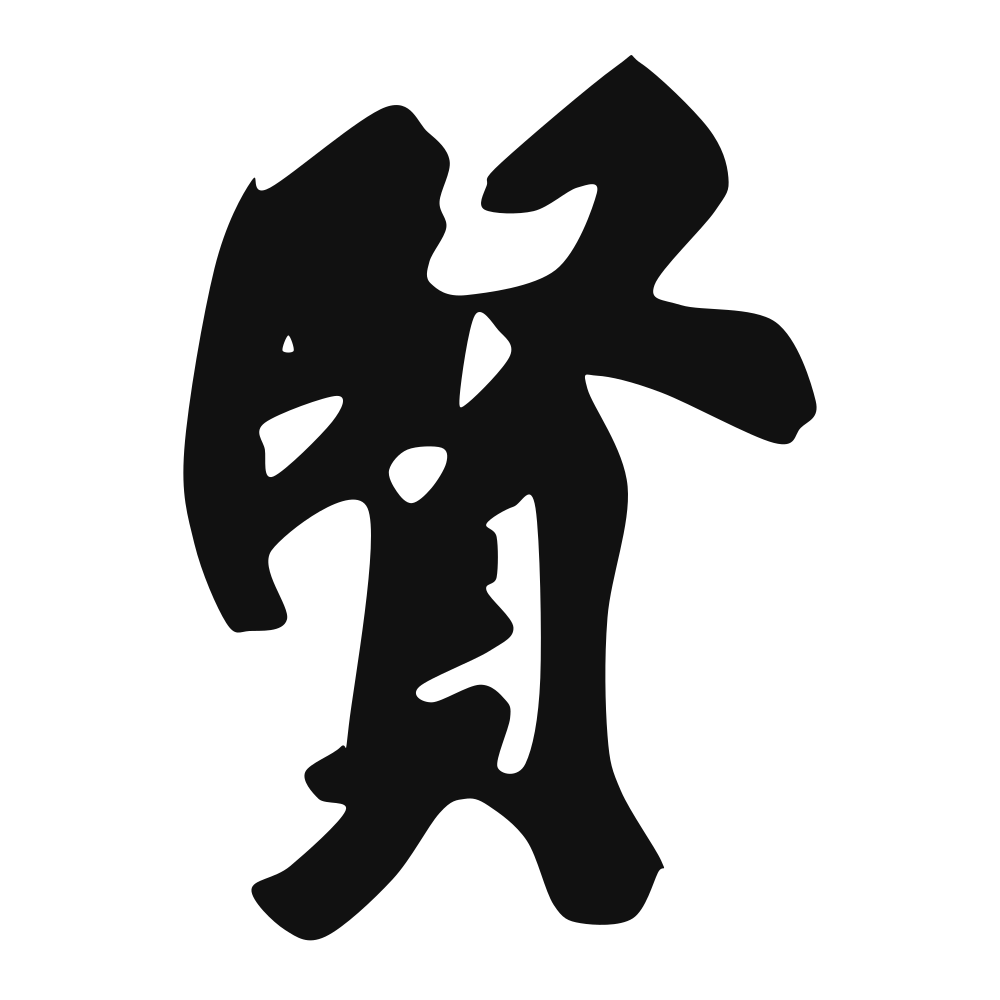
贤
贤 (xián) — worthy, virtuous, able. Treasure 贝 + 臤 (firm): valued firmness — a worthy person. Classical life: 圣贤 — sages and worthies; 贤 is the Confucian ideal of the able good. Grammar: free morpheme — also: worthy or virtuous person; honorific used for a person of the same or a younger generation
Closest English meanings
worthy·virtuous·able·sage·wise
The Calligrapher — Bāo Shìchén 包世臣
Qing theorist whose 'Art Boat' (艺舟双楫) championed the stele school.
Qing calligrapher (), master of running script — known for 《艺舟双楫》. Qing dynasty
Etymology & Meaning · 字义溯源
2 · The Character: 贤 Xián (2nd tone). The Shuowen Jiezi is terse and generous: 「賢,多才也。从貝臤聲」 — 'abundant in ability; from 貝 (shell/value) with 臤 as the phonetic.' The 貝 is not decoration: worth here is reckoned like treasure, something a state stores. Confucius makes it an instruction rather than a compliment: 《論語·里仁》 「見賢思齊焉,見不賢而內自省也」 — 'when you see a worthy person, think of equalling him; when you see an unworthy one, look inward.' The Yijing turns it into policy: 《易·大畜·彖》 「不家食吉,養賢也」 — 'that he does not eat at home is fortunate: it means the worthy are being nourished.' 賢 is a free, wholly positive morpheme and stands alone. Honest disclosure: it is formal, slightly literary, and belongs to a register of praise given by others — 賢妻良母 ('virtuous wife, good mother') is a dated gender trope, and 賢弟/賢internal-helper forms are courtly. It says 'worthy of office', not 'holy'.
Cultural Story
Confucius said look to the worthy and try to match them, jian xian si qi yan, and when the unworthy appear, turn inward and examine yourself. The character xian is that virtue worth emulating, the xian ren whose life is a standard. From the saying it passed to the xian ming ruler and the xian hui wife, the able and good the old world taught a son to seek.
Where a Western reader can stand: Where a Western reader can stand: 贤 is Latin 'dignus' or 'probatus' — worthy, tried, commended. Its building block is 貝, value or shell-money, so the graph literally attaches worth to a person. The Analects (Li Ren) gives its motto: 見賢思齊, 'when you see the worthy, think how to be level with them' — emulation, not envy. The Hexagram Dà Xù (26), Great Accumulation, is the hexagram that names 養賢, the nourishing of the worthy. Bao Shichen is the fitting hand because he was above all a teacher. His treatise 《艺舟双楫》 shaped a generation of stele masters — He Shaoji, Zhao Zhiqian — and his life was the cultivation of others' worth. His running-cursive, theorized and archaic, writes 贤 as earned standing rather than self-praise. The honest catch: 賢 is praise conferred by others, formal and a little literary; worn as a self-description it can read as blowing your own trumpet, which is precisely what 見賢思齊 warns against. Disclose that.
Energy Reading
Wood (木)
Comparative symbology, not fortune-telling.
Common words & phrases
- 贤人 worthy person · sage · wise man
- 圣贤 sage · saint · wise and virtuous
- 贤惠 virtuous · kind (of a woman) · amiable
- 贤能 able and virtuous · capable and worthy · worthy and able
- 贤明 wise and able · sagacious · wise and bright
- 先贤 late worthy · ancients · former worthies
Read the story behind the character
A panel weighs a candidate's xian neng before the hire, and a school honors its xian ming teachers at the fall meeting. The village keeps the xian hui grandmother as its model, and a reader studies the xian of the past. The character xian still marks the able and good a community is meant to rise toward.
Why this character belongs on skin
The village always knew who to send for when the river rose. 贤 is that person—the worthy one, the steady mind among the shouting. Confucius ranked it highest among the lesser virtues, the man who hears the truth and lives it before he speaks it. Not the clever, not the loud; the one whose door is open and whose word can be trusted with your child. A sage is not born distant and cold. He is near, patient, amused by his own failings. To carry 贤 on your skin is to set a standard you must grow toward, not a crown you already wear. It is the humblest of ambitions: to be the one others turn to. Let it sit near the heart, a quiet commission, the daily reminder that worth is earned in small rooms, not announced in large ones.
Own this character
Purchase delivers the original SVG of this glyph, brushed by Bāo Shìchén 包世臣, ready to place on skin, paper, or screen.