
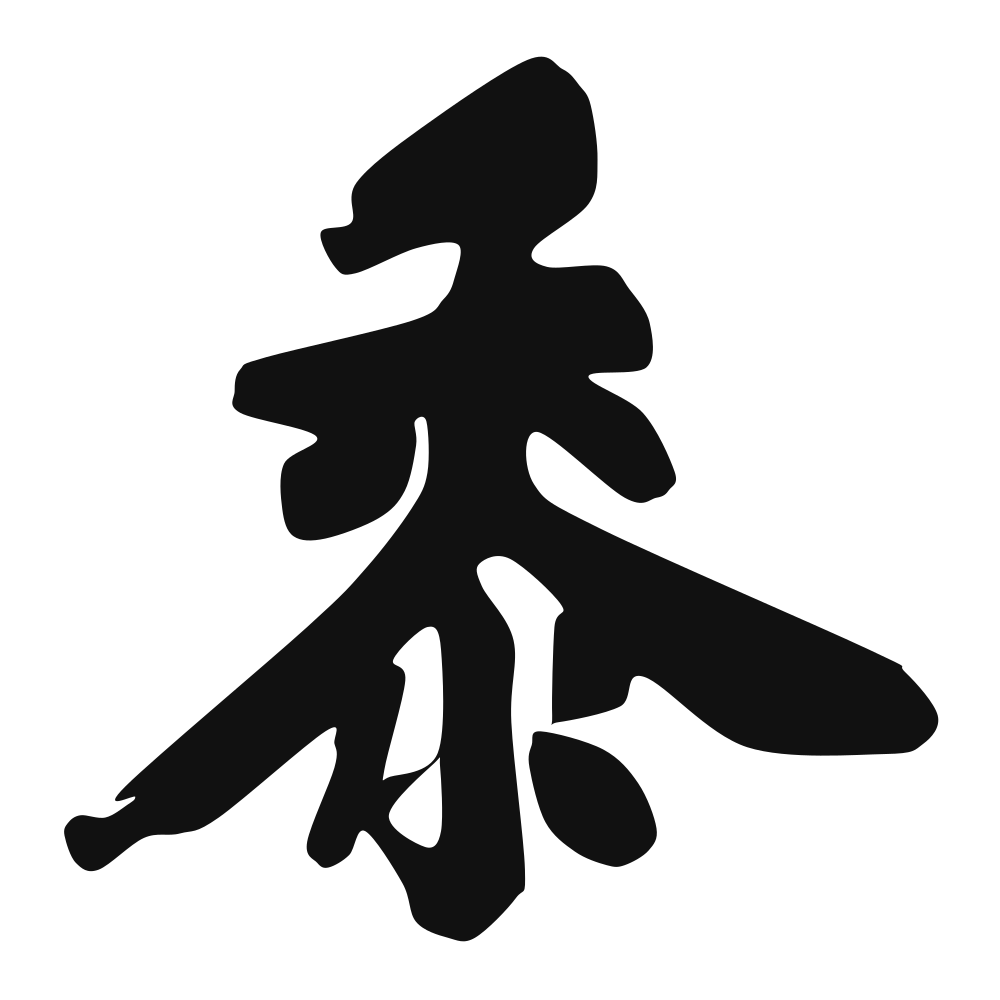
黍
broomcorn millet; glutinous millet
Closest English meanings
millet·broomcorn
The Calligrapher — Bāo Shìchén 包世臣
Qing theorist whose 'Art Boat' (艺舟双楫) championed the stele school.
Qing calligrapher (), master of running script — known for 《艺舟双楫》. Qing dynasty
Etymology & Meaning · 字义溯源
2 · The Character: 黍 黍 (shǔ, 3rd tone). 《说文·卷七·黍部》: 禾屬而黏者也。以大暑而穜,故謂之黍。从禾,雨省聲。孔子曰:黍可爲酒,禾入水也 — 'a grain-kind that is glutinous; sown at Great Heat (大暑), hence the name; Confucius said: millet can be made into wine — grain entering water.' Duan Yucai objects that the real sowing time is 夏至, not 大暑, and suspects a copyist's addition (verify). The plant is broomcorn millet, 黄米, one of the 五谷. The Shijing uses it twice unforgettably: 《魏风·硕鼠》無食我黍 ('do not eat my millet') and 《王风·黍离》彼黍離離,彼稷之苗 — a Zhou officer walking the ruined capital, the origin of 黍离之悲, the classical idiom for grief over a fallen homeland. 《论语·微子》 has the recluse 殺雞爲黍而食之 — hospitality itself, echoed by Meng Haoran's 故人具雞黍. 《续齐谐记》 calls the zongzi 角黍, cast into the Miluo for Qu Yuan. 黍 is a free morpheme, but a rustic and archaic one, and to a literate Chinese reader it carries 黍离 — dynastic mourning — as readily as it carries harvest.
Cultural Story
《説文解字》defines 黍 as “禾屬而黏者也” (a sticky member of the grain family), a pictograph of drooping millet ears. Broomcorn millet, it was brewed into wine for ancestors and cooked at festivals. Its glutinous quality set it apart from ordinary rice and fed the north's ritual tables.
Where a Western reader can stand: Where a Western reader can stand: 黍 is 'milium' — broomcorn millet, the humble grain of the north Chinese plain, the stuff of a simple country meal. Its graph is 禾 (grain) with water, named for how it swells. But the Shijing turned it into elegy: 彼黍離離, 'the millet grows thick', is sung over the ruins of the Zhou capital at Wang, and 黍離之悲 became the fixed phrase for mourning a destroyed homeland. The Hexagram Wúwàng (25), Without Falsehood, speaks of not sowing for the harvest — the grain as honest labour. Bao Shichen is an odd but right hand. His stele-school creed loved the plain, archaic, undecorated 'bone' of Northern Wei stone — exactly the unpretentious grain, not the ornamental blossom. His running-cursive writes 黍 with the weight of carved inscription, so the little grain carries the gravity of loss. The honest catch: an educated Chinese reader may read a bare 黍 as elegy, not plenty — 黍離之悲 is never far. Disclose it, and consider pairing with a contrasting character.
Common words & phrases
- 黍子 broomcorn millet
- 黍米 millet
- 黍稷 millet crops
- 黄黍 yellow millet
Read the story behind the character
The 黍子 (broomcorn millet) and 黍米 (millet) still simmer into congee and festival wine, the 黍稷 (millet crops) recall old harvest rites, and 黄黍 (yellow millet) fills health-food bins. Northern cooks mold sticky 黍 into cakes, keeping a Neolithic grain alive on modern holiday tables.
Why this character belongs on skin
Before rice fed the south, millet fed civilization. 黍 is the golden grain of the Yellow River valley, the crop a starving people gambled every spring on. It appears in the oldest poems we have: a homesick traveler sees the ruined capital overgrown with millet, and weeps because the grain is thriving where his life once was. Grief and sustenance in the same field. There is no softer way to say human: we are the animals that plant, that wait, that bet on a season we won't control. The character is humble—a grain head nodding under its own weight, the way the ripest men bow lowest. To ink 黍 is to honor the ordinary miracle, the daily bread, the fact that you are fed by the earth and will one day feed it. Chew slowly. Everything golden comes from dirt.
Own this character
Purchase delivers the original SVG of this glyph, brushed by Bāo Shìchén 包世臣, ready to place on skin, paper, or screen.