
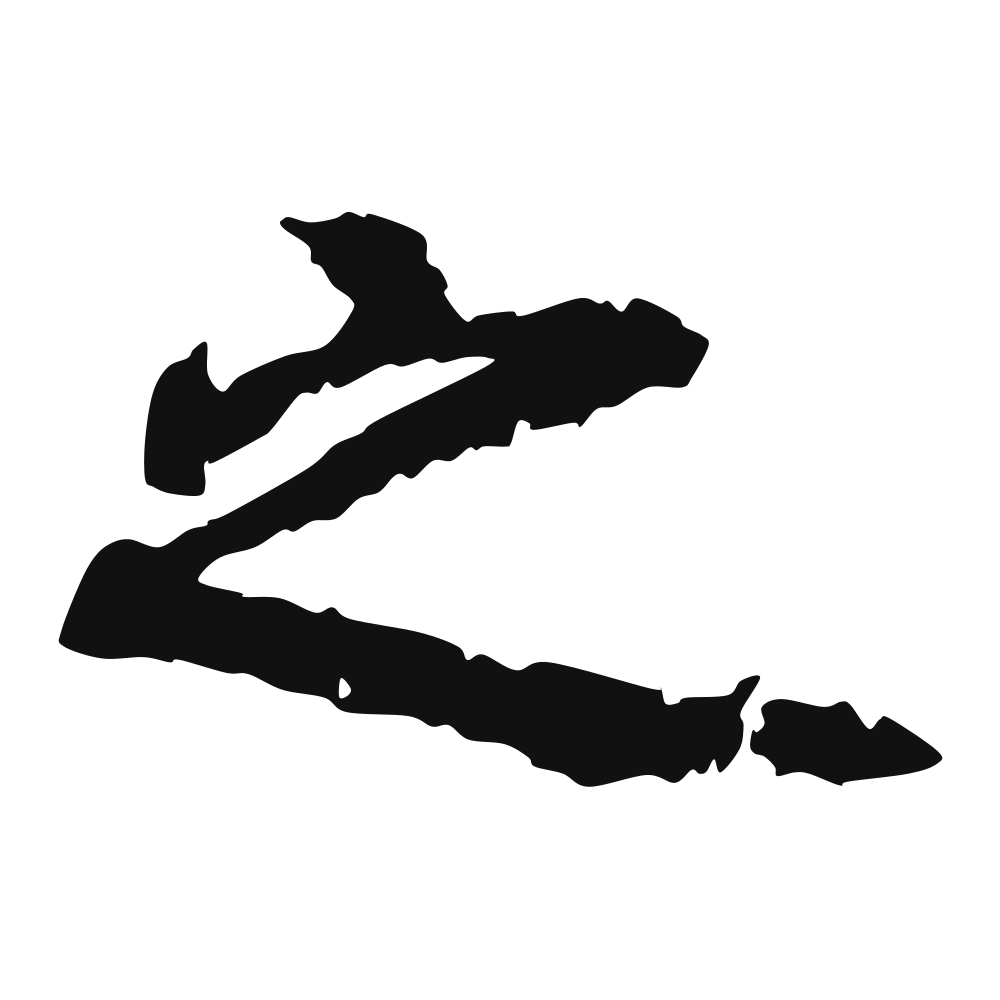
之
(possessive particle, literary equivalent of 的[de5]); him; her; it
Closest English meanings
of·'s·him·it·to go (archaic)
The Calligrapher — Bèi Yìyuān 贝义渊
Liang calligrapher of the regular-script Xiao Dan Stele, a rare Southern Dynasties monument.
南朝梁 calligrapher (), master of regular script — known for 《始兴忠武王碑》. Liang dynasty (Southern Dynasties)
Etymology & Meaning · 字义溯源
2 · The Character: 之 之 (zhī, 1st tone) is, in Xu Shen, motion and grammar entwined: 出也。象艸過屮,枝莖益大有所之。一者,地也 — 'to go forth; shaped like grass passing 屮, its stem and branches growing as it goes; the one stroke is the earth.' It is the great connective — 'of, to go to.' The classics lean on it for departure and devotion: the Liji (檀弓) '之死矢靡他' (sworn to death, none other); the Shijing (周南) '之子于归' (that one goes to her home); the Yizhuan and Shijing (鄘风) '之死矢靡慝' fix it as 'to.' As a free morpheme 之 means 'to go, of, this,' and is the most classical of function words — 之后, 之处. Honest disclosure: 之 is a particle, never a noun; on skin it is a single looping stroke and reads as a comma, a 'z', or a flourish. It is beautiful as a minimalist mark of 'going toward' but means nothing alone — pair it with another character (如之, 往之) or wear it as pure calligraphic gesture. In Japanese it is no/ishi.
Cultural Story
之 is the busiest little word in classical Chinese, of, him, it, and, originally, the verb to go. The 論語 is threaded with it, 學而時習之. A traveler 之楚 went to Chu. Over centuries it settled into the grammatical glue of before, after, between. The 說文 reads it as a foot setting out; the foot became a possessive, then a punctuation mark of the mind.
Where a Western reader can stand: Where a Western reader can stand: imagine the Roman inscription cut into a triumphal arch — not the sentence, but the carved connective that joins the names. Bei Yiyuan is the near-anonymous Liang carver of such arches, and his 之 is the smallest joint of classical Chinese grammar set in stone. So a 之 from his hand is less 'a word' and more 'the punctuation of a monument' — the going-toward stroke that holds a whole dedication together. For the Western wearer it is a minimalist, almost architectural gesture: the ampersand of an empire's script, worn as quiet evidence that even the smallest mark can be made to last forever.
Common words & phrases
- 之后 after · afterwards · behind
- 之前 before · prior · ahead
- 之中 within · among · in the midst
- 总之 in short · in conclusion · all in all
- 之间 between · among · amid
- 之一 one of · among them · one among
Read the story behind the character
之后, 之前, 之中, 之间, 总之, 之一, the character now lives almost entirely inside these fixed pairs, the hinges of time and space in written Chinese. Speech prefers 的 and 在, so 之 sounds bookish, the register of contracts and headlines. You will meet it in a news lead, 事件之一, and rarely aloud. It is the classical footstep that froze into grammar.
Why this character belongs on skin
Grammarians call it a particle; poets call it the breath between words. Zhī is the small connective tissue of classical Chinese—'of,' 'to,' the marker of movement toward. Its oldest form was a foot leaving a place, a journey reduced to a single stroke of going. It links nothing to nothing and makes meaning happen, the way a doorway is not a room but makes rooms possible. To wear zhī is to honor the connections rather than the things connected: not the lover but the of, not the road but the toward. It is a tattoo for the relational soul, the one who knows we are prefixes and suffixes to each other, never standalone. Quiet, almost invisible, it sits best where two parts of the body meet—a hinge of a character, the smallest acknowledgment that you are held in relation, always going, never arriving alone.
Own this character
Purchase delivers the original SVG of this glyph, brushed by Bèi Yìyuān 贝义渊, ready to place on skin, paper, or screen.