
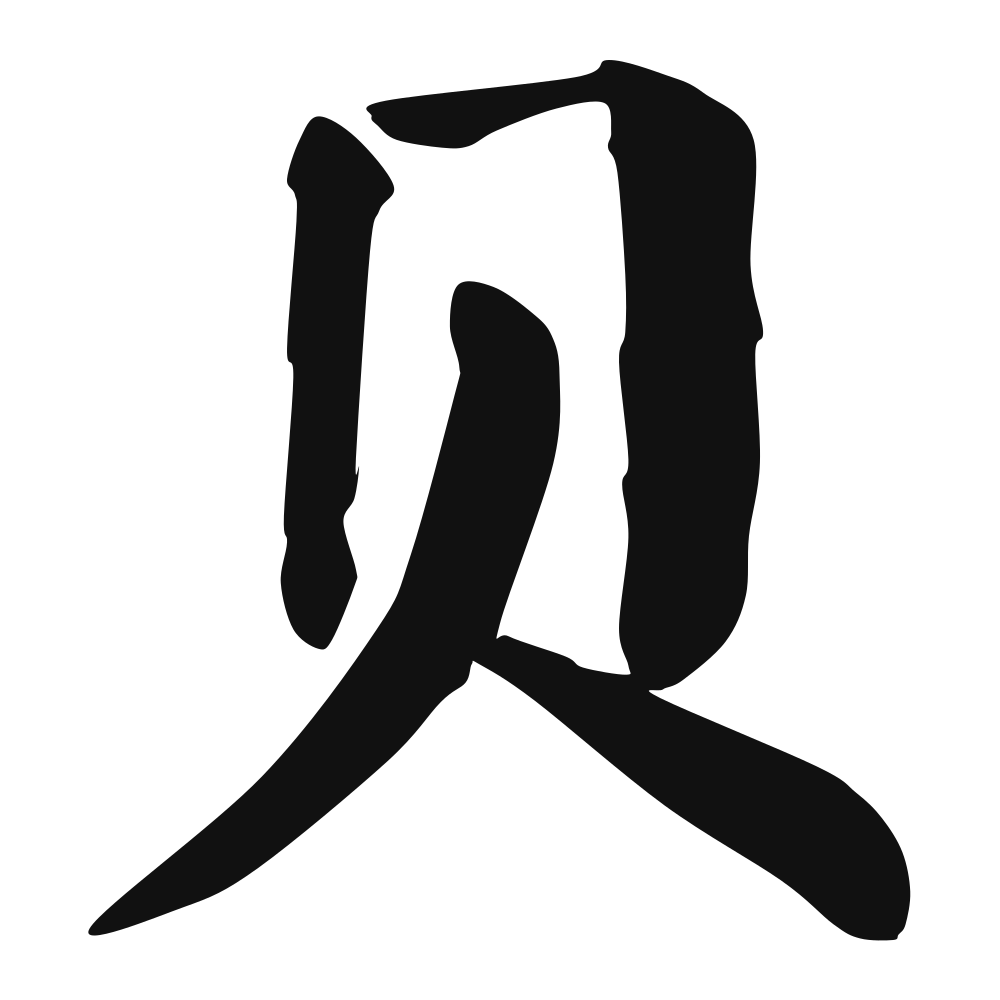
贝
surname Bei; cowrie; shellfish; currency (archaic)
Closest English meanings
shell·shellfish
The Calligrapher — Bèi Yìyuān 贝义渊
Liang calligrapher of the regular-script Xiao Dan Stele, a rare Southern Dynasties monument.
南朝梁 calligrapher (), master of regular script — known for 《始兴忠武王碑》. Liang dynasty (Southern Dynasties)
Etymology & Meaning · 字义溯源
2 · The Character: 贝 Bèi (4th tone). The Shuowen Jiezi gives 貝 an unusually historical entry: 「貝,海介蟲也……象形。古者貨貝而寶龜,周而有泉,至秦廢貝行錢」 — 'a shelled sea creature… a pictograph. In antiquity shells served as money and tortoise-shell as treasure; under the Zhou there were 泉 coins; by the Qin, shell-money was abolished and 錢 coin was used.' The dictionary has packed the history of currency into one glyph. The Book of Songs already uses it ornamentally: 《詩·小雅·巷伯》 「萋兮菲兮,成是貝錦」 — 'lush and fine, it makes this shell-patterned brocade.' 貝 is a free morpheme, a Kangxi radical, and a surname — borne by the Liang stele-master 貝義淵. Honest disclosure: because 貝 is the semantic radical inside nearly every money word (財 貨 貴 賤 貧 賠 賞 資), a literate viewer reads a bare 貝 as 'money/value' before 'seashell'. And 寶貝 (bǎobèi) means 'darling, baby' — sweet, but juvenile in tone.
Cultural Story
Long before coins were cast, the Shang and Zhou used cowrie shells, bei, as money, stringing them for trade and burying them with the dead. The character bei is that glossy spiral, and the radical still sits in every word for wealth, from cai to gu. What the sea gave, the market took, and the shell became the first sign of value a Chinese hand could hold.
Where a Western reader can stand: Where a Western reader can stand: 貝 is the Chinese obolus. Greek coinage began as weighed iron spits; Chinese money began as these cowrie shells, and the Shuowen says so outright — 'anciently shells were money and tortoise-shell was treasure; by the Qin, shell-money was abolished'. Every word for wealth, cost, poverty and payment in the language is still built on this little shell: 財, 貨, 貴, 賤, 貧. The pairing is the rare one where the character IS the calligrapher. Bei Yiyuan — 貝義淵 — carried this surname, and he is known only through monumental stone he cut for the Liang court. So a 貝 in his hand is a signature and a mint-mark at once: a man's family name, the oldest currency in East Asia, and the money radical of an entire script, carved by someone whose own biography was never written down. Modest object, immense reach.
Common words & phrases
- 贝壳 shell
- 宝贝 treasure · baby
- 干贝 dried scallop
- 分贝 decibel
- 贝类 shellfish
Read the story behind the character
A child pockets a bei ke on the beach and a chef braises gan bei for the banquet, while a sound meter reads fen bei on the phone. The word bei lei names the shellfish the tide leaves, and bao bei has become the dear one. The character bei still runs from the shore to the wallet, shell, score, and sweetheart.
Why this character belongs on skin
Before coins, there was the sea's small purse. The cowrie — glossy, closed, the shape of an eye half-shut — was the first money, carried in the hands of traders who trusted its weight more than kings. The character 贝 still lives inside every word for wealth, treasure, commerce; it is the root of value itself in this language. To set it on your skin is to remember that worth was once something organic, something gathered, something with a smell of salt. We have forgotten that. We worship numbers on screens, abstract and cold. But the shell asks a cleaner question: what do you hoard, and what do you carry because it is beautiful? The cowrie closes around its secret. So might you. A small, curved mark, older than empire, older than debt — a quiet emblem of the treasures you refuse to spend.
Own this character
Purchase delivers the original SVG of this glyph, brushed by Bèi Yìyuān 贝义渊, ready to place on skin, paper, or screen.