
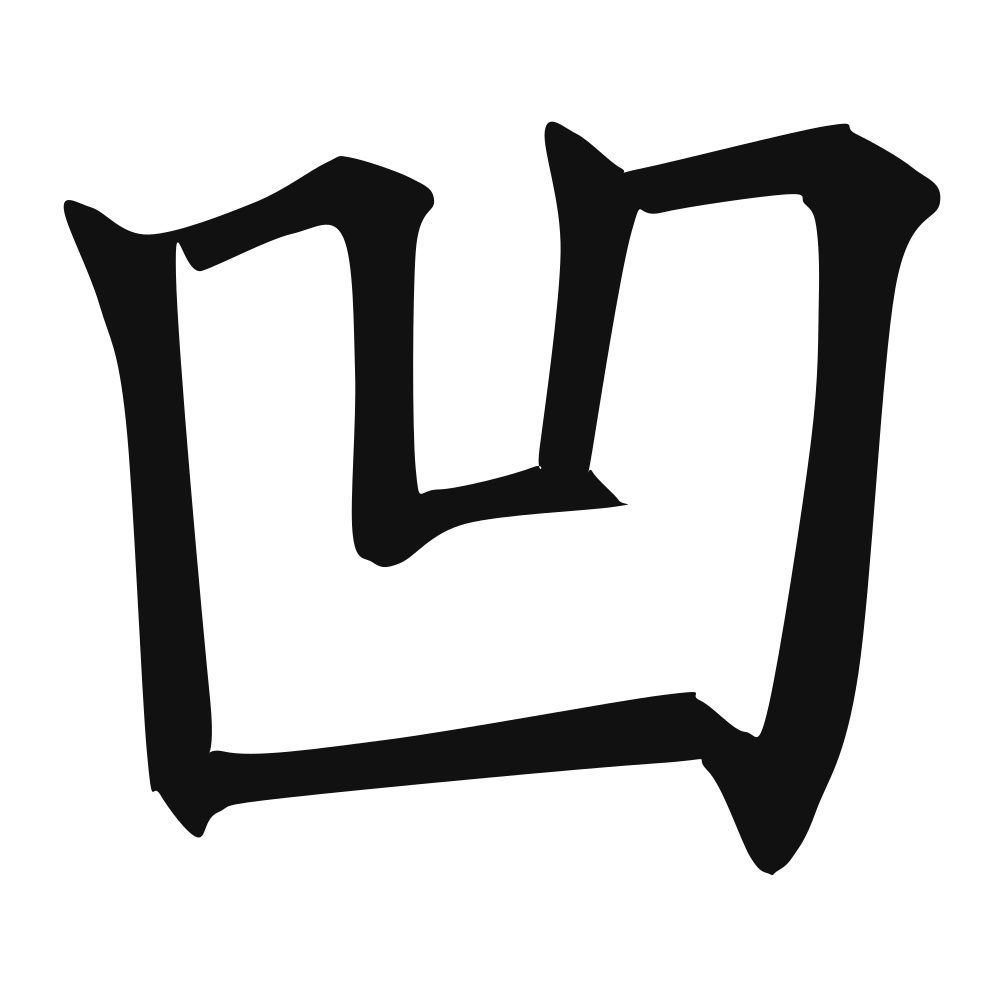
凹
concave; depressed; sunken; indented; female (connector etc); (used in names)
Closest English meanings
concave·hollow
The Calligrapher — Bó Shàozhī 薄绍之
Liu Song calligrapher paired with Yang Xin as 'Yang-Bo', famed for running and cursive script
南朝宋 calligrapher (), master of running script — known for 与羊欣并称. Liu Song dynasty (Southern Dynasties)
Cultural Story
凹 describes a hollow, the negative of 凸. Garden-makers prized it in 太湖石, the grey scholar rocks from Lake Tai pulled from the water for their worn, 凹凸 holes; one such stone anchors the rockery at 留园 in Suzhou. A concave surface catches shadow and water. The character itself is a little basin, drawn to be read as much by the eye as by the hand.
Common words & phrases
- 凹陷 concave · sunken
- 凹版 intaglio · gravure
Read the story behind the character
The bank prints banknotes by 凹版 gravure, the ink sitting in sunken lines you can feel with a fingernail. A 凹陷 in the car door sends the owner to the body shop for a pull. At the dressing table a 凹面镜 widens the face for plucking. The word names any dent, pit, or scoop cut below the surface around it.
Why this character belongs on skin
The ground dips and the water stays. 凹 is the hollow — the concave, the sunken place a hand or a foot or time itself has pressed into something once flat. It is the opposite of proud; it is the part that gave way, that learned to hold by going lower. The character is a shape drawn inward, a little valley on the page. To wear 凹 is to make peace with the dented parts of a life, the places loss carved so something could gather there. Not all of us are raised. Some of us are recessed, and in the recess the rain collects, the seed waits, the truth pools. Ink it where you have been pressed. The hollow is not a wound. It is where you finally learned to keep what fell.
Own this character
Purchase delivers the original SVG of this glyph, brushed by Bó Shàozhī 薄绍之, ready to place on skin, paper, or screen.