
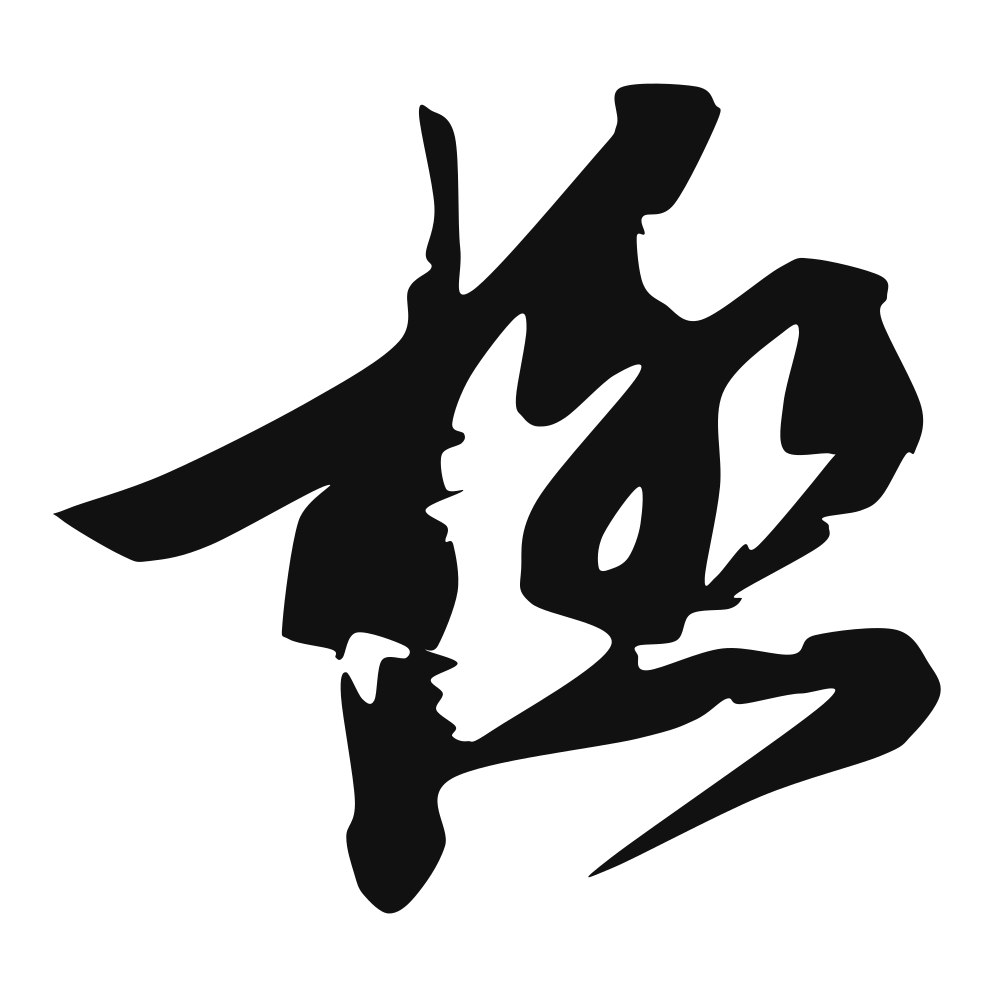
极
extremely; pole (geography, physics); utmost; top
Closest English meanings
extreme·pole·utmost
The Calligrapher — Cài Xiāng 蔡襄
One of the Four Song masters, known for graceful regular and running script.
Song calligrapher (1012–1067), master of regular script/running script — Song master of warm, disciplined regular script, the most 'proper' of the Song Four. Song dynasty
Etymology & Meaning · 字义溯源
2 · The Character: 极 Jí (2nd tone). Shuowen Jiezi defines 極 as 棟也 — 'the ridge-pole, the beam at the roof's peak', from 木 (wood) and 亟 (urgent / utmost). From 'ridge-pole' the word rose to mean 'utmost, apex, pole'. The 易經·繫辭 proclaims 易有太極,是生兩儀 — 'the Great Ultimate (太極) gives birth to the two modes'. The Shi Jing (大雅·崧高) sings 崧高維嶽,駿極于天 — 'lofty is the mountain; it reaches supremely to heaven'. Kangxi counts twelve strokes (simplified 极 = 7). Honest disclosure: 极 means 'extreme / pole / ultimate'; it builds 極致 (the utmost) but also 極端 (extreme, often negative) and 消極 (passive). A Chinese reader reads it as 'apex / pole'. Safe as a standalone of the ultimate and the peak; pair with 太 (太極) or 致 (致極) to keep the lofty sense and avoid the 'extreme' drift.
Cultural Story
极 is the ridgepole, the top beam that holds the roof — and so the furthest point, the utmost. The 太極 is the supreme ultimate of the 易經, the hinge of all opposites. The character began as carpentry's key timber and rose to mean the boundary of anything, the place where a quality runs out of room.
Where a Western reader can stand: Where a Western reader can stand: 极 is the ridge-pole of the roof — the highest beam from which the whole structure hangs, the Latin 'culmen.' In Cai Xiang's balanced hand it becomes the 'axis mundi,' the Great Ultimate (太极) that births the pairs, the pole-star of a thing. Stand with it as the peak, the utmost, drawn true. A Westerner might call it 'the apex' — but not 'extreme' (that is the dark 极端); Cai Xiang's measure keeps it lofty.
Common words & phrases
- 积极 active · positive
- 极其 extremely · most
- 极限 limit · extreme
- 北极 North Pole
- 极度 extreme · utmost
- 太极 Taiji · supreme ultimate
Read the story behind the character
极 maps the edges: 北极 the pole on a globe, 极限 the wall a climber hits, 极其 the adverb of excess. 积极 is the praise for the eager student; 太极 the slow morning exercise in a park. The character went from roof beam to superlative, the syllable that marks the end of a scale.
Why this character belongs on skin
Jí is the pole you cannot pass — the top of the pole, the furthest point, the ultimate. From it came the great pair, the two poles of the world in motion, the supreme polarity that the sages said the whole turning cosmos rides on. To reach your jí is to arrive at the edge of something and know there is no further. We spend our lives either fleeing our limits or chasing them. The mark honors the meeting of both: the highest and the lowest held in one stroke. A tattoo of jí is the line drawn to its own end and stopped — a remembrance that every road has its pole, and that standing at the extreme, briefly, is its own kind of peace. The ink rests at the boundary, where the two great forces lean into each other and hold.
Own this character
Purchase delivers the original SVG of this glyph, brushed by Cài Xiāng 蔡襄, ready to place on skin, paper, or screen.