
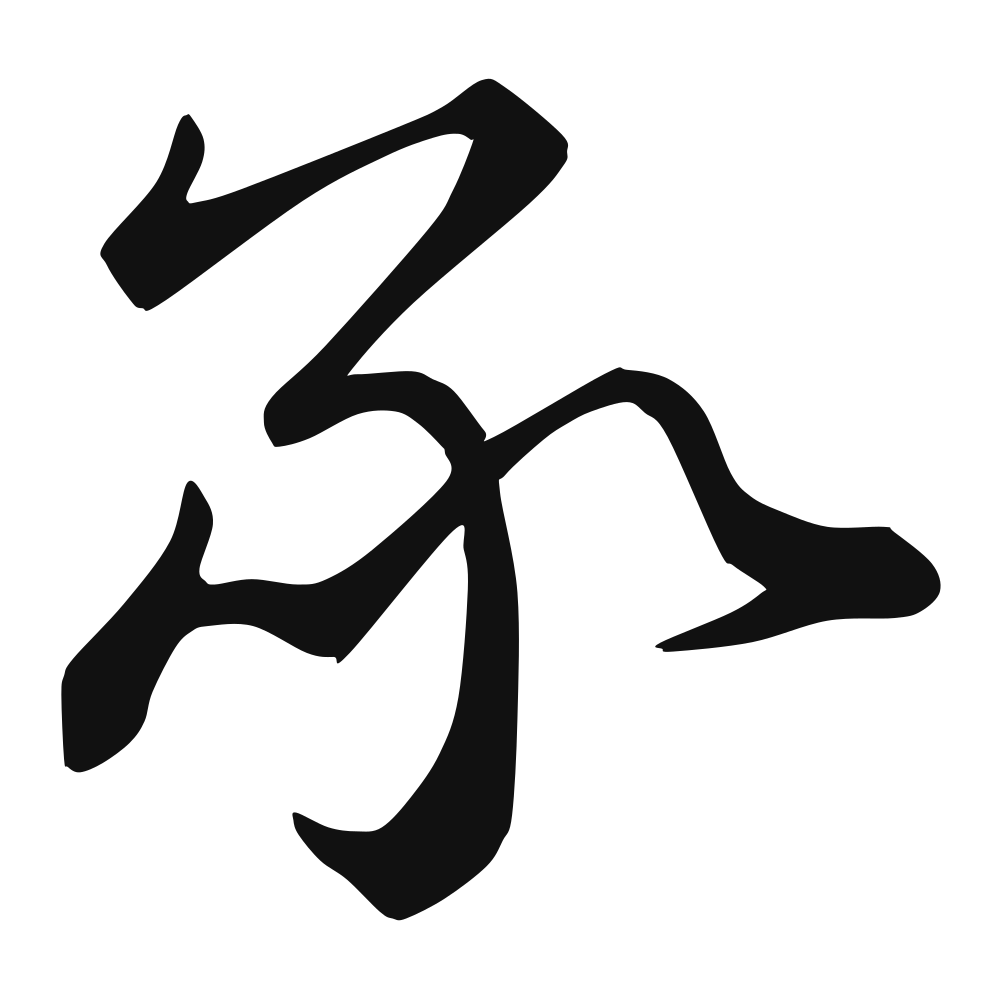
承
surname Cheng; Cheng (c. 2000 BC), third of the legendary Flame Emperors 炎帝[Yan2 di4] descended from Shennong 神農|神农[Shen2 nong2] Farmer God; to bear; to carry; to hold; to continue; to undertake; to take charge; owing to; due to; to receive
Closest English meanings
bear·carry on·receive
The Calligrapher — Cài Yōng 蔡邕
Han scholar who perfected clerical script and invented flying-white.
Han calligrapher (133–192), master of clerical script/飞白书 — known for 《熹平石经》/ 飞白书. Han dynasty
Etymology & Meaning · 字义溯源
2 · The Character: 承 Chéng (2nd tone). The Shuowen: 「承,奉也。受也。从手从卪从𠬞」 — to receive with both hands, from hand (手), a seal/figure (卪) and two hands (𠬞); oracle-bone forms show a person lifted by two pairs of hands. Classical: 《诗经·小雅·鹿鸣》 「承筐是将」 (they bear the basket); 《易经·坤·彖》 「万物资生,乃顺承天」 (all things are born, and obediently receive from heaven); 《尚书·说命》 「敢不承受君之明德」. Grading: 承 is warm and positive — 'bear / receive / continue' (传承, 承担) — and stands alone gracefully as 'to carry on'. Disclose the subordinate sense (承 = submit/bear down). A fine standalone for 'inheritance / continuity'.
Cultural Story
承 is to receive and to carry on, the hand passing a thing down the line. The histories use 继承 for the throne that moves father to son, and 承认 is the fault owned aloud. The character shows hands meeting a falling load. It is the bearing that links the generations.
Where a Western reader can stand: Where a Western reader can stand: 承 is 'to carry on' — the Latin tradere, 'to hand across,' the root of 'tradition' itself. Cai Yong was handed the empire's scriptures and handed them on; his daughter did the same for his manuscripts after he died in prison. On skin 承 is a vow of continuity: 'what was entrusted to me, I pass on.'
Common words & phrases
- 承担 bear · undertake
- 继承 inherit
- 承认 admit · acknowledge
- 承接 undertake · receive
- 承受 bear · endure
- 承包 contract
Read the story behind the character
承 is the taking and the keeping: 承担 the blame, 继承 the apartment, 承认 the mistake, 承接 the order, 承受 the loss. 承包 is the contract a village signs. It names the receiving that obliges, the weight passed to you and the yes that accepts it.
Why this character belongs on skin
The daughter lifts her aged father as he once lifted her, and the circle 承 itself without a word. 承 is to bear, to receive, to carry on—the character of hands passing something down the line of years so nothing precious is dropped. The Confucians made 承 a piety: inherit the virtue, bear the name, hand it forward unbroken. To ink it is to admit you are a vessel, that you carry more than you began with—grief, blessing, the weight of those who came before. Let it rest across your shoulders, the place built for burden and for glory alike. It is a mark of the faithful carrier, the one who does not set down the load when the road grows long. The ink keeps the lineage in your skin: you receive, you bear, you pass on. What you 承, you honor; what you honor, you cannot lose. Stand straight beneath it. The hands of the ancestors are on your shoulders, and they are not heavy. They are home.
Own this character
Purchase delivers the original SVG of this glyph, brushed by Cài Yōng 蔡邕, ready to place on skin, paper, or screen.