
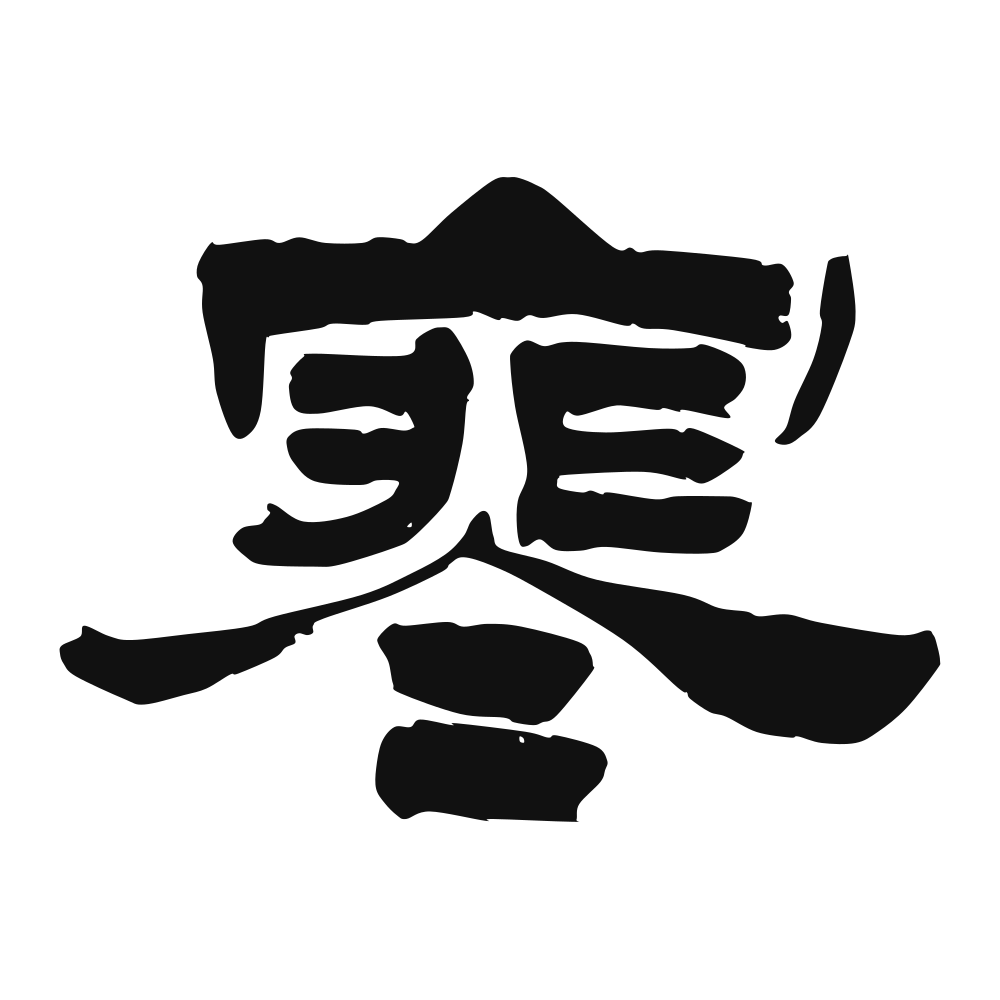
寒
寒 (hán) — cold, poor, bleak. Roof with ice 仌 and straw — the cold within. Classical life: 寒来暑往 — cold comes, heat goes (the seasons turn). Grammar: free morpheme — also: cold; poor; to tremble
Closest English meanings
cold·chilly·poor·humble
The Calligrapher — Cáo Xǐ 曹喜
Han seal-script master credited with the hanging-needle (xuanzhen) style.
Han calligrapher (), master of seal script — known for 悬针篆. Han dynasty
Etymology & Meaning · 字义溯源
2 · The Character: 寒 Hán (2nd tone). The Shuowen Jiezi defines 寒 as 「冻也。从人在宀下,以茻荐覆之,下有仌」 — a person under a roof, covered with grass matting, with ice beneath: the picture of freezing. The Songs feel it: 《诗经·豳风·七月》 speaks of the year's end 「无衣无褐,何以卒岁」, the cold that threatens survival. Chu Ci's Jiubian writes 「薄寒之中人」 — 'the slight cold pierces the man.' The Changes note 「一寒一暑」, the turning of cold and heat. 寒 means cold, poverty, and the desolate; it is a caution character for tattoos. Alone it can read as 'bitter cold / hardship' rather than steadfastness, and in funerary or mournful Chinese contexts cold is a shade-word. If used, pair it with a warming counterword — 寒梅 (cold-plum, the flower that blooms in frost) or 寒山 (Cold Mountain, the poet-hermit) — to turn the chill into endurance. Element tables assign Water (水).
Cultural Story
Liu Zongyuan's 'River Snow' sets 'a lone fisher' on 'the cold river's snow' — 寒江雪 — and the 寒食 festival mourned Jie Zitui by forbidding fire. 寒梅 braved the frost; 贫寒 marked the poor scholar. The graph roofs a man with no warmth — cold as the condition of exile and of study alike.
Where a Western reader can stand: Where a Western reader can stand: 'cold, the freeze' — the Old English ceald, but here drawn as a needle of ice: Cao Xi's hanging-needle seal tapers like a suspended icicle, and 寒 becomes endurance rather than misery. Honest caveat: 寒 alone can read mournful — pair it (寒梅, the cold-plum) and disclose.
Energy Reading
Water (水)
Comparative symbology, not fortune-telling.
Common words & phrases
- 寒冷 cold · chilly · frigid · freezing
- 寒风 cold wind · chilly wind · icy wind
- 寒假 winter vacation · winter holiday · winter break
- 寒冬 cold winter · deep winter · bitter winter
- 寒梅 winter plum · plum in cold · winter plum blossom
- 贫寒 poor · impoverished · humble
Read the story behind the character
School calendars mark 寒假, and weather apps warn of 寒风. Tea houses sell 寒梅 blossom oolong, while aid forms tag 贫寒 applicants. The cold river of the poem now means a break, a forecast, and a relief check — exile and study still measured in degrees.
Why this character belongs on skin
Look at this character like an archaeologist: inside 寒 is a person, huddled in a shelter of rushes, with ice — the two dashes — below and around. Four thousand years old and you can still feel the shiver in it. Chinese poetry made cold its master metaphor for the solitary condition: 寒窗, the cold window of the scholar studying alone through winter nights; 寒门, the cold gate of a poor family. Yet every tradition knows the secret cold keeps: winter forces the root deeper, the pine that survives 寒冬 is prized above the summer flower, and monks sought the cold mountain on purpose to find what warmth had hidden. Ink 寒 and carry the season with you — the proof that you have been out there, and came back.
Own this character
Purchase delivers the original SVG of this glyph, brushed by Cáo Xǐ 曹喜, ready to place on skin, paper, or screen.