
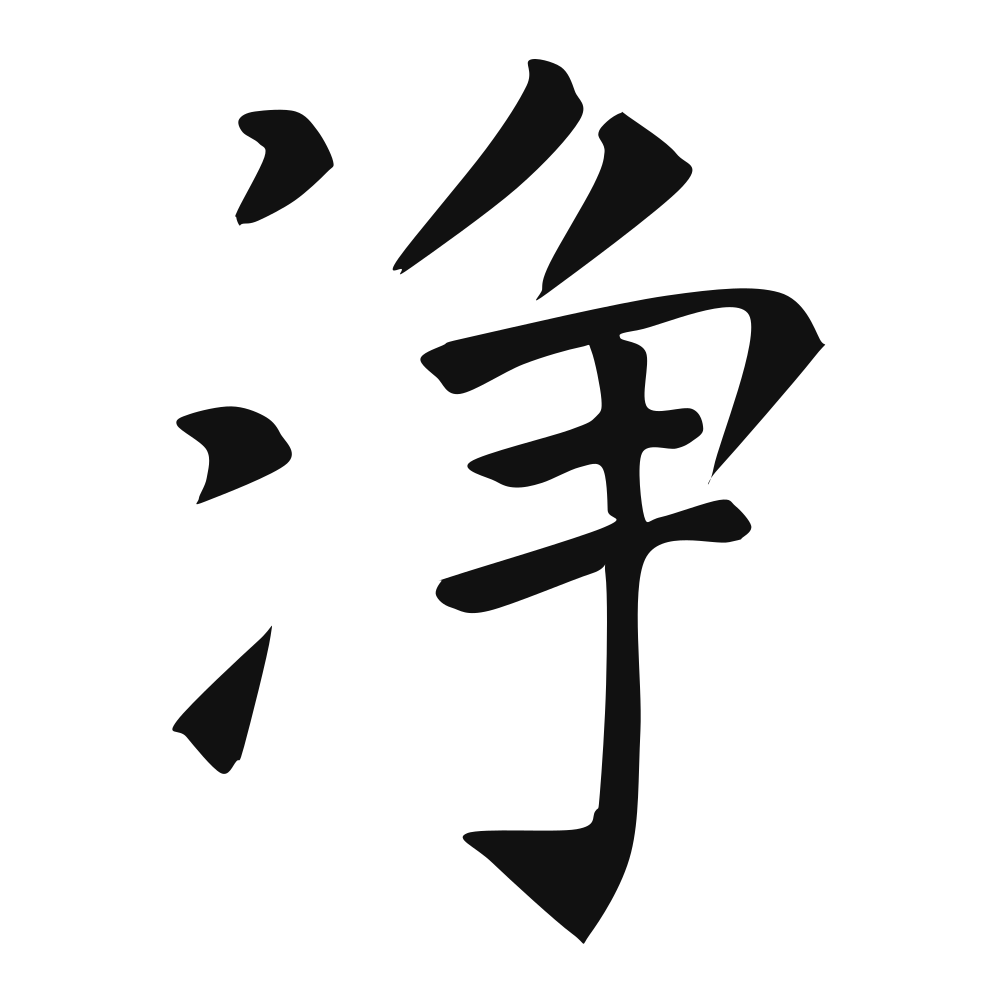
凈
usually seen in: to purify one's body (i.e. to get castrated) (净身); to leave a marriage with nothing (no possessions or property) (净身出户)
Closest English meanings
clean·pure·net
The Calligrapher — Chǔ Suíliáng 褚遂良
Tang chancellor and regular-script master of elegant, balanced strokes.
Tang calligrapher (596–658), master of regular script — Tang master of graceful, tensile regular script favored by the imperial court. Tang dynasty
Etymology & Meaning · 字义溯源
### Soundjìng (凈/净); chēng (凈 as a Kangxi head-entry) — jìng (4th tone) as 凈/净; chēng (1st tone) as the Kangxi head-entry 凈. Free-standing morpheme ### Original meaningJìng (4th tone) as the working form of 淨/净 — and, as a separate Kangxi head-entry, chēng (1st tone). The Shuowen Jiezi has no 凈; it has 淨: 「淨,魯北城門池也。从水爭聲」 — 'the pool at the north gate of Lu', a moat that gave its name to a gate, built from 水 with 爭 as phonetic. The ice-radical form 凈 has its own Kangxi entry: 【子集下】【冫部】 10 strokes, 「《唐韻》楚耕切…音琤。冷貌」 — 'cold-looking', read chēng. In practice the two merged, and 凈/净 went on to carry the borrowed sense 'clean' (段玉裁's 假借 for 瀞, still clear water). That borrowed sense is the one everybody wants, and its classical home is 周敦颐《爱莲说》「香远益清,亭亭净植」 and 吴均《与朱元思书》「风烟俱净,天山共色」. Honest disclosure: 凈 is a variant/old glyph shape — the received traditional form is 淨 (11 strokes, 水部), the simplified form is 净, and Kangxi deliberately keeps 凈 apart under a different reading. Anyone tattooing 凈 should know they are choosing a variant. ### The structure (形聲 · 从水(俗作冫),爭聲 — water (水, later written 冫) with 爭 as phonetic; Shuowen's gloss names it the moat at Lu's north gate)①冫bīngicethe cold radical — why Kangxi reads 凈 as 'cold-looking'②爭zhēngto contendthe phonetic, and the noise moving water makes③淨jìngclean, clearthe received traditional form, 水部 11 画④瀞jìngstill, clean waterthe graphic proper to 'clean'; 净 is a 假借 for it ### In use todayItemReading / meaningNoteReadingjìng (4th tone); chēng as the Kangxi headtwo readings, two characters mergedCore senseclean / pure / clear / netborrowed from 瀞; the Shuowen sense is a moatGrammaradjective and adverb干净 clean, 清净 quiet-and-clean, 净重 net weightTattoo fitcaution — the glyph is a variantprefer 淨 (traditional) or 净 (modern) ### Closest words in English — and what each misses - Pure / innocent — 純 holds purity; 净 means free of dirt — physically clear, not morally clean - Quiet / still — 靜 (jìng) holds stillness; 净 is clean. The two are confused constantly because they sound identical - Empty — 空 holds emptiness; 净 can mean 'nothing left' (净尽) but its core is cleanness, not void - Holy / sacred — 聖/潔 carry holiness; 净 is a plain word for clean water and clean surfacesAn honest note on grammar. Free morpheme as 净 (干净, 清净, 净土); also a noun for the painted-face role in Peking opera (生旦净末丑), and in Buddhist usage 'pure' (净土, the Pure Land)Where a Western reader can stand: 凈 (jìng) means 'clean', and the standard traditional form of that word is 淨 — written with the water radical because it began as the name of a moat at the nort
Cultural Story
The traditional form set ice and a fight, 凈, cleared and still. The altar had to be 乾凈 before the rite. A monk's 淨土 was the pure land west of the seas. The histories praise a 凈 court where bribes did not land. To be 凈 was to be emptied of the clutter that clouds a thing.
Where a Western reader can stand: 凈 (jìng) means 'clean', and the standard traditional form is 淨 — written with the water radical because it began as the name of a moat. The ice-radical 凈 you are looking at is a variant the Kangxi files separately, with a different reading (chēng) and the gloss 'cold-looking'. Chu Suiliang's clear hand suits the lotus standing clean from mud. As a tattoo the idea is good and quiet, but have the artist carve 淨 or 净 rather than 凈 unless you want the variant — and it is not 靜, stillness.
Common words & phrases
- 乾淨 clean
- 純淨 pure
- 淨化 purify
- 淨利 net profit
- 洗淨 wash clean
Read the story behind the character
A floor is 乾凈 before the guests; the filter 淨化 the tap water. The 純凈 label means no sugar added. The accounts show 淨利, profit after tax. The cook 洗淨 the leaves. The word means clean, pure, and net — the same stillness, written with the older hand.
Own this character
Purchase delivers the original SVG of this glyph, brushed by Chǔ Suíliáng 褚遂良, ready to place on skin, paper, or screen.