
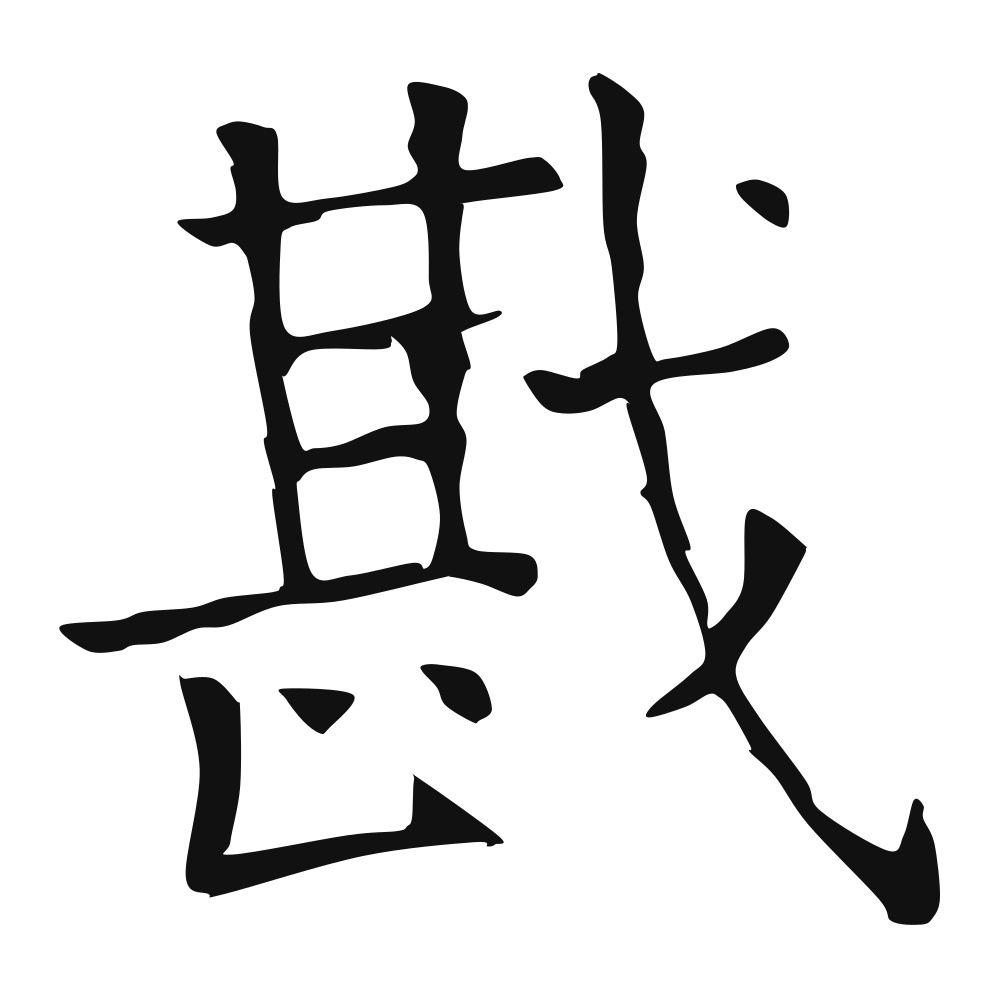
戡
kill; suppress
Closest English meanings
suppress·subdue·quell
The Calligrapher — Chǔ Suíliáng 褚遂良
Tang chancellor and regular-script master of elegant, balanced strokes.
Tang calligrapher (596–658), master of regular script — Tang master of graceful, tensile regular script favored by the imperial court. Tang dynasty
Cultural Story
戡 is to put down by force what has risen. The 尚書 records 西伯戡黎 — King Wen's campaign against the state of Li — and the word always implies a rebellion met and ended. The spear with 堪, to bear, is the crushing of what cannot be borne. It is the quelling, not the fight.
Common words & phrases
- 戡乱 suppress a rebellion
- 戡平 quell · put down
Read the story behind the character
戡 lives in 戡乱, the label for any campaign against insurgency, and 戡平 the bulletin's verb for order restored. It is a word of the military communiqué and the textbook on rebellions. You meet it where a government describes its own necessary violence.
Why this character belongs on skin
戡 is a warrior's verb with a scholar's face: to quell rebellion, to pacify what has broken into arms — 戡乱, putting down chaos, the phrase every dynasty used for the wars it hoped would be its last. Its bones are simple and brutal: martial force pressed against excess, the sword laid against the surplus that could not stop growing. Against the uprising in the province or the uprising in your own chest, the classics prescribe the same word. Marcus Aurelius ruled an empire of them — the uprisings of legions on the Danube, and every dawn, the uprising of the self, which he called the harder war and noted in the same journal. You have your own rebellion going somewhere: the appetite, the despair, the part that wants to burn it all down and watch. 戡 is the seal on the general's letter home: quelled. Held. Order restored, again, until morning.
Own this character
Purchase delivers the original SVG of this glyph, brushed by Chǔ Suíliáng 褚遂良, ready to place on skin, paper, or screen.