
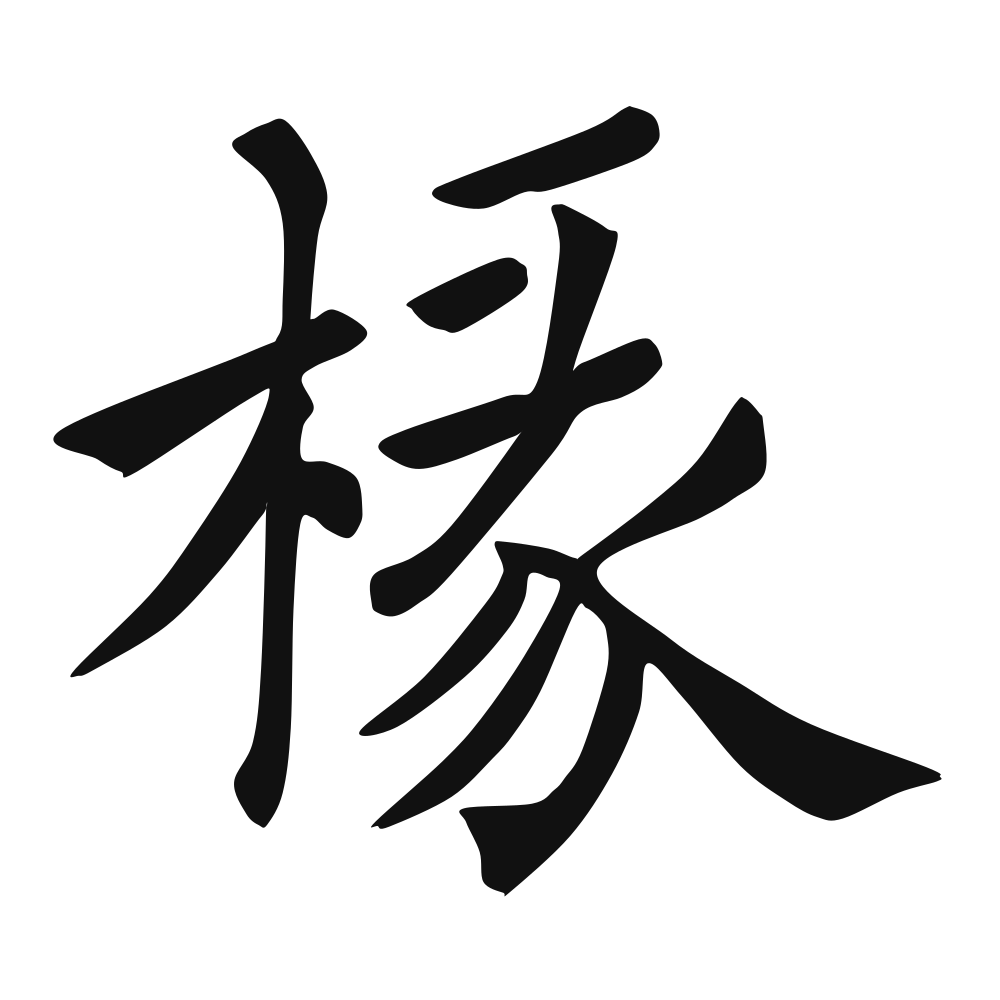
The Calligrapher — Chǔ Suíliáng 褚遂良
Tang chancellor and regular-script master of elegant, balanced strokes.
Tang calligrapher (596–658), master of regular script — Tang master of graceful, tensile regular script favored by the imperial court. Tang dynasty
Cultural Story
椽 is the rafter, the 木 that carries the tiles from ridge to eave — smaller than the beam but more numerous, the bones a roof is actually made of. The character is the working timber of every hall and hut, the piece a builder lays by the dozen. Structure, counted in rows overhead, invisible when done.
Common words & phrases
- 椽子 rafter
- 椽木 rafter wood · rafter timber
Read the story behind the character
椽 is the roof's rib: 椽子 the rafter a carpenter spaces, 椽木 the timber a restorer orders. You meet it only on a scaffold or in a building text. The character is the repeated member overhead, the small wood that, by the hundred, becomes the shelter — invisible once the tiles go on for good.
Why this character belongs on skin
Before fame, the poor writer lived under 椽—a rafter, the bare rib of a roof—and so 笔如椽, a brush like a rafter, came to mean a pen mighty enough to write history. The image is perfect: the same timber that shelters the humble becomes, in the right hand, the instrument that records emperors. Rafters are the skeleton of shelter, dozens of them repeating like ribs under the tiles, taking the snow's weight without signature. There is humility in the wood and ambition in the idiom, and the character holds both. You know what you have carried; the roof never announces the beams. Ink 椽 where the shoulder takes its loads, and let it say what you never do: that you are the structure, and your words could outlast the house.
Own this character
Purchase delivers the original SVG of this glyph, brushed by Chǔ Suíliáng 褚遂良, ready to place on skin, paper, or screen.