
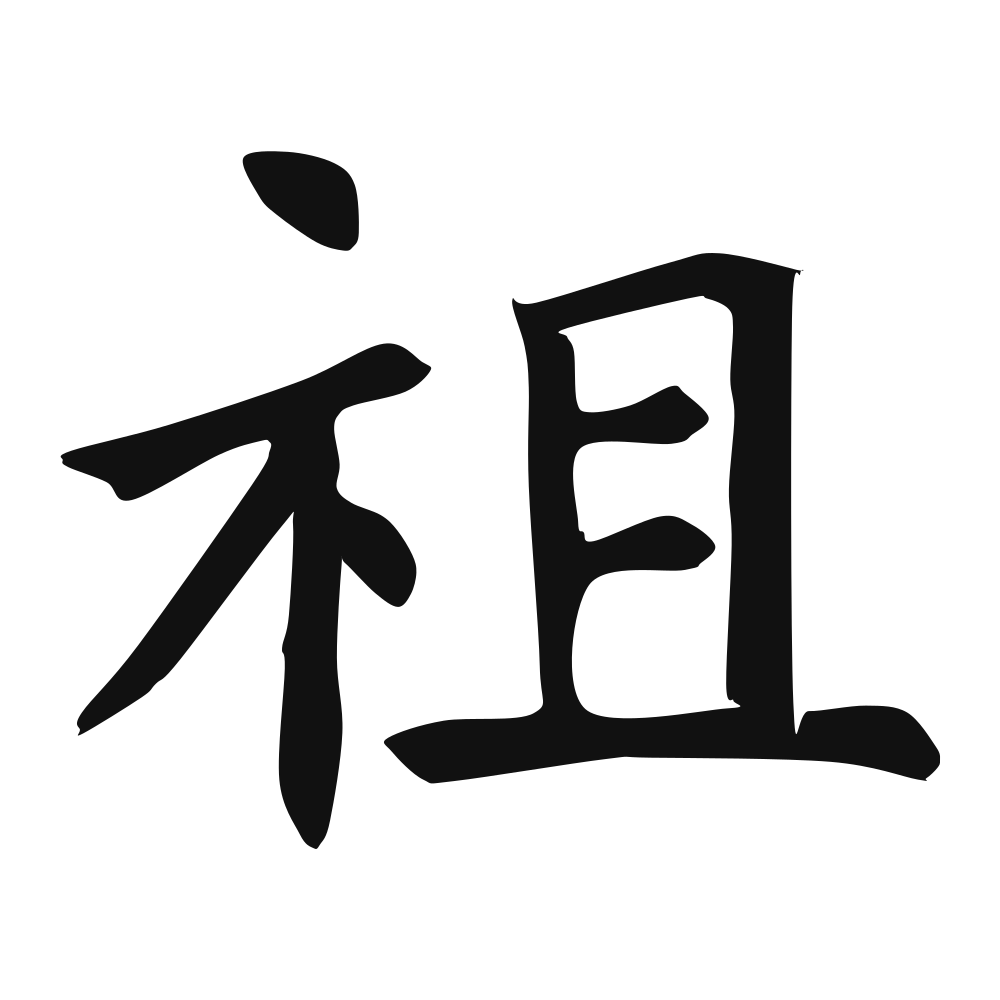
祖
surname Zu; ancestor; forefather; grandparents
Closest English meanings
ancestor·grandfather
The Calligrapher — Chǔ Suíliáng 褚遂良
Tang chancellor and regular-script master of elegant, balanced strokes.
Tang calligrapher (596–658), master of regular script — Tang master of graceful, tensile regular script favored by the imperial court. Tang dynasty
Cultural Story
The oldest form of 祖 shows the ancestral tablet itself — the stone where the dead received offerings — later joined with the altar radical. Confucian family life arranged everything around such tablets: generation after generation serving the ones who came before.
Common words & phrases
- 祖先 ancestor
- 祖父 grandfather
- 祖国 motherland
- 祖宗 ancestors
- 祖师 founder · master
Read the story behind the character
Kinship words keep it busy: 祖先, ancestors, in genealogy books; 祖父, grandfather, teaching calligraphy; 祖宗, forebears, invoked at graveside; 祖师, founding master, honored by a guild or kung-fu school; and 祖国, motherland, sung in every school assembly.
Why this character belongs on skin
At the altar stands the ancient post that marked the tomb — that is 祖, the ancestor, the forefather who came before and made your coming possible. The rites to 祖 were the spine of a civilization; to forget him was to forget the ground underfoot. To wear it is to plant yourself in a line longer than your own breath. We are all the downstream of someone who endured: a grandmother who crossed an ocean, a father who held his silence, a stranger whose risk became our ease. 祖 is gratitude made visible, the tattoo as offering. Let it sit over the heart or the back, a small monument carried everywhere. The character does not mourn; it remembers. It says you are not the beginning. You are the middle of a story someone else began, and your only duty is to hand it on, intact, to whoever comes after, bearing the name forward.
Own this character
Purchase delivers the original SVG of this glyph, brushed by Chǔ Suíliáng 褚遂良, ready to place on skin, paper, or screen.