
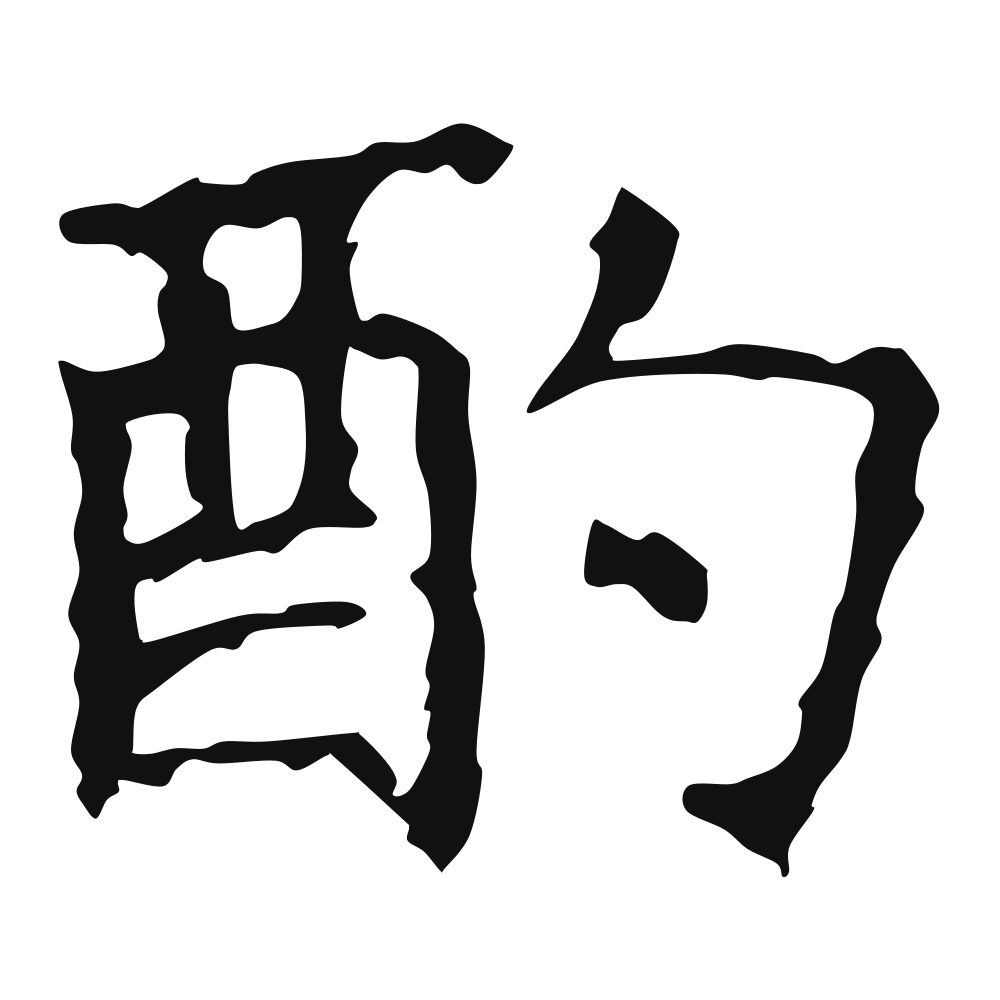
酌
to pour wine; to drink wine; to deliberate; to consider
Closest English meanings
pour·deliberate·consider
The Calligrapher — Chǔ Suíliáng 褚遂良
Tang chancellor and regular-script master of elegant, balanced strokes.
Tang calligrapher (596–658), master of regular script — Tang master of graceful, tensile regular script favored by the imperial court. Tang dynasty
Etymology & Meaning · 字义溯源
### Soundzhuó — zhuó (2nd tone). Free-standing morpheme ### Original meaningZhuó (2nd tone). The Shuowen Jiezi defines it as 「盛酒行觴也。从酉勺聲」 — 'to fill wine and pass the cup', built on 酉 (the wine vessel) with 勺 (the ladle) as phonetic — and the ladle does real work here too, since 勺 is the thing you dip with. Its oldest appearances are ritual: 《詩·周南·卷耳》「我姑酌彼金罍,維以不永懷」 — let me pour from that bronze jar a while, so I need not grieve forever; 《禮記·郊特牲》「縮酌用茅」 filters the offering through cogon grass. By the Zuo Zhuan the word has already taken its second life, the one it still lives today: 《左傳·成六年》「子爲大政,將酌於民者也」 with the commentary 「酌取民心,以爲政」 — to draw from the people's hearts and govern by that measure. That slide from ladling wine to weighing a matter is the whole history of the character, and 斟酌 still means both. Li Bai made the older sense immortal: 《月下獨酌》「花間一壺酒,獨酌無相親。舉杯邀明月,對影成三人」. Kangxi: 10 strokes (酉 radical + 3). Wuxing: the naming tables assign Metal (金); other schools sort the 酉 wine radical differently (verify). ### The structure (形聲 · 从酉勺聲 — the wine vessel 酉 with the ladle 勺 as phonetic, and the ladle is half the sense as well as the sound)①酉yǒuwine vesselthe radical — everything here is about wine②勺sháoladlethe dipper, sound-carrier and sense-carrier both③酌zhuóto pour / to weighwine measured out into the cup and handed on④斟zhēnto pourits standing partner in 斟酌 — to weigh a matter ### In use todayItemReading / meaningNoteReadingzhuó (2nd tone)single syllableCore senseto pour wine; to weigh upthe one word holds bothGrammarfree verb酌酒 to pour; 獨酌 to drink alone; 斟酌 to deliberate; 酌情 as circumstances warrantTattoo fityes-standalone — a real classical verbreads as measure and good company, not as intoxication ### Closest words in English — and what each misses - Wine — 酒 holds 'wine'; 酌 is what you do with it — fill the cup and pass it - Drunk — 醉 holds 'drunk'; 酌 is the measured pour, temperate by definition - Decide — 決 holds 'to decide'; 酌 is the weighing that comes before deciding (斟酌) - Pour — 斟 holds 'to pour' specifically; 酌 is pouring with a cup's measure and, classically, passing it onAn honest note on grammar. Free morpheme — a verb that stands alone (酌酒 to pour wine, 獨酌 to drink alone, 斟酌 to weigh a matter, 酌情 as circumstances warrant)Where a Western reader can stand: 酌 (zhuó) is the classical verb for filling wine and passing the cup — and the same word later came to mean 'to weigh a matter', which is why 斟酌 still means both 'to pour' and 'to deliberate'. It is the word of Li Bai drinking alone under the moon, and of the minister who ladles
Cultural Story
The Book of Songs bids a host pour for his guest, 我姑酌彼金罍, filling the bronze jar so the evening may flow, and the 酌 was the measured ladle of hospitality. To pour was to honor, and the word kept that careful measure in its grain. From the ritual cup it widened into weighing a matter, the same steady hand at the wine and at a decision.
Where a Western reader can stand: 酌 (zhuó) is the classical verb for filling wine and passing the cup — and the same word later meant 'to weigh a matter', which is why 斟酌 still means both 'to pour' and 'to deliberate'. It is the word of Li Bai drinking alone under the moon, and of the minister who ladles the people's hearts before he governs. As a tattoo it reads as measure, hospitality and solitude with good grace — not as getting drunk.
Common words & phrases
- 斟酌 consider · deliberate
- 酌情 use discretion
- 酌量 consider · weigh
- 商酌 consult and consider
Read the story behind the character
A ward supervisor tells the staff to 酌情 and bend the visiting hours for a dying patient, while two managers 斟酌 the wording of a layoff letter over coffee. A committee will 商酌 the budget at noon. The 酌 now belongs to hospitals and offices, the old art of pouring measured into the discretion a supervisor exercises and the caution a memo is written with.
Why this character belongs on skin
To 酌 is to pour the wine and, in the same breath, to weigh — the host's measure of how much his guest can hold, the mind's measure of how much a moment deserves. The character is wine and a careful hand; 斟酌 means to deliberate, to find the right amount of everything. There is a Confucian hospitality in the pouring and a Daoist restraint in the stopping. To tattoo 酌 is to honor the art of the right measure — of love, of silence, of drink. It is moderation worn as a toast. Let it rest where you would raise a cup — the inner arm, the breast — a mark that says I poured, I considered, I knew when to stop. You are the host of your own life, generous and exact, the hand that fills the cup and sets it down.
Own this character
Purchase delivers the original SVG of this glyph, brushed by Chǔ Suíliáng 褚遂良, ready to place on skin, paper, or screen.