
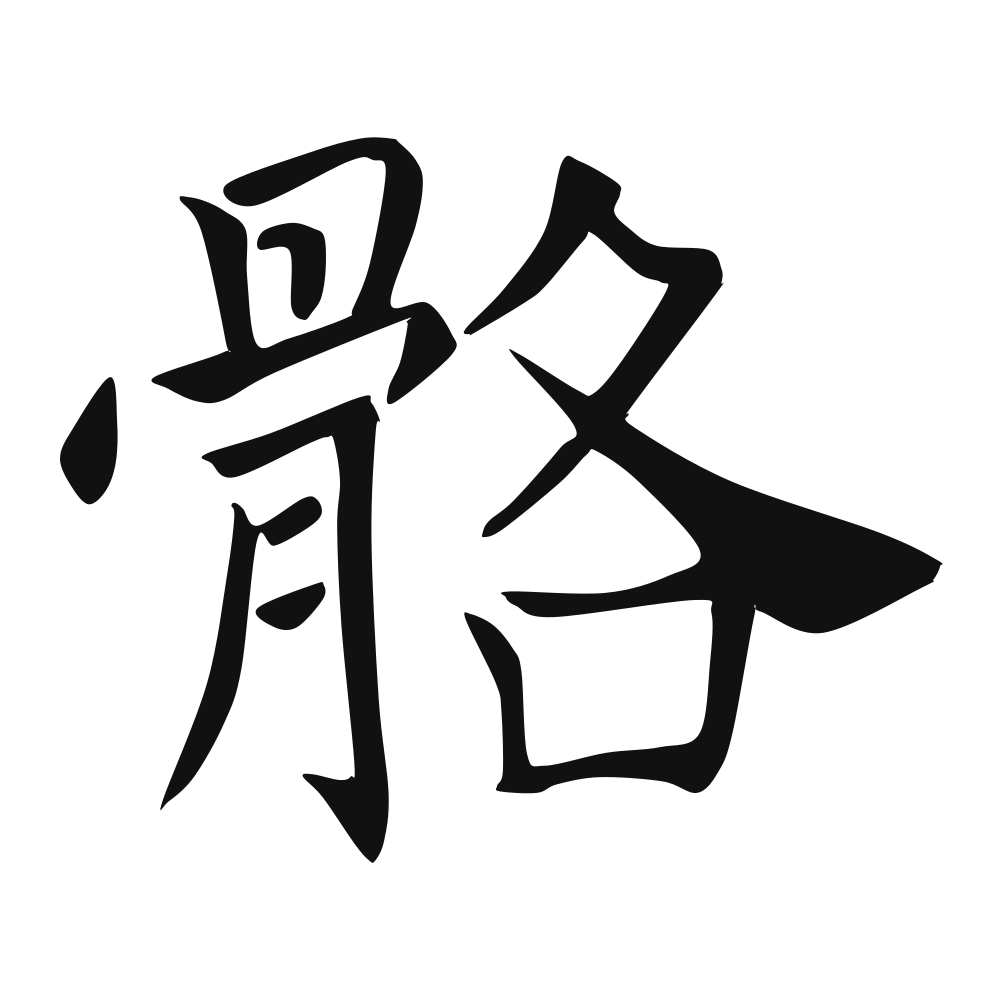
骼
usually seen in: (zoology) exoskeleton (外骨骼); bones (骨骼); striated muscle (骨骼肌)
Closest English meanings
skeleton·bone
The Calligrapher — Chǔ Suíliáng 褚遂良
Tang chancellor and regular-script master of elegant, balanced strokes.
Tang calligrapher (596–658), master of regular script — Tang master of graceful, tensile regular script favored by the imperial court. Tang dynasty
Cultural Story
骼 pairs 骨 with 各 and is defined in the 《説文解字》 as 禽兽之骨曰骼, "the bone of birds and beasts." It named the skeletal frame of animals, the hard architecture beneath the flesh.
Common words & phrases
- 骨骼 skeleton · bones
- 躯骼 skeleton
Read the story behind the character
Today 骼 survives mainly in 骨骼, the skeleton or bones that doctors X-ray and students study. 躯骼 means the skeletal body. Though less common than 骨, it keeps a clinical, anatomical tone—the word you meet in a textbook or a hospital chart.
Why this character belongs on skin
Beneath every face, the frame. The character means skeleton, bone structure, and it comes carrying the bone radical like an x-ray — the white architecture the flesh keeps forgetting to mention. Chinese medicine saw the skeleton as the body's innermost register: flesh lies, posture tells the truth, and bones keep the record longest after everything soft has gone. Warriors were judged by their frame; calligraphers described strong strokes as bony and weak ones as fleshly, and meant it as the highest praise — structure as virtue, the line that holds under its own weight. It is a philosophy of character hiding in anatomy: what carries load is what endures, and what endures is what you chose. Strip a life to its structure and see what remains. This is ink for the frame you have built — the supports, the load paths, the quiet architecture that lets you stand upright and be looked at.
Own this character
Purchase delivers the original SVG of this glyph, brushed by Chǔ Suíliáng 褚遂良, ready to place on skin, paper, or screen.