
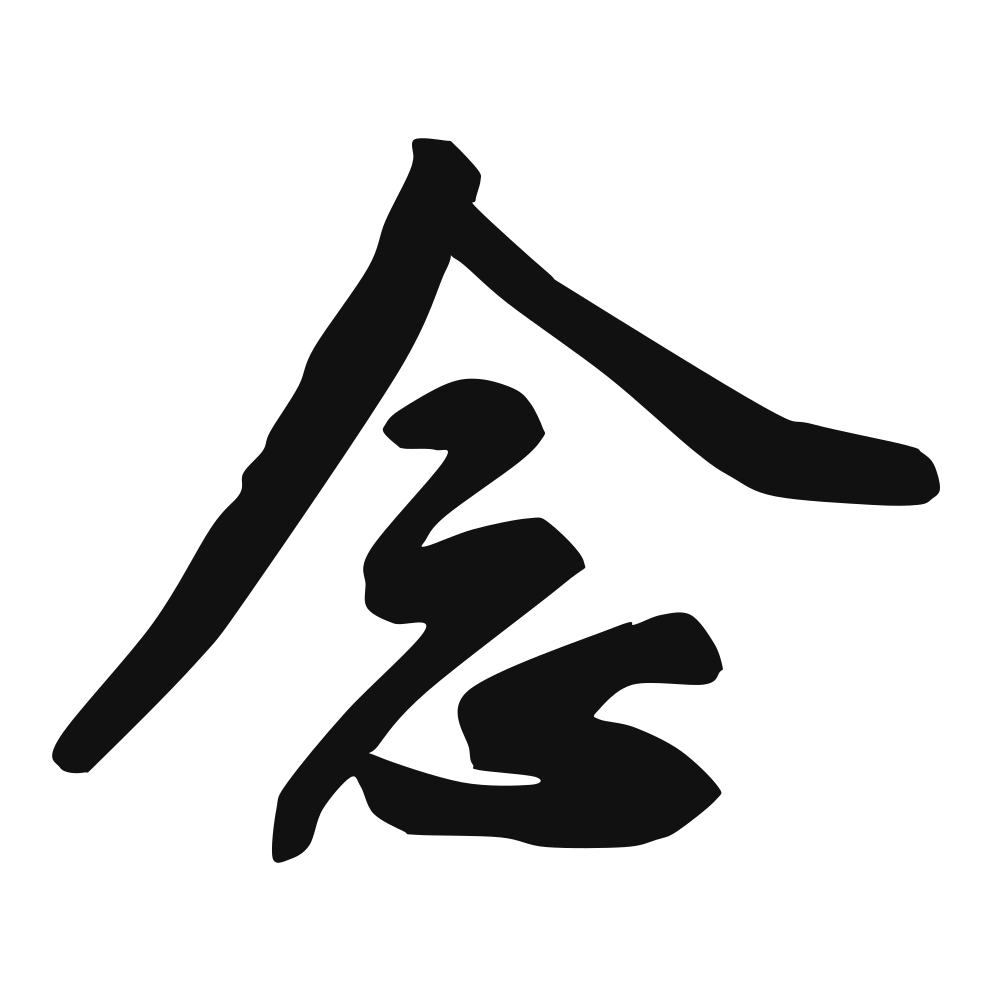
念
to read; to study (a subject); to attend (a school); to read aloud; to give (sb) a tongue-lashing (CL:頓|顿[dun4]); to miss (sb); idea; remembrance; twenty (banker's anti-fraud numeral corresponding to 廿[nian4])
Closest English meanings
miss·read·thought
The Calligrapher — Cuī Yuàn 崔瑗
Han pioneer of cursive script and author of an early cursive treatise.
Han calligrapher (77–142), master of cursive script/clerical cursive — known for 《贤女帖》. Han dynasty
Etymology & Meaning · 字义溯源
2 · The Character: 念 念 (niàn, 4th tone) is glossed by the Shuowen Jiezi as 常思也。从心今聲 — 'to think of constantly; from 心 (heart) and 今 (now) as sound,' the present moment held in the heart. Kangxi files it at 8 strokes. As a word 念 means to miss, to remember, a thought or intention. 《書·大禹謨》 gives the idiom: 念茲在茲 — 'think of this, be present in this.' 《詩·大雅·文王》 says 無念爾祖 — 'do not forget your ancestors' (無念 here means 念, 'think of'). 《論語·公冶長》 praises 不念舊惡 — 'not brooding on old wrongs.' Honest note: 念 is tender remembrance, but 萬念俱灰 ('all thoughts turn to ashes') and 執念 ('fixation') show its melancholic edge — it can mean clinging as well as love. In daily speech 念 also means to study (念書) or to read aloud — a homely, gentle extension of 'holding the present in mind.'
Cultural Story
念 is to hold a person in the mind — 想念 — and to read aloud, the voiced thought. 念奴嬌 is 蘇軾's lyric named for a singing girl, and 纪念 is the thing kept so the dead stay present. The character is the mind that speaks, to absence or to a page.
Where a Western reader can stand: Where a Western reader can stand: 念 is 今 'now' set over 心 'heart' — to miss someone by keeping them present-now, and 念茲在茲, to dwell where your thought is. Cui Yuan is the right hand for it: he wrote the first 座右銘, the motto placed beside the seat, which is exactly what a remembered thought is supposed to be, and his 草書勢 is the earliest surviving Chinese essay treating writing as art. Honest caveat: the same character feeds 執念, fixation or obsession, and 萬念俱灰, 'all thoughts turn to ash' — despair. A 念 tattoo can read as devotion or as clinging, so if the intention is letting go, this is the wrong character.
Common words & phrases
- 想念 miss · think of
- 纪念 commemorate · souvenir
- 念头 thought · idea
- 概念 concept
- 念书 study · read
- 信念 belief · faith
Read the story behind the character
想念 is the message you don't send, 纪念 the keychain from the trip, 念书 the homework you delay, 信念 the line a team chants. The singing girl is a tune now; the kept thing is a mug. We still voice the thought to absence, and call the voice love or duty, as the old lyric did.
Why this character belongs on skin
Above the heart sits the character for now — and together they mean to hold someone in your mind, to miss them into the present tense. 念 is the daily devotion of memory, the name you murmur when no one is listening, the dead kept warm by attention. Buddhists count it as the root of prayer: to think of, again and again, until the thinking becomes a lamp. To carry it on your skin is to refuse forgetting as a form of mercy you don't want. It is the mark of a person who loved so completely that erasure would be a kind of death. Ink it near the heart it describes, and let it be the small altar you wear — not grief, exactly, but fidelity. Some people fade. You decided one would not. That decision, made permanent in ink, is the most honest thing your body could say.
Own this character
Purchase delivers the original SVG of this glyph, brushed by Cuī Yuàn 崔瑗, ready to place on skin, paper, or screen.