
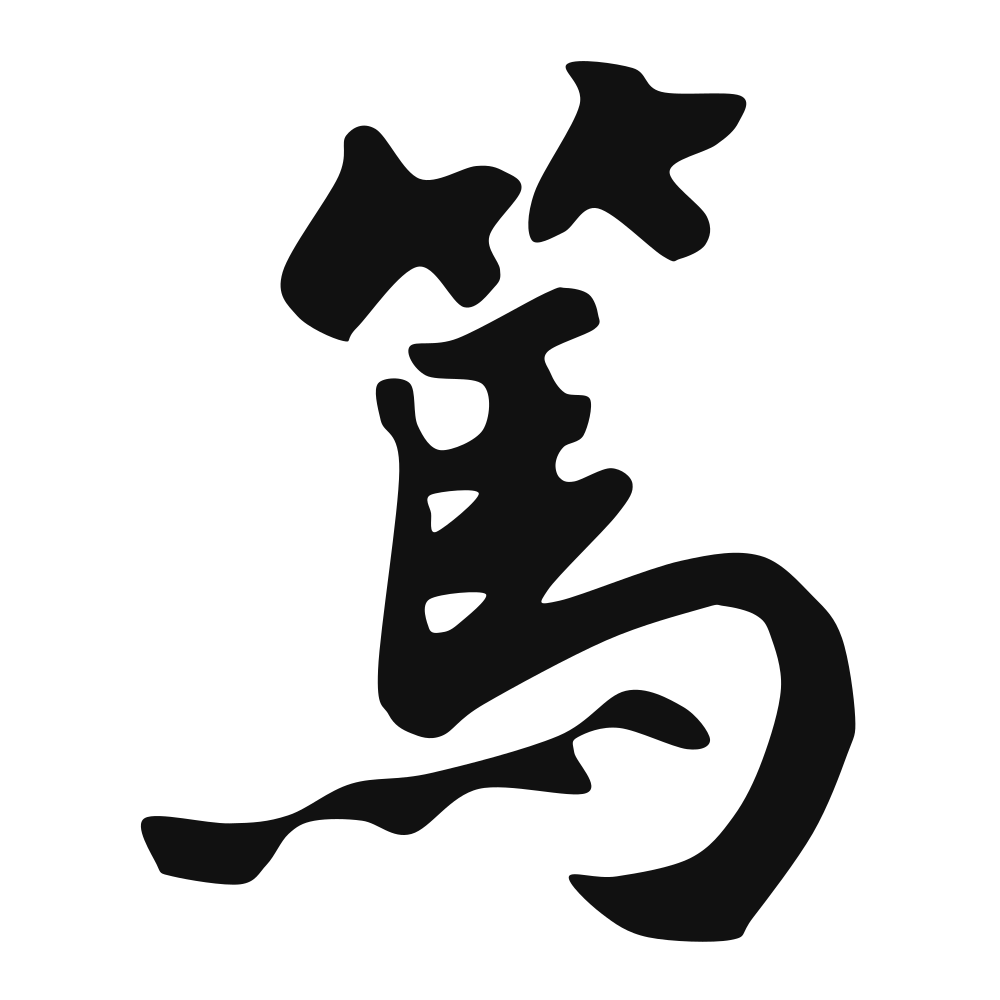
笃
(bound form) sincere; genuine; (bound form) (of an illness) serious
Closest English meanings
sincere·earnest·serious
The Calligrapher — Cuī Yuàn 崔瑗
Han pioneer of cursive script and author of an early cursive treatise.
Han calligrapher (77–142), master of cursive script/clerical cursive — known for 《贤女帖》. Han dynasty
Etymology & Meaning · 字义溯源
2 · The Character: 笃 笃 (dǔ, 3rd tone), traditional 篤. 《說文·馬部》: 篤,馬行頓遟。从馬竹聲 — 'a horse's gait, head-down, heavy and slow', built from 馬 with 竹 as phonetic. Duan Yucai's note explains the moral sense as a loan from 竺 'thick, generous': 篤行而竺廢矣. 《爾雅·釋詁》 keeps both readings — 篤,固也 and 篤,厚也, firm and thick. 《論語·泰伯》: 篤信好學,守死善道 — 'steadfast in faith and fond of learning; guard the good Way to the death.' The Zhongyong's five steps of study end on it: 博學之,審問之,慎思之,明辨之,篤行之. 《詩·大雅·公劉》 opens 篤公劉. Kangxi: 16 strokes, 竹部 (simplified 笃 = 9). Free morpheme in the classical register (篤志, 篤行, 篤實); semi-bound in modern speech. Honest disclosure: 篤 is also the classical word for critical illness — 《史記·范雎列傳》應侯遂稱病篤, 李密《陳情表》劉病日篤 — and Japanese 危篤 (kitoku) means 'at death's door'.
Cultural Story
笃 began as the sound of a horse's steady, deliberate trot, then settled into 'thick, solid, sincere.' The Analects urges 笃信好学 — hold belief firmly and love learning. A scholar's 笃志, his settled resolve, and a friend's 笃实 honesty were among the highest praise one character could carry.
Where a Western reader can stand: Where a Western reader can stand: 笃 (篤) is steadfastness measured in duration — the Shuowen's image is 馬行頓遟, a horse plodding with its head down, and the moral sense is on loan from 竺, 'thick, generous'. 《論語》 gives the vow, 篤信好學,守死善道, and the Zhongyong ends its five steps of learning on 篤行之: after study, questioning, thought and judgement, you simply keep doing it. Cui Yuan's unhurried, stand-alone cursive suits that patience. One hard caveat: 病篤 means critically ill (《陳情表》: 劉病日篤) and Japanese 危篤 means 'at death's door' — never on anything given to someone who is sick.
Common words & phrases
- 笃信 firmly believe
- 笃实 honest · sincere
- 病笃 seriously ill
- 笃厚 sincere · honest
Read the story behind the character
Doctors' notes say 病笃 (critically ill) when a relative is failing, and families gather quietly. Elsewhere 笃 stays warm: a 笃信 (devout) believer keeps daily practice, HR praises a candidate's 笃实 (honest, steady) manner, and neighbors call a 笃厚 (kind, sincere) uncle the block's most reliable man.
Why this character belongs on skin
笃 is devotion with a spine—the sound of a horse's steady hoofbeats hardened into a character meaning sincere, devoted, deep-going, beyond doubt. The Confucians loved it: 笃行, to practice what you have learned with unglamorous consistency; 笃志, a will that does not renegotiate itself on bad days. It is not enthusiasm—enthusiasm is weather. It is the animal under the weather: the same gait on the good road and the bad one, the promise kept mostly when no one is checking. Every culture has canonized this quality under different names—the faithful servant, the one who shows up—and every culture knows how rare it is, because most virtue is seasonal and 笃 refuses to be. Ink it if steadiness is the thing you are proudest of, or the thing you are still becoming. Inside the forearm works: visible to you in the middle of ordinary days, which is precisely when the character speaks. Not loud. Not fast. The hoofbeat does not need to be either. It needs to continue.
Own this character
Purchase delivers the original SVG of this glyph, brushed by Cuī Yuàn 崔瑗, ready to place on skin, paper, or screen.