
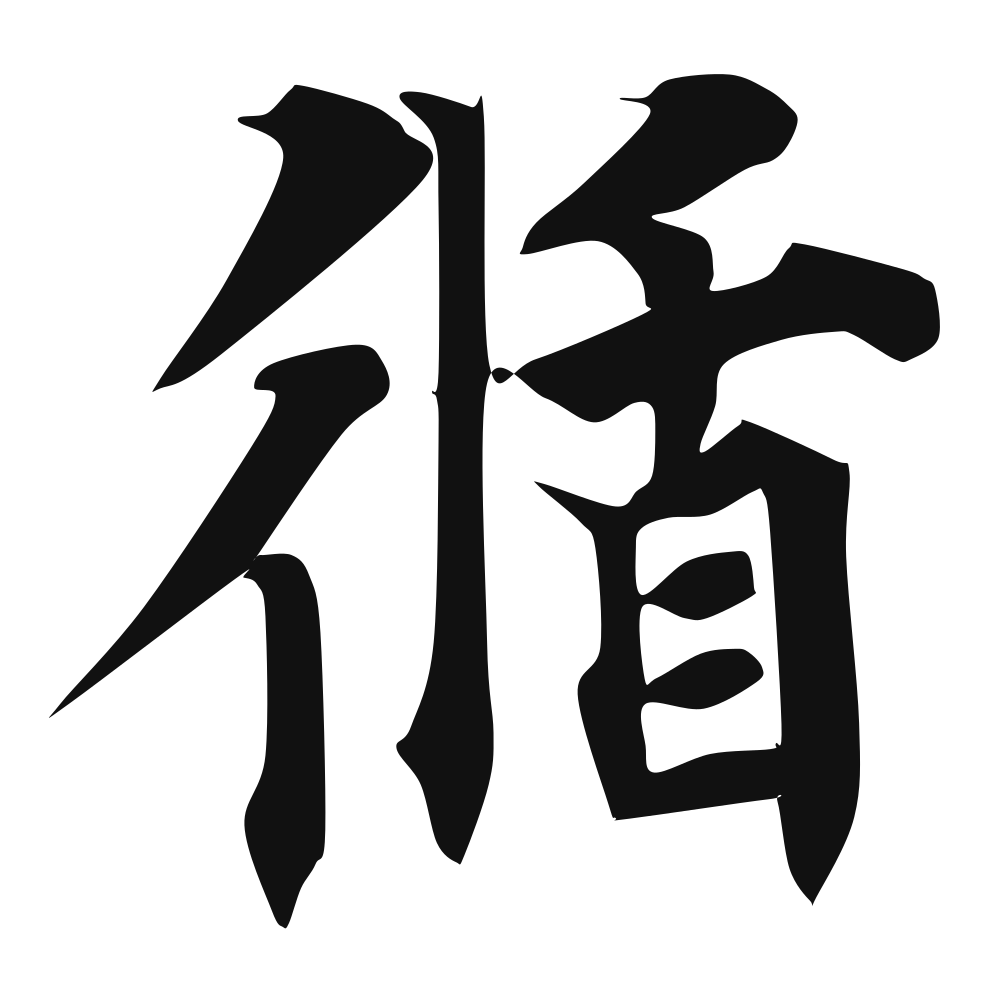
循
(bound form) to follow; to act in accordance with
Closest English meanings
follow·abide by·circulate
The Calligrapher — Dīng Dàohù 丁道护
Sui regular-script calligrapher of the Qifa Temple Stele, a precursor to Tang standard script.
Sui calligrapher (), master of regular script — known for 《启法寺碑》. Sui dynasty
Etymology & Meaning · 字义溯源
2 · The Character: 循 循 (xún, 2nd tone) is glossed by the Shuowen Jiezi as 行順也 — 'to go along smoothly,' built from 彳 (step on the road) and 盾 (shield, here phonetic). Duan Yucai corrected the received text to simply 行也, 'to go,' since the sense of 'following' developed later. As a moral term it means to obey, to abide by, to keep to a cycle. Kangxi files it at 12 strokes under 彳. 《論語·子罕》 shows the pedagogical sense: 夫子循循然善誘人 — 'the Master led his students on step by step.' 《史記·高祖本紀》 gives the cosmic one: 三王之道,若循環,終而復始 — 'the ways of the three kings turn like a wheel, ending only to begin again.' 《禮記·射義》 uses it for lawfulness: 卿大夫以循法為節. Honest note: 循 also feeds 因循, 'to drift along by habit,' a stale, unambitious sense — so the character carries both disciplined follow and passive routine.
Cultural Story
循 is to follow the old groove. 大學 taught 循序 — proceed in order, step by step — and 循吏 were the officials who kept the custom instead of inventing a sharper wheel. The character is the track worn safe by previous feet, the wisdom of not leaving the road.
Where a Western reader can stand: Where a Western reader can stand: 循 is 'to follow / abide by / keep to a cycle' — the Master leading students on step by step (循循然善誘人), and the wheel that ends only to begin again (若循環,終而復始). Honest caveat: it also forms 因循, 'to drift along by habit', so alone it can read as passive conformity — pair it with 道 or 環. And be straight about the hand: Ding Daohu's dates are unknown and he survives through a handful of stele attributions, a transmitting link rather than a documented personality.
Common words & phrases
- 循环 cycle · circulate
- 遵循 follow · abide by
- 因循 follow old ways · delay
- 循序渐进 proceed step by step
- 循例 follow precedent · as usual
- 循规 follow the rules
Read the story behind the character
循环 is the arrow a recycling bin draws, 遵循 the rule a contract binds you to, 循序渐进 the method a teacher insists on, 循例 the form filled because it always was. The groove is a process now; we still follow the safe track, often because the new road is simply closed, which the old feet would understand.
Why this character belongs on skin
Not all who refuse the herd are lost; some simply walk in order. 循 means to follow, to trace, to proceed step by step — the walking radical paired with a hand feeling the way, a tracker reading sign in frost. Its genius is patience: rivers follow the fall of the land, seasons follow the sun, and Confucian cultivation was never a leap but a slow, obedient climb — learn, practice, become. There is sensuality in that surrender, the same ease a dancer knows when the body stops arguing with the music. To follow a pattern is not to be enslaved by it; it is to trust that the way has been walked before and will hold your weight. Inked on a shoulder blade or the inside of an arm, 循 is a vow of devotion to process over hurry. For anyone who has learned that the long way is often the true way. Follow the line. It knows where it's going.
Own this character
Purchase delivers the original SVG of this glyph, brushed by Dīng Dàohù 丁道护, ready to place on skin, paper, or screen.