
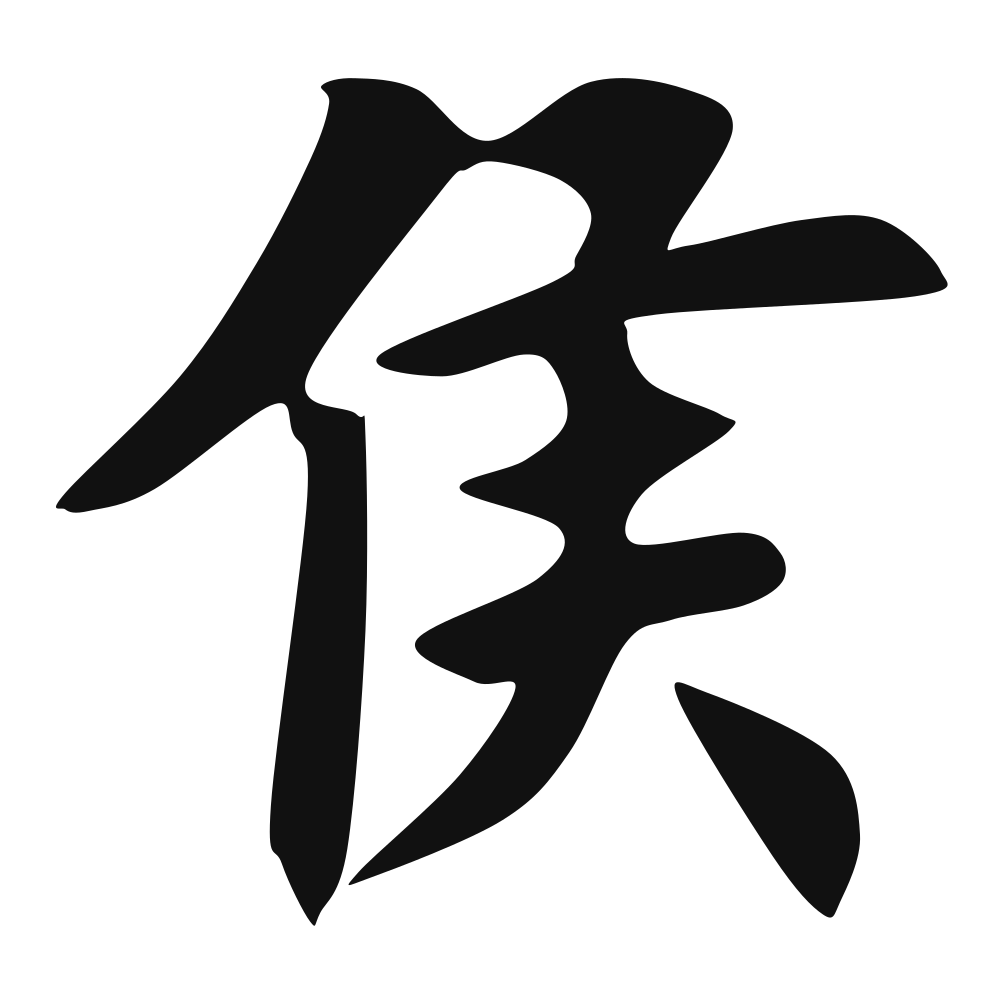
侯
surname Hou; marquis, second of the five orders of ancient Chinese nobility 五等爵位[wu3 deng3 jue2 wei4]; nobleman; high official
Closest English meanings
marquis·surname
The Calligrapher — Hándān Chún 邯郸淳
Cao Wei calligrapher; author of the Zhengshi Three-Script Stone Classics in seal and clerical script.
三国魏 calligrapher (), master of seal script/clerical script — known for 《魏受禅表》. Wei kingdom (Three Kingdoms)
Cultural Story
侯 is the noble rank. The 诗经 feasts 王侯; a 侯爵 held land beneath the king. In the 战国 the 诸侯 carved the realm into rival states. To be 侯 was to stand just under the throne, armed and hereditary. The character carries the old ladder of power, rung by rung.
Common words & phrases
- 王侯 kings and marquises
- 侯爵 marquis
- 诸侯 feudal lords
Read the story behind the character
A costume drama crowns a new 侯爵; the map of the 战国 lays out the warring 诸侯. The surname 侯 still rings on a doorbell in the lane. The titles now survive in film and genealogy — the rank, the fief, the family name — though no one kneels to them any longer.
Why this character belongs on skin
Before the empire, the land was carved into fiefs, and the men who held them were 侯—the lords, the marquises, the arrows of authority shot from the king's hand. The character itself is an archer at a target, a man aimed and aiming, invested with power and watched. To be a 侯 was to owe loyalty upward and command it downward, a knot in the long rope of rule. But the word also names the noble in any person—the dignity that answers to something higher and protects those below. The Confucian lord governs by virtue, not fear. We are all, in some small fief, called to be lordly: to keep our word, to shield the weak. To wear this mark is to claim that charge. Let it rest on your skin like a seal—proof you were entrusted with a piece of the world, and meant to hold it well.
Own this character
Purchase delivers the original SVG of this glyph, brushed by Hándān Chún 邯郸淳, ready to place on skin, paper, or screen.